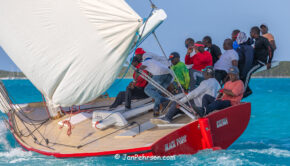


Bahamian sloop racing on the rise
Published on December 10th, 2025
With more than 3,000 islands, cays and islets in the Atlantic Ocean, Jan Pehrson reports how traditional boating is alive and well in the Bahamas:
Unlike other wooden boat regattas in the world, the annual Best of the Best Regatta, sailed off Montague Beach in Nassau, The Bahamas, from December 3-9, continues to expand each year. This year, with 94 boats registered, it was the largest since the first Best of the Best in 2016.
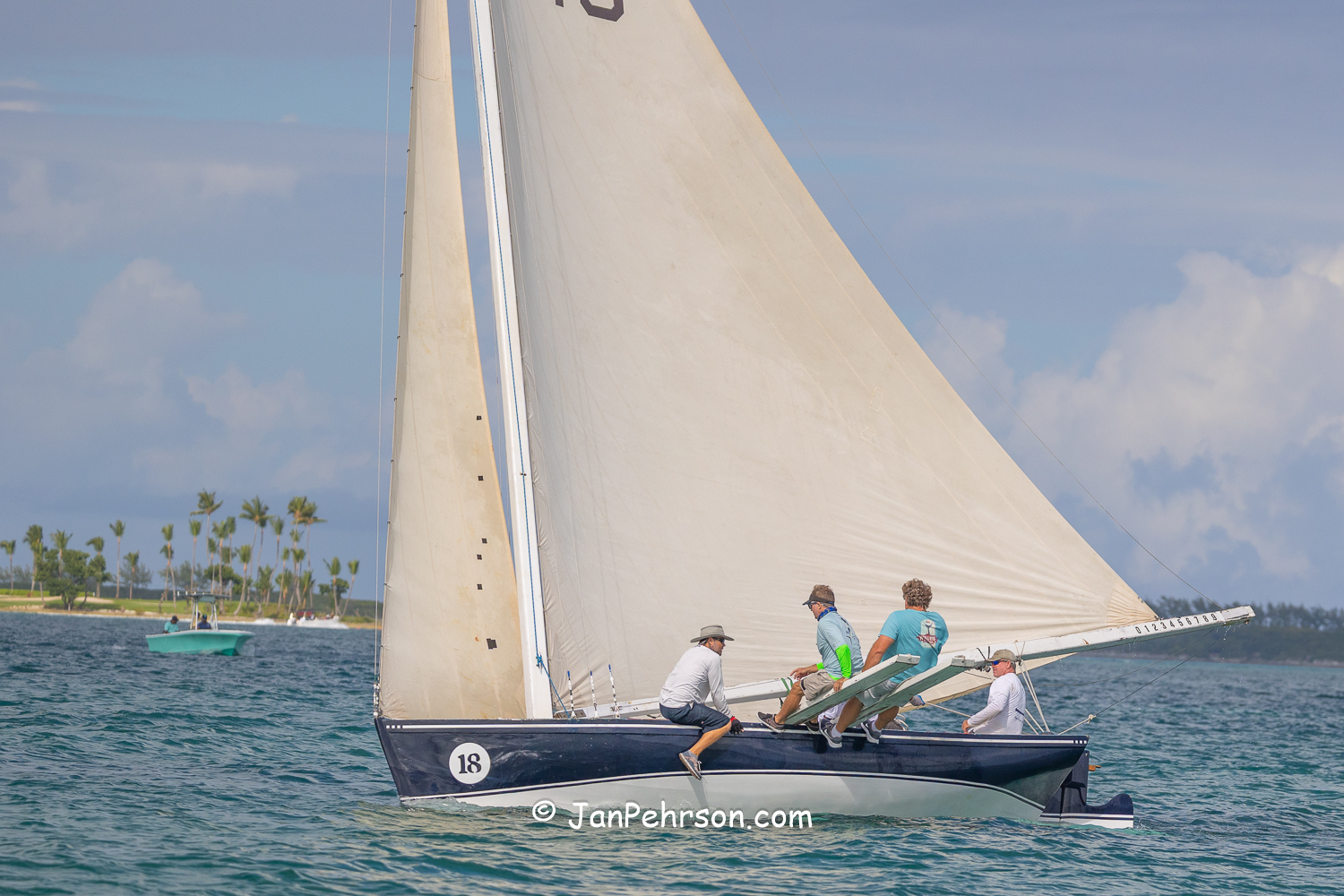
There are four racing classes of Bahamian wooden sloops – A-Class (28 feet long), B-Class (21 feet long), C-Class (17 feet long), and E-Class (12 feet long). Crowds came for the onshore fun, watching the big screens and wagering on the results.
The regatta was sailed in near perfect conditions. The air temperature in the high 70s was tee-shirt weather, and the water was warm so crews could sail barefoot. Winds were relatively light, ranging from 5-15 knots.
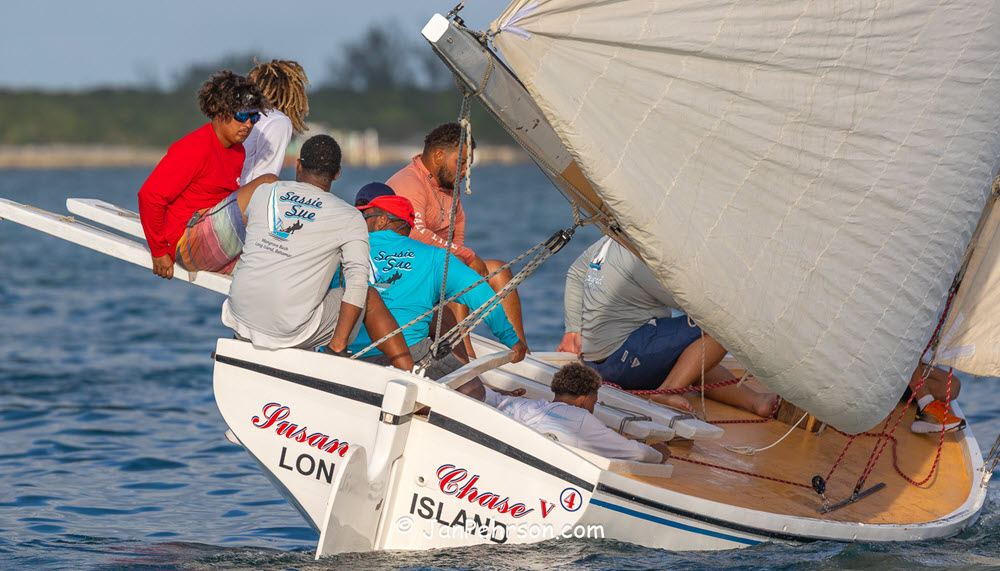
A-Class boats may have fifteen people in a crew, many riding the pry boards, planks held to the deck by large staples running out to windward to seat human ballast.
Sailors ranged from pre-teens to experienced captains in their 80s who have sailed since their own childhoods. Junior sailors were everywhere. On the bigger boats, they mixed into the crews, sometimes as captains. On the smaller E-Class boats, they dominated the fleet. Some sailed single handed, and the youngest and lightest sailed three-to-a boat.
Captain Stefan Knowles won the three classes that he entered, earning him the nickname “Tripple Crown.” In A-Class, he took first place in Running Tide, in B-Class in Susan Chase V, and in C-Class in Sassie Sue, named for his mother in his hometown, the small settlement of Mangrove Bush, Long Island, Bahamas.
Honors in the E-Class were won by Captain Alvington McKenzie sailing Miss Agnes, from Exuma in the family islands of the Bahamas.
The Nassau Channel is legendary among sailors for its extreme currents. Cruising sailors have trouble docking their boats during powerful currents, sometimes leading to disastrous consequences.
During the regatta, currents ebbed and flowed during the day as water flowed back and forth between the dark blue waters to the west, thousands of feet deep, and the shallower waters to the east, where depths average only a few feet, and you can see the bottom through the incredibly clear, turquoise waters.
Captain Stefan Knowles, on his way to the “Tripple Crown,” navigated the currents expertly. Sailing Susan Chase V to windward in the B-Class, he continued sailing for a quarter of a mile past the weather mark before changing course and tacking Susan Chase V in the direction of the next mark. He layed the next mark perfectly, going on to win.
Hours later, sailing Running Tide to windward in the A-Class towards the same weather mark, Captain Stefan Knowles realized the currents were not as strong, having slackened. He drastically changed his tactics and tacked much sooner. His judgement was faultless. Once again, he layed the next mark perfectly, and went on to win. Bahamian sloops have no navigational aids, so many other boats with less experienced captains misjudged the current all day long.
Bahamians are renowned for being superb boat handlers as well as good sailors.
Captain Jeff Gail demonstrated this while fighting for the lead in B-Class in his sloop, Lonesome Dove. In a big puff of wind, Lonesome Dove was knocked down. She is heavy and carries much sail area for a 21-foot-long sailboat. She displaces around eight thousand pounds. Her boom (32-foot) is longer than her length. Her mast (48-foot) is double her length. It looked like disaster for Lonesome Dove and she would sink.
In a sudden burst of energy, two crew jumped off the pry and grabbed the gunnel with their fingers. Leaping down, they hung over the side of the boat, managing to pull her upright in an outstanding show of seamanship. Quick reflexes and adrenaline allowed them to overcome the power of the puff without losing the boat’s position in the race.
Seconds later, with the mast once again pointing towards the sky, Captain Jeff Gail continued to compete near the top of the fleet as if nothing had gone wrong, much to the amazement of spectators. Relieved, Captain Gale said “I hope to never have such a close call again.”
You wonder, “OK, I get that Bahamian sailing is spectacular and fun, the waters are beautiful and the sailors rank among the world’s best. I still have the question, why is Bahamian sloop racing expanding while other wooden boat regattas are shrinking.”

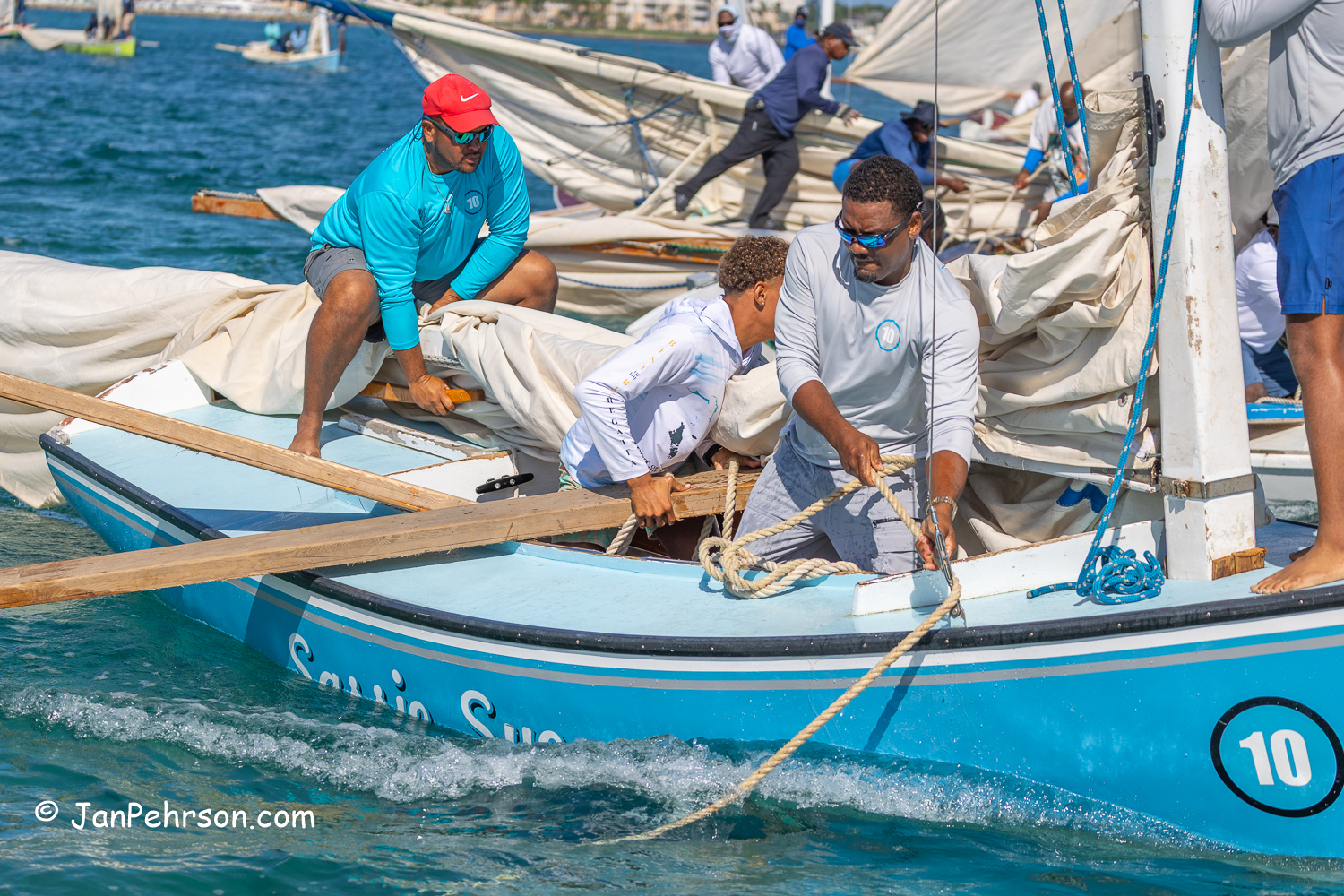

Other regattas draw fewer entries each year as wooden hulls are replaced by fiberglass, aluminum, and composites like carbon fiber and Kevlar.
In addressing the question, Bahamians are swimming as soon as they are out of diapers, and the regattas are building from the bottom up. E-Class was designed for juniors but, as the class increased in popularity, opened to sailors of all ages. Since then, sloop sailing has grown by leaps and bounds. Juniors are building them, racing them, and challenging the seniors, often winning.
Around half of the 94 entries at the Best of the Best were E-Class, and a lot more are being built right now. Every year the class grows, and it is the E-Class expansion that is causing an increase in the overall numbers in the Best of the Best.
The surge of youth sailors in E-Class is felt not only in Nassau, the capital, but throughout The Bahamas. In this island nation of approximately 700 islands, 30 inhabited, there are 17 major regattas each year that are funded and assisted by the government, including the Best of the Best.
Additional mini regattas are popping up all over. On some weekends, several different regattas are sailed at once on different islands. To put on a regatta, boats and crews must be transported long distances from their home island to the regatta site.
Dari Turnquest of the Bahamian Government’s Regatta Desk explains the government’s support of sailing, which recently replaced cricket as the national sport of The Bahamas.
“Logistically, you are talking about loading wooden sloops by cranes onto inter-island barges for what may be as long as a 17-hour voyage. In addition, the government, along with the local committees and sponsors, provides the crews and the skippers food, prize money, and per diems. It may be a six-figure task to put on a regatta.”
“This thing is exploding.” says Clyde Rolle, Vice Commodore of the National Family Island Regatta for the past 42 years. “I don’t know what we are going to do. Hundreds of juniors are involved so sailing is very healthy in the Bahamas in wooden boats.
“E-Class is the type of boat that almost anyone can afford. The rich, not so rich and the poor are all getting involved. So, you know, wooden boat racing ain’t going nowhere anytime soon. And the government of the Bahamas is giving the support to it. We’re in good shape.”
Here’s a cost/benefit primer to the economics of Bahamian Wooden Sloop Racing as explained by Vice Commodore Rolle:
The Cost:
“To buy an A-Class boat now, if one is for sale, you’re $200,000 into it. It’s gonna cost you. The B-Class is maybe around $45,000 dollars. Maybe $50,000 dollars. Everything is going up right now. $40,000 dollars will get you a decent C-Class. That’s with everything, including the sails.”
E-class costs between $8,000 and $12,000 including the trailer to put it on. Everybody wants to have an E-Class, it is so affordable. Or if you build it yourself, it costs even less.”
The Benefit:
Sloop sailing is a blast! This is an extreme sport! The government supports it financially, so you could say they are funding your fun. There is prize money to be had for the winners, although this won’t fully compensate you for your boat’s cost. There are bragging rights for the regatta winners. Sloop sailors in the Bahamas have had streets named after them, songs written about them, and been knighted. And finally, this is a lifelong sport. All the generations can sail together on the same boat or compete against their cousins on different boats hailing from different islands.
I’d read before coming to The Bahamas that at the first regatta in 1954, the government agreed to fund it for the fishermen so they could take some time off fishing and come race. Regattas initially were started to help compensate the fishermen but now have evolved into something much different. Regattas today are all about mentoring the youth. It is because of the energy and enthusiasm of the youth that sloop sailing in The Bahamas is growing.
As the new year approaches, make your reservations now for one or more of the 2026 Bahamian Sloop regattas. You won’t be disappointed. Bring your bathing suit!
Jan Pehrson is a sailing photojournalist who spends summers in San Francisco, California and winters in St. Pete Beach, Florida. As a racing and cruising sailor and Coast Guard licensed skipper, Jan’s familiarity with sailing and the sailing community lends an in-depth element to her prolific array of photographs and articles. Contact her at www.janpehrson.com

Related Posts

All in the family for 2026 edition →
Helping the sport thrive in the Bahamas →

National Committee praises supporter →