



Stronger, more agile, capable, responsive
Published on January 20th, 2026
The United States Coast Guard have released the Force Design 2028 Initial Update, detailing the reforms implemented since January 2025 and the significant, measurable impacts these changes have delivered for the American people.
“The United States Coast Guard serves as a vital instrument of national power, advancing security both at home and abroad, safeguarding the American economy, and providing rapid response to emergent contingencies,” reports Kristi Noem, Secretary of Homeland Security. “Through the implementation of Force Design 2028, the extraordinary return on investment—the value the Coast Guard provides to our Nation—is poised to grow even further.”
Adm. Kevin Lunday, Acting Commandant of the U.S. Coast Guard, notes how the Coast Guard is already a stronger, more agile, capable, and responsive fighting force. “Force Design 2028 is already improving operational outcomes while establishing the foundation for even greater achievements in the future.”
The update includes:
• Through disciplined and aggressive stewardship of its $12.1 billion annual budget, the Coast Guard delivers an unmatched return on investment for the Nation. Conservative analysis shows the Service generates more than $74 billion in social and economic value through cost avoidance—representing a 6-to-1 return on taxpayer investment.

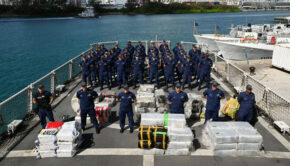
• Since January 2025, the Coast Guard has seized more than 466,000 pounds of cocaine—equivalent to over 176 million lethal doses, enough to kill more than 52 percent of the U.S. population. In Fiscal Year 2025 alone, the Service interdicted more than 510,000 pounds of cocaine, the highest total in Coast Guard history and an increase of more than 200 percent over FY24.
Beyond interdictions, Coast Guard counter-drug and law enforcement missions generate substantial social value. Conservative estimates indicate these operations saved the Nation over $10 billion in avoided costs, including more than $2.27 billion in healthcare costs associated with cocaine interdiction alone.
• The Coast Guard’s continued governance and protection of the Marine Transportation System enabled the safe movement of 1.8 billion tons of cargo in FY25—an increase of more than 13 percent from FY24—returning more than $28 billion in value to the American people.
The Service also reaffirmed its enduring commitment to saving lives at sea. In FY25, Coast Guard crews saved nearly 5,000 lives and preserved/assisted more than $974 million in property while responding to mariners in distress across the Nation’s waterways.
• Force Design 2028 continues to advance efforts to build a healthier, more resilient, and mission-ready workforce, including progress toward expanding the force by 15,000 military members to meet evolving operational demands and support new assets.
In FY25, the Coast Guard exceeded 110 percent of its active-duty enlisted recruiting goal, enlisting more than 5,200 members—the highest total since 1991. The Service also achieved 104 percent of its Reserve Enlisted recruiting goal and 100 percent of its active-duty Officer mission.
• Increased agility resulting from Force Design 2028 initiatives enabled the Coast Guard to rapidly address emerging threats and national priorities:
1. Operation Border Trident, launched in March 2025, targeted transnational terrorist and criminal organizations and illegal alien activity in the California Coastal Region, increasing interdictions by 44 percent compared to FY24.
2. Operation River Wall, initiated in October 2025, secured approximately 260 miles of the Rio Grande River, resulting in the interdiction of 47 illegal aliens and the deterrence of 237 more.
3. Operation Pacific Viper, launched in August 2025, doubled the Coast Guard’s most capable assets in the Eastern Pacific. In just over four months, crews seized more than 170,000 pounds of illegal narcotics—averaging approximately 1,600 pounds of cocaine interdicted per day.
• These outcomes were made possible by sweeping reforms enacted under Force Design 2028. The Coast Guard established new leadership roles—including Chief of Staff, Deputy Commandant for Systems, Deputy Commandant for Personnel, and Program Executive Offices—while eliminating 14 Admiral positions (32 percent) to streamline decision-making and maximize efficiency.
The Service also created the Rapid Response Prototype Team (RAPTOR) to deliver technology solutions at speed. RAPTOR transitioned a capability from concept to operational use in just three weeks, supporting Operation Border Trident with a contractor-owned, contractor-operated long-range unmanned aerial system employing artificial intelligence.
Additionally, the Coast Guard empowered commanders by revising administrative policies related to non-judicial punishment and delegating surface and airborne use-of-force authorities, increasing operational effectiveness at the tactical level.
• Capability delivery is being further accelerated through Force Design 2028 and resources provided by the One Big Beautiful Bill Act (OB3). More than $3 billion in OB3 funds have already been obligated, with 75 percent of total funding expected to be obligated by the end of FY26. In the coming months, the Coast Guard will implement major structural changes and investments, including:
1. Establishing a Deployable Specialized Forces Command to enhance integration with the Department of War and optimize force employment.
2. Expanding training capacity to support a growing force of more than 15,000 additional military members.
3. Enhancing Maritime Domain Dominance through Coastal Sentinel, improving sensor integration and operational responsiveness.
Rapidly identifying, testing, and acquiring commercially available boats, cutters, and aircraft to empower Coast Guard personnel across all mission areas.
4. Executing a comprehensive Force Posture and Operational Concepts Campaign to transform how the Service organizes, trains, equips, and employs forces—streamlining strategic decision-making, decentralizing execution, and leveraging next-generation technologies to ensure enduring U.S. maritime dominance.
The Force Design 2028 Initial Update affirms the Coast Guard’s commitment to reform, readiness, and results—delivering security, prosperity, and unmatched value for the American people today and into the future.
Source: USCG

Related Posts
Historic operational successes in 2025 →
Coast Guard exceeds recruiting goals →

Possible criminal charges for boat crash →
 We’ll keep your information safe.