


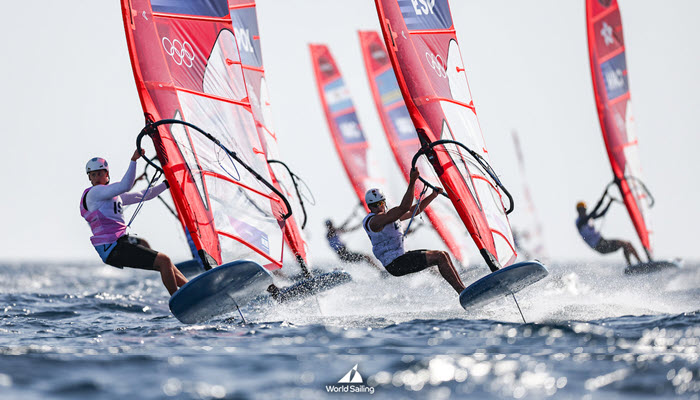
World Sailing is cleaning up its act
Published on January 20th, 2026
Sailing is an equipment sport, and new gear tends to be faster than old gear. At the elite level, that translates to a lot of turnover and the environment can be the loser. As Sailing seeks to remain as an Olympic sport, World Sailing is cleaning up its act.
Their efforts now include a landmark project to measure and reduce the environmental impact of every Olympic-class boat, marking the first initiative of its kind across any Olympic sport.
The 12-month project will see all six Olympic sailing classes – ILCA, 470, Nacra 17, 49er, Formula Kite, and iQFOiL – undertake a life-cycle assessment (LCA) to understand their full footprint across production, use and end of life of building, and campaigning Olympic equipment.
“As expectations on sport continue to evolve, sustainability has to be built into decision-making,” said Julie Duffus, Head of Sustainability at the International Olympic Committee.
The findings will inform future rules, technical standards and Olympic class selection, placing environmental data at the heart of World Sailing’s Olympic decision-making framework.
The work delivers on World Sailing’s Sustainability Agenda 2030 and its Olympic Vision, which commits the federation to embedding sustainability into technical standards, equipment regulation and evidence-based decisions aligned with IOC priorities.
From 2032, all classes seeking Olympic inclusion will be required to provide an independently verified LCA, making environmental impact a key factor alongside performance.
“This project provides the evidence we need to make smarter choices and shape the future of Olympic equipment,” said Alexandra Rickham, Director of Sustainability at World Sailing. “By working with our classes and manufacturers on a shared LCA framework, we can balance performance with environmental responsibility and help the whole sport move forward.”
MarineShift360, a purpose-built life-cycle assessment tool for the marine industry delivered by Marine Futures and supported by 11th Hour Racing, will provide the methodology, tools, and training for each class and manufacturer involved.
Shared data will enable fairer, more transparent standards for manufacturers competing for Olympic selection, and it is hoped that innovation at the top can cascade through the wider marine industry and influence how recreational and youth boats are built worldwide.
World Sailing has begun onboarding Olympic-class manufacturers, with the first workshops held in October 2025. Each class is expected to complete its assessment within three months, coordinated by World Sailing’s technical team.
Future phases will expand the assessment to cover complete Olympic campaigns, including equipment transport and athlete travel, to guide how events are structured and to identify further opportunities to reduce impact.
Early-adopting classes such as iQFOiL and ILCA, which have already undertaken individual assessments, will contribute valuable experience to the shared framework.
Results from the first two phases will inform updated sustainability criteria for future equipment and event operations, helping ensure sailing remains a leader in both performance and environmental leadership.
Los Angeles 2028 Olympic Sailing Program (July 16-28):
First Week – July 16-20
Men’s Kiteboard – Formula Kite Class – Long Beach, CA
Women’s Kiteboard – Formula Kite Class – Long Beach, CA
Men’s Windsurfing – iQFOiL – Long Beach, CA
Women’s Windsurfing – iQFOiL – Long Beach, CA
Second Week – July 23-28
Men’s One Person Dinghy – ILCA 7 – Los Angeles, CA
Women’s One Person Dinghy – ILCA 6 – Los Angeles, CA
Mixed Two Person Dinghy – 470 – Los Angeles, CA
Men’s Skiff – 49er – Los Angeles, CA
Women’s Skiff – 49erFX – Los Angeles, CA
Mixed Multihull – Nacra 17 – Los Angeles, CA
For more details, click here.
Source: World Sailing

Related Posts

Reviewing the Olympic Sailing Program →

IOC agrees on new gender policy →
Making sport more sustainable →

 We’ll keep your information safe.