


Mission accomplished for female team
Published on January 26th, 2026
Alexia Barrier and her crew of Dee Caffari, Annemieke Bes, Rebecca Gmür Hornell, Deborah Blair, Molly LaPointe, Támara Echegoyen, and Stacey Jackson became the first all-female team to complete the Jules Verne Trophy non-stop, round-the-world course which starts and finishes between Créac’h lighthouse (Isle of Ushant) and Lizard Point (England).
After their start on November 29 on the 103-foot trimaran IDEC Sport, which set the course record in 2017, they soon fell behind the pace to eclipse the course record of 40:23:30:30 (since lowered to 40:10:45:50), but their finish on January 26 established a reference time for women of 57 days, 21 hours, and 20 minutes.
Upon crossing the starting line, strong north-westerly winds and rough seas made it challenging to find the right balance without risking breakages. This was followed by repeated gybes in the Portuguese trade winds and a transition to irregular north-easterly winds, interrupted by wind holes. On December 7, the team crossed the equator after eight days and three hours.
In the South Atlantic, The Famous Project CIC crew picked up the pace with south-easterly trade winds to the Cape of Good Hope, which they crossed on their 17th day of racing. However, problems began with a stuck mainsail hook which forced the crew to dismantle every time they took in or released a reef, requiring them to lower the entire sail to access this part.

They passed the Cape of Good Hope (South Africa) on December 16, followed by crossing the longitude of Cape Leeuwin (Australia) on December 25. However, their progress was interrupted when a fishing net and its floats became caught in the starboard foil of the multihull.
“We went from 30 knots to 5 knots!” Barrier recalled. “We had to put the boat in reverse to remove the large net, but unfortunately, the foil ended up stuck in the down position for a while.” This limitation would later force the crew to sail without the appendage.
When they rounded Cape Horn (Chile) on January 6, they became the first all-female crew to achieve this milestone in a non-stop multihull race. After 38 days at sea and nearly 16,000 miles covered (25,700 km), they began the final leg of their journey: ascending the Atlantic Ocean.
It took them 9 days, 5 hours, and 38 minutes to reach the equator, with the Intertropical Convergence Zone causing delays as storm clouds gathered along their route. With the arrival of the trade winds came the discovery of a tear in the leech of the mainsail. “If it were easy, everyone would do it!” quipped Caffari.
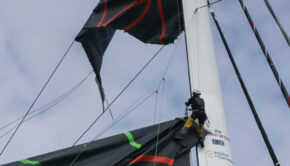
However, a thousand miles from the finish line, the mainsail exploded after 55 days at sea. Without its starboard foil, the maxi trimaran also lost the use of its autopilots. A final hurdle was storm Ingrid, with the team taking shelter at the Azores before proceeding.
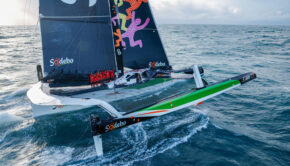
While far off record pace, which was lowered by Thomas Coville’s team that got underway on December 15, The Famous Project CIC now is the first all-female crew to complete the Jules Verne Trophy course.
Tracker: https://trimaran-idec.geovoile.com/julesverne/2025/viewer/
Record Facts
• Start and finish: a line between Créac’h lighthouse (Isle of Ushant) and Lizard Point (England)
• Course: non-stop around-the-world tour racing without outside assistance via the three Capes (Good Hope, Leeuwin and Horn)
• Minimum distance: 21,600 nautical miles (40,000 kilometres)
• Ratification: World Sailing Speed Record Council
Here are the nine that have held the trophy:
2026 – Thomas Coville / Sodebo Ultim 3 (32m) – 40:10:45:50
2017 – Francis Joyon / IDEC SPORT (31.5m) – 40:23:30:30
2012 – Loïck Peyron / Banque Populaire V (40m) – 45:13:42:53
2010 – Franck Cammas / Groupama 3 (31.5m) – 48:07:44:52
2005 – Bruno Peyron / Orange II (36.8m) – 50:16:20:04
2004 – Olivier De Kersauson / Geronimo (33.8m) – 63:13:59:46
2002 – Bruno Peyron / Orange (32.8m) – 64:08:37:24
1997 – Olivier De Kersauson / Sport-Elec (27.3m) – 71:14:22:08
1994 – Peter Blake, Robin Knox-Johnston / Enza New Zealand (28m) – 74:22:17:22
1993 – Bruno Peyron / Commodore Explorer (28m) – 79:06:15:56

Related Posts
Cape Horn Hall of Fame, Class of 2026 →
12 Metre IKRA: World’s Coolest Yachts →
Thomas Coville claims Jules Verne Trophy →