


Less confrontation, Better sport
Published on January 28th, 2026
Sailing, like all sports, has rules, but that’s where the comparison ends. With no fixed field of play, no referees, and a concern for safety and damage, the rules must cover a lot of situations. As a participant, it can be overwhelming.
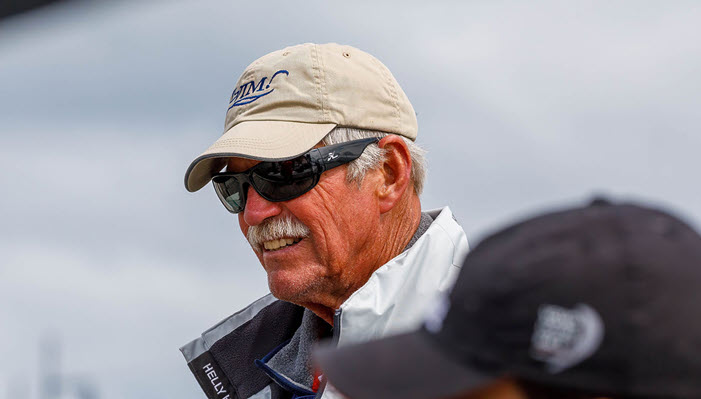
Moose McClintock has seen it all en route to 10 world championship titles, two America’s Cup campaigns, and five Congressional Cup titles. Now aging gracefully, he shares the view from those sailing miles:
If we consider the original rules of the road were strictly for preventing collisions (in commercial applications), I feel that what rules are intended for, and what they are used for, is an issue.
In my coaching, I stress to the sailor that rules are designed to be defensive, not offensive. Simplified, and in avoiding collisions, port avoids starboard, windward keeps clear, and outside gives room. By simplifying the rules, having this basic understanding lowers the hurdle for why people avoid getting into racing. These are defensive maneuvers; everyone should be able to avoid and keep sailing.
In team racing, which I judge a fair amount, the acts of the right of way boat change rapidly, and the rules become offensive (in many ways) as boats are tossed around and onus changes in split seconds. In these situations I always remember that Dave Perry counsels how the boat attaining right of way boat has a lot of onus to make sure the give way boat can react.
In team racing, with a lot of screaming and boat handling, I often green flag protest hails as the right of way boat generally has achieved what they want, to affect the give way boat to react and avoid.
If the give way boat is making any effort to avoid, without collision, they are doing what they can do, they generally get out of the way, and though there is a lot of screaming from the protestor, the desired effect occurs. No need for contact, just make the give way boat react as you want.
In my own sailing these days, I have a little PHRF boat that is very slow upwind and very fast downwind. Since it’s rated for its best performance, we sail against much larger, faster boats, particularly upwind. We sail the boat defensively all the way around the course because in confrontations, as a slow boat, we have no recourse.
Tacking on people means nothing as they go right through us. If we lee bow someone, we get rolled in short order. We can’t afford to have a boat lee bow us because we point lower, so we wave them on.
Since we tack very slowly, we pick a side and go there with minimal interaction and boat handling. Even in our fast offwind angle, we let other boats go if possible because we have a really short rig and park in bad air.
The point is, if sailors attack the course mostly to avoid confrontation, rather than pursue it, the sport is better for it.

Related Posts
How would you decide this? →
What if Judges walked the dock? →

Can a disqualified boat still protest? →

 We’ll keep your information safe.