


Protecting the herd from the wolves
Published on February 3rd, 2026
There’s a certain arrogance about handicap systems, fueled by self-importance and competition. They all believe their tools can fairly rate dissimilar boats, because if they don’t, events won’t use their rule.
Events want to maximize participation and will use the rule to do that. Nobody is looking out for what’s good for the sport. Just themselves. On his Facebook page, Yacht designer and past Seahorse magazine editor Julian Everitt wonders if one rule is stretched too far:
The offshore scow has landed! Well not really. Like everything else in life, little is really new, but how it is utilized sometimes is.
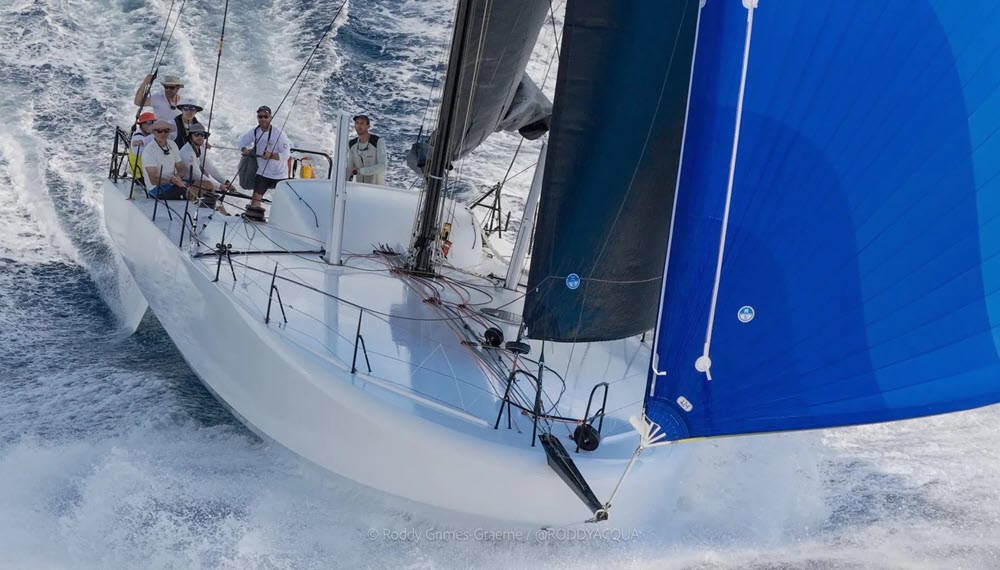
Sam Manuard, designer of the Mach 50 Palanad 4’s, which recently won the RORC Transatlantic Race has potentially opened up a can of worms for the IRC rating authorities with his scow bow – a design shape now effectively utilized and coming of age in the fully crewed offshore world.

Of course, the scow bow is only a variation, or development, if you like, of the Intrepid bow (a near upright stem with a knuckle above the waterline). A shape widely disliked, for no particular reason, by successive measurement rules including IRC, ORC, CHS, IOR, and RORC. The long forgotten CCA rule was a little kinder.
If the random nature of the current IRC decides to ‘rate’ the scow bow ‘fairly’, then it won’t be long before second generation scow bows will be developed. Perhaps in an attempt to increase all round performance against rating, the developed scow bows will become finer and more pointy, and before you know it, Intrepid bows will appear as the next ‘new’ thing.
Wouldn’t that just be ironic after suffering 30 years of fashionable plumb bows! It only takes a tiny adjustment to those secret measurements to make overhangs great again! Whoops!
Ever since the early days of the CHS version of IRC, there hasn’t been an effective and fair way of measuring potential sailing length at the front end. This is why since 1987, or thereabouts, virtually every CHS/IRC purpose designed racing boat has had a plumb or near plumb bow.
The very success of the IRC, in becoming the go-to international rule for offshore racing, has somewhat blurred its primary purpose. It’s convenient now, for protagonists of the rule, to forget its humble beginnings. It began as a way to encourage the ubiquitous cruiser racer out onto the race course.
The IOR had effectively lost its way to provide a fair rule to measure all-purpose ocean racers. Indeed, the poor old cruisers racers found themselves with higher ratings than their stripped-out sisters. This provided the perfect opportunity for a simplified rule, CHS, to fill a gap and provide meaningful competition to a very large cohort of sailors and their not so racy boats.
All good while the IOR remained in power, but things began to fall apart when the IOR replacement rule, IMS, failed to enthuse sailors and owners. There was quite literally nowhere for the Grand Prix sailors to go.
They had spent ten years rubbishing CHS, as a pot hunters charter, but then warmly embraced it, after a rebranding as IRC. These hypocrites now proudly proclaim the IRC as the best rule the world has got. There is an alternative in the form of the ORC – a sort of sanitized version of the failed IMS – but in the way typical of IRC history, that too is rubbished.
So, where does the rule go now as its laissez-faire attitude catches it out. It began life 40 plus years ago with noble intentions to give a ‘fair’ rating to almost anything that was thrown at it. As a way of rating existing boats, it has always had unparalleled success, but as a way of rating development in the same way, it’s doomed by its own free-wheeling- give everything a chance – attitude.
Rather than having a controlling influence on design parameters, like the Metre boat rules or, indeed, the much-maligned IOR, the IRC is open to attack by developments like the scow. And the only ‘defense’ it has is guesswork.
While brilliant, the winning performance of Palanad 4 in the Transatlantic Race was, who’s to say that the rating was ‘fair’? ‘Fair’ – that all important word and concept – is so important to a handicap formula, but irrelevant to a rating system like IOR or Metre boats.
Maybe it’s time for IRC to return to its roots and for the RORC to develop a companion system that has a rule policy rather than just being simply reactive to trends. The problem it’s facing now is that the very freedoms it embraces may well become its Achilles heel.

Related Posts
Handicapping the number of headsails →

Make participation easy and worthwhile →

Inescapable question with dual scoring →