

America’s Cup is being run illegally
Published on February 4th, 2026
Yacht designer and past Seahorse magazine editor Julian Everitt hosts an active Facebook page in which John Sweeney shares a strongly worded opinion regarding the America’s Cup:
The America’s Cup is not merely a sport in decline. It is operating outside the Deed of Gift that governs its existence.
Since the demise of the International America’s Cup Class (IACC) at the 2007 Valencia regatta, the Cup has careened into a high-speed, foiling spectacle. Some celebrate it. Most sailors do not. But aesthetics and nostalgia are not the real problem.
The real problem is legal: the current holder of the America’s Cup is running the event in material violation of the Deed of Gift, and the New York courts — the only courts with jurisdiction — have a duty to intervene.
I intend to ask them to do exactly that.
THE DEED OF GIFT IS NOT OPTIONAL
The America’s Cup is not owned by a federation, a commercial rights holder, or a media company. It is governed by a trust instrument — the Deed of Gift — enforced for more than 170 years by the New York courts.
It has been modified before. But it has never been abandoned.
Among its core requirements are:
• Racing in yachts that comply with specified waterline limits
• Racing without stored power or engines
• Racing on a windward–leeward or triangular course
• Racing on an arm of the sea within a defined distance of the winning club’s location
• Yachts propelled solely by sailors
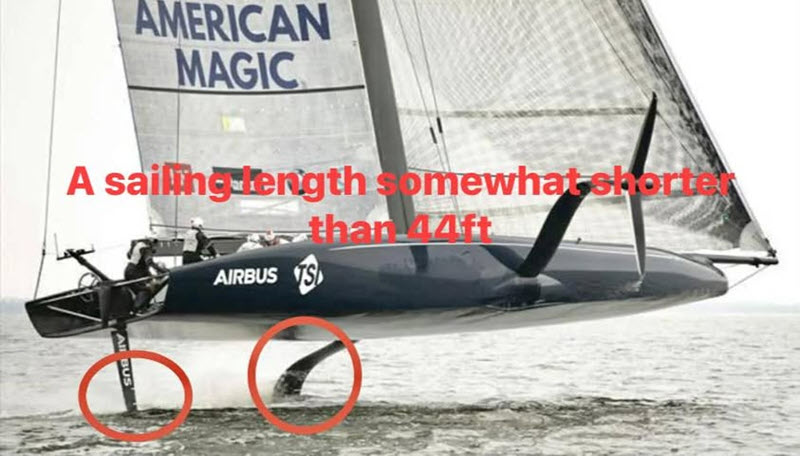
Today’s foiling craft fail these requirements on multiple levels.
I will not disclose every element of my legal action here. But one fact is undeniable: foiling yachts do not comply with the minimum racing waterline requirements as clarified by New York courts, nor do they comply with the Deed’s prohibition on stored and assisted power.
Flying above the water is not “sailing” as contemplated by the trust.
WHO I AM – AND WHY THIS MATTERS
I am not a casual critic.
I trimmed the main on America True and Oracle BMW Racing. I later funded my own campaign — the Sausalito Challenge — for the 2007 cycle, which ultimately evolved into Shosholoza. From 1999 to 2007, my partner Tina and I purchased and restored four IACC yachts and ran a vintage challenge series out of the Sausalito Yacht Club.
That series attracted serious teams. Larry Ellison joined with USA-61 and USA-76. The momentum ended when Alinghi and Oracle shifted focus to the commercial Moët Cup concept.
I have spent my life inside the America’s Cup ecosystem — as a sailor, a syndicate founder, and a steward of its history.
This is not theory. It is lived experience.
WHAT THE CUP WAS MEANT TO BE
The original America’s Cup envisioned large, demanding monohulls — closer in spirit to the J-Class than to aircraft. Yachts sailed by crews of 25–30. No engines. No batteries. No flight control systems.
Just sailors.
Racing was meant to be grueling. Tactical. Human. Conducted on recognizable courses that rewarded seamanship and endurance.
Today, the Cup is sailed by pilots managing systems — not crews sailing boats.
Speed alone is not the violation. Structure is.
THE LEGAL LINE THAT WAS CROSSED
The most direct violation — and the one that brings the event squarely back under New York jurisdiction — concerns racing waterline length.
Foiling yachts circumvent waterline limits by removing displacement from the equation entirely. The New York courts have already spoken on minimum waterline standards in prior Deed litigation.
Foiling did not amend those rulings.
Marketing did not amend the trust.
Commercial success does not supersede law.
Additionally:
• Races are not held on Deed-compliant courses
• Stored energy systems assist control and propulsion
• The competition is effectively sold and re-written by the defender
That is not how trusts work.
THE SOLUTION: A MODERN DEED-COMPLIANT CLASS
My petition will not merely challenge. It will propose.
I will ask the court to enforce a 90-foot maximum waterline monohull class, sailed by approximately 30 crew, with:
• No engines
• No stored power
• No assisted control systems
• Deed-compliant courses
• Racing held within a 50-mile radius of the winning club
Not retro. Not nostalgic. Modern — but lawful.
A class that blends the majesty of J-Class with the discipline of IACC. Aluminum or alloy behemoths. Brutal. Punishing. Spectacular in a way that sailing is meant to be.
“TEAM NEW ZEALAND DOESN’T WANT THAT”
That argument fails historically.
In 2007, I was the chosen Challenger of Record contingent upon Team New Zealand winning the Cup. My lawyer and I were present to execute the agreement. Together, we developed a 90-foot waterline concept — precisely the hybrid class now being ignored.
What changed wasn’t feasibility.
It was commercialization.
A FINAL WORD
New York Yacht Club has a responsibility here. Silence is acquiescence.
The America’s Cup does not belong to flying machines, sponsors, or television formats. It belongs to sailors — and to the law that created it.
Someone has to enforce that law.
Details: https://www.americascup.com/
Defender New Zealand and Challenger of Record from Great Britain confirmed the Protocol for the 38th America’s Cup on August 12, 2025. The close of the initial entry period was October 31, 2025, with late entries considered up to March 31, 2026. If no USA team participates in the 38th America’s Cup, it will be the first time in the event’s 175-year history.
Current entrants:
• Emirates Team New Zealand (NZL) – Defender
• Athena Racing (GBR) – Challenger of Record
• Luna Rossa (ITA) – Challenger
• Tudor Team Alinghi (SUI) – Challenger
• K-Challenge (FRA) – Challenger
After the 2024 event, Barcelona, Spain declined hosting another edition, with the venue moved to Naples, Italy. Challenger racing begins in the spring before the 38th Match on July 10-18, 2027.
Preliminary Regattas:*
May 21-24 – Cagliari, Sardinia
* More to be announced.

Related Posts

America’s Cup: What will fifth sailor do? →
America’s Cup: Bring on the lawyers →

Inside AC: How USA can catch up →