


Stop trying to rate everything
Published on February 19th, 2026
It was 2022 when FlyingNikka was revealed, a 60 feet full-foiling monohull yacht conceived by a team of designers coordinated by Irishman Mark Mills. Similar to the AC75 now used in the America’s Cup, the plan was to compete in notable maxi events in the Mediterranean.
In a series of reports, Scuttlebutt questioned how a rating system (IRC) or event managers could see a good outcome from their inclusion. “It’s amazing how people repeatedly make the same mistakes as far as handicapping is concerned,” observed notable yacht designer Tony Castro.
While FlyingNikka has had a lower profile since 2023, the latest threat has arrived with the scow-bowed Mach 50 by Sam Manuard. After winning the 2026 RORC Transatlantic Race, its next test will be the 2026 RORC Caribbean 600, but yacht designer and past Seahorse magazine editor Julian Everitt sees history, noted by Castro, occurring again:
Where does IRC go now under pressure from scow hull shapes and foils? The answer, it seems to me, is that it’s time for IRC to stop trying to rate everything and return to its roots of promoting cruiser racers and stop being a rule that actively promotes development.

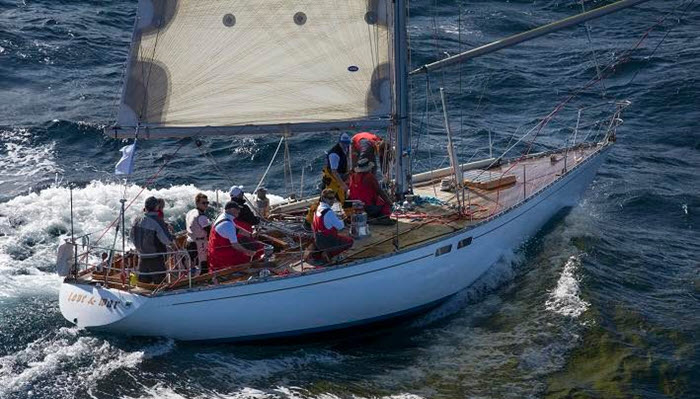
There needs to be a return to the ethos of CHS and the first few years or IRC when new designs were penalized and the more classic designs encouraged. It’s probably only a small change required looking at the results of the 50+ year old S&S 47 Love and War in the 2025 Sydney Hobart. Tiny changes to time correction does have a big effect.
If the new, more racy development boats don’t like it, then they can compete in an IRC division 2. And with foils and scows coming on stream, it may be necessary to even sub divide Division 2 with an IRC division 3. Of course, the division 2 and division 3 boats won’t be prevented from racing in Division 1, but they will carry a rating that is more appropriate to their development status.
This is how it was when the rule was born and it worked perfectly well until the, so called Grand Prix owners, left IOR and IMS and decided to colonize IRC.
What I am calling traditional IRC, should be the primary rule and the rule under which the major prizes are raced under. These would include the RORC points championship, the Fastnet, Sydney Hobart, etc. New trophies and events should be set up for IRC development classes.
The basis of the IRC rule today is predicted on a lie and because it has evolved into a full-blown development rule, it has lost its preeminence as an effective rule for all competitors.
Slavish supporters, come what may of the fairness of the current IRC, use the argument of boats like Love and War, with her third overall in the recent Sydney Hobart, as proof of just how good the rule is.
But this proof is based on a misconception. If the rating of Love and War was indicative of an accurate measurement system and not a mixture of arbitrary allowances, due to an age-based formula, then we would see new boats built along similar lines. It makes me ask the question if old style boats are rated fairly under IRC, with a genuine chance of winning, then why doesn’t anybody build new boats to these more moderate lines. That’s where the lie comes in.
The IRC rating authorities have been seduced by what they think owners want so the rule has slipped into an extremely narrow development band at odds with the original goals of an all-inclusive handicap system. Ironically defenders of the status quo think this type forming is a good thing, but it doesn’t belong in a rule that expressly began to broaden the appeal of racing offshore style yachts.
It’s effectively become a two-tier rule. Time to recognize this and give the IRC Grand Prix class the choice of its own playground. My guess is they won’t like it as it will take away their cannon fodder.

Related Posts

IRC considers direction for future →

Ten best regatta parties in the USA →

Cleaning removes honor, sentimentality →