

SailGP investigation confirmed Kiwi error
Published on February 24th, 2026
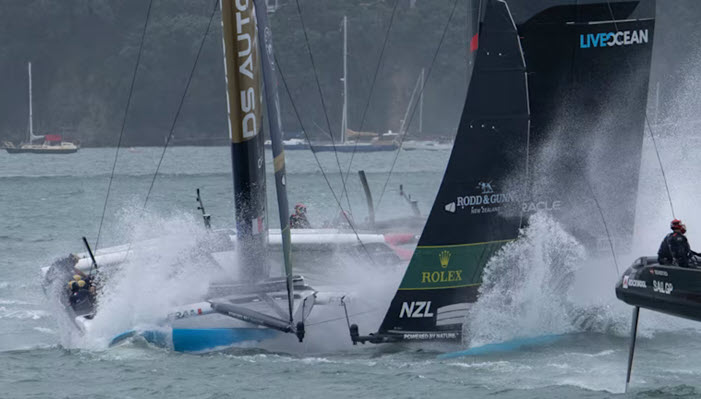
When New Zealand SailGP Team lost control in the second event of the 2026 season, it resulted in a dramatic collision with France that led to injuries for both teams, and significant boat damage that can’t be repaired for the next event.
Kiwi skipper Peter Burling believed a system limit within the foil assembly contributed to losing control, but a review by the league found the team was effectively flying too high.
Following the incident, SailGP engineering teams conducted a detailed review using high-rate performance data, onboard telemetry, simulator recreations, and video analysis to understand precisely what occurred.
The analysis shows that the New Zealand F50 was sailing at 49 knots when they encountered a gust as the 13-boat fleet was reaching toward the first mark after the start.
That increase in wind speed caused their boat to accelerate rapidly, increasing lift on the hydrofoils and raising the ride height of the boat. As the boat rose, the leeward foil pierced the surface of the water, triggering a side slip and a rapid increase in leeway.
SailGP Director of Performance Engineering Alex Reid said the combination of speed, gust conditions, and foil ventilation created a highly dynamic sequence which developed within seconds.
“The data shows the boat accelerated quickly and rose high on its foils,” Reid said. “Once the leeward foil pierced the surface, the boat entered a side slip where the foil began generating unwanted lift through leeway rather than via rake.
“At that point the dynamics of the boat changed very quickly. Control inputs from the flight controller were still being applied, but we believe the physics of the slide meant the boat could not be brought down in time.”
As the side slip developed, the rudder angle increased significantly as the crew attempted to regain control while avoiding nearby boats. The rudder briefly lost effective flow before re-attaching along with the windward bow immersing, causing the boat to round up sharply into the wind and decelerate rapidly.
With the French F50 sailing close astern at speed, there was insufficient time or distance to avoid contact once the sequence began. All the other teams retained control during the gusty leg.
Importantly, there was no evidence of a mechanical or software failure in the systems leading up to the incident. Reid added, “What we see in the data is a very fast chain of aerodynamic and hydrodynamic events that pushed the boat beyond its controllable envelope at that moment.”
As part of its ongoing review process, SailGP engineers are assessing mitigations which could help crew better manage similar scenarios in future.
A penalty review hearing has since upheld the original decision that New Zealand broke Rule 14 (avoid contact), resulting in an eight event point penalty, while France was found to have had no reasonable opportunity to avoid the collision.
Sydney crew lists: https://sailgp.com/news/26/revealed-full-crew-lists-sailgp-sydney-australia
SailGP information – Sydney details – How to watch
Season 6 Results (after 2 of 13 events)
1. Australia, Tom Slingsby (AUS), 2-1
2. Great Britain, Dylan Fletcher (GBR), 1-2
3. Spain, Diego Botin (ESP), 12-3
4. France, Quentin Delapierre (FRA), 3-4
5. Artemis, Nathan Outteridge (AUS), 4-5
6. Germany, Erik Heil (GER), 9-6
7. United States, Taylor Canfield (USA), 5-7
8. Denmark, Nicolai Sehested (DEN), 8-8
9. New Zealand, Peter Burling (NZL), 13-9
10. Canada, Giles Scott (CAN/GBR), 6-10
11. Switzerland, Sébastien Schneiter (SUI), 11-11
12. Brazil, Martine Grael (BRA), 10-12
13. Italy, Phil Robertson (NZL), 7-13
Season 6 – 2026 Schedule:
• Jan 17-18 – Perth, Australia
• Feb 14-15 – Auckland, New Zealand
• Feb 28-March 1 – Sydney, Australia
• Apr 11-12 – Rio de Janeiro, Brazil
• May 9-10 – Hamilton, Bermuda
• May 30-31 – New York, USA
• June 20-21 – Halifax, Canada
• July 25-26- Portsmouth, GBR
• August 22-23 – Sassnitz, Germany
• Sept 5-6 – Valencia, Spain
• Sept 19-20 – Geneva, Switzerland
• Nov 21-22 – Dubai, UAE
• Nov 28-29 – Abu Dhabi, UAE
Note: The 11th event was moved to Geneva from Saint-Tropez, France.
Season 6 format:
• Thirteen teams compete in identical F50 catamarans.
• Each event is two days.
• All teams compete in up to seven qualifying fleet races of approximately 15 minutes.
• The top three teams from qualifying advance to a final race for the event title.
• The season ends with the Grand Final event which includes the Championship Final Race for the top three teams in the season standing.
• All teams are privately owned except for New Zealand and Spain which are owned by the league.
Season 6 prize money:
A total of USD $12.8 million is up for grabs in 2026. The winner of each of the 13 events takes home $400,000, with $260,000 for second and $140,000 for third. The team with the most points at the end of the season wins $400,000, while the team that wins the Championship Final Race wins USD $2 million.
F50 Configuration:
All teams use same configuration based on weather forecast. There are four wingsail sizes (18m, 24m, 27.5m, and 29m), two T-foil daggerboards (high-speed and low-speed), and one set of rudders with high-speed and low-speed settings.
Established in 2018, SailGP seeks to be an annual, global sports league featuring fan-centric inshore racing among national teams in some of the iconic harbors around the globe.
Source: SailGP

Related Posts
SailGP Spain wins in Geneva →
SailGP: Five things to watch in Geneva →

Harry Melges IV out for SailGP Geneva →