


Technology is hard to stop
Published on March 5th, 2026
by Craig Leweck, Scuttlebutt Sailing News
When the autonomous driving company Waymo revealed plans to enter the San Diego market, organizations that represent taxi and other transit options were opposed. “No corporation should be allowed to quietly replace people with machines just to boost profits,” was the chant.
I suspect there was also opposition to robotic manufacturing and AI tools reducing the workforce, yet it’s happening. Technology is hard to stop.
Technology has been hard to stop in sailing, and each advancement tends to raise the cost to compete. Since affordability is closely tied to participation, I contend we are capable of evolving toward extinction.
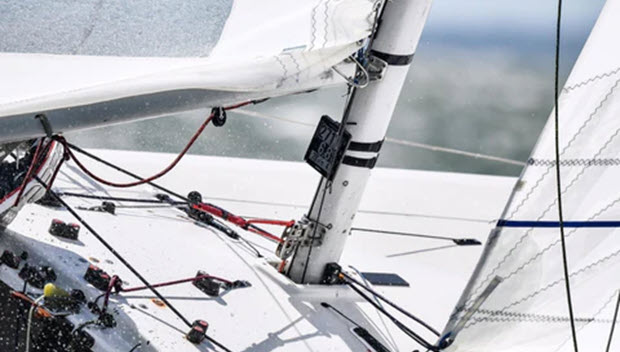
Among recent advancements is the Vakaros RaceSense system. Much more than a compass, the instrument has a lot of features for the sailor, but what’s getting most attention is how it alerts both competitor and race committee on premature starts. No hiding on the line… it finds you.

When first introduced, equipment was either for sale or could be rented, but benefiting from its clever tools needed a full commitment. Renting wouldn’t be enough as the equipment is changing sailor skill, and when the system is used by race management, everyone must use it too. No opting out.
The Etchells Class approved electronic devices for major championships, and with the bonus features of the Vakaros Atlas 2, the onboard instrument is $1249.00 (plus bracket if needed). When the RaceSense starting system is used, there’s a fee of either $149.00 for the year or $50.00 per event.
The Etchells Class has embraced professional sailing, so the full system cost might be nominal when factored in among crew and coach fees, coach boats, sail replacement, etc. And the Vakaros equipment delivers significant information as pro sailor Chris Busch explains:
————-
As we all discover the various features of onboard electronics, one hidden gem is the log file generated with each session. Data from those files allows you to analyze your performance using tools like Sail Njord or Charted Sails. Both programs allow you to sync onboard video or audio to review your sailing in detail.
Additionally, you can compare data and video from multiple boats to analyze technique and gain/loss while racing or testing. Use your Vakaros data to score each Etchells tack from helm initiation until the boat reaches ~90% of pre-tack speed, focusing on:
• Minimum speed (avoiding rudder braking)
• Time to target speed (crew hiking and main trim timing)
• Distance lost
• Minimal heading overshoot past close-hauled
• Minimal heel spike
• A smooth, continuous acceleration curve with no stall
Consistent performance—not just peak numbers—is the hallmark of elite Etchells teams. Vakaros offers many online help videos on downloading log files, and the analysis programs mentioned above provide guidance on how to get the most out of your data.
————-
The RaceSense system was used for the 2026 Etchells Pacific Coast Championship, a lead-up event for the 2026 Class Worlds at the same venue. I attended the skippers meeting when there was an announcement regarding who hadn’t fulfilled the necessary system registration.
“I know some of you aren’t happy about this,” I recall being said, “but remember this was decided by a class vote.” I questioned democracy at that moment.
People also vote with their feet, so it will be interesting to see the final competitor total at the 2026 Etchells World Championship in San Diego. It was held there in 2011, well before pro sailing had made a dent, and there were 81 teams. Currently, with two months to go, and an entry deadline in a few weeks, there are 52 entrants. Standing by…

Related Posts

Online testing fails to improve safety →

What it takes to win, 15 years later →

Norway does it right, again →

 We’ll keep your information safe.