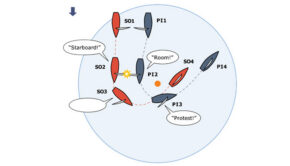


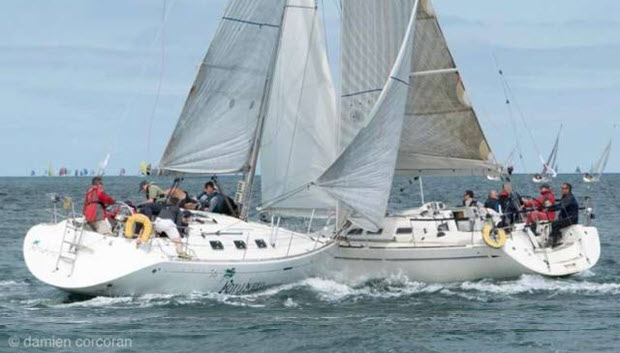
Does this rule do more harm than good?
Published on March 22nd, 2026
In every situation, the Racing Rules of Sailing are intended to keep boats from colliding. But when a collision is still possible, rule 14 states:
—————–
14. AVOIDING CONTACT
If reasonably possible, a boat shall
(a) avoid contact with another boat,
(b) not cause contact between boats, and
(c) not cause contact between a boat and an object that should be
avoided.
However, a right-of-way boat, or one sailing within the room or mark-room to which she is entitled, need not act to avoid contact until it is clear that the other boat is not keeping clear or giving room or mark-room.
—————–
But Luis Leal de Faria finds rule 14 providing more cloud than clarity:
The problem in these situations of a right-of-way boat not avoiding contact lies within rule 14, as it contradicts itself in many situations. I would say that with what is written in its last paragraph, rule 14 is an invitation to unseamanlike sailing (protected by the rules), which might result in collisions with possible injuries, even fatalities.

Sailing in a seamanlike way includes trying to avoid contact, and that is the aim of the first part of rule 14 (if reasonably possible a boat shall avoid contact and not cause contact). Mainly with modern boats (which can turn almost on themselves), a give-way boat may get very close (2, 1 or even less boat-lengths) to a right-of-way boat and still be able to maneuver and keep clear of her.
In quite many situations, mainly when it looks quite likely that the other boat will not keep clear, if a boat waits for the time when it becomes clear that she is not keeping clear or giving room or mark-room, it might no longer be possible to avoid contact.
So, even if, by maneuvering earlier, it would be reasonably possible to avoid contact (as the first part of rule 14 requires a boat to do), the right-of-way boat, or a boat sailing in a room or mark-room to which she is entitled, is cleared under rule 14, even if a collision results in serious damage or, worse, injuries or even fatalities. Is that reasonable? In my opinion it is not.
I believe that the last paragraph of rule 14 should be deleted. Might ruling rule 14 become too subjective? Well, to some extent it is already subjective (what is “reasonable”? How to establish the moment when it became clear that the other boat was not keeping clear?). And as subjective as ruling many other rules is. That is why judges are there. Otherwise, all protests might be dealt with by computers. And we may always apply the “reasonable apprehension of collision” principle used in Case 50 to support the right-of-way boat’s action.
And the situation becomes even worse with the redress options in rule 61.4(b) (2) and (3). Confident that they will be entitled to redress, many sailors do not try hard enough to avoid contact. They rely on the redress, even if they cannot sail one or more races.
I am quite sure that, if these rules (is sailing the only sport with such a rule?) or if the last paragraph of rule 14 did not exist, the number of contacts with injury or damage would be substantially reduced.

Related Posts
Room to tack at an obstruction →
If it’s not written, it’s not required →
How would you decide this? →