


Last point of certainty for safety
Published on February 23rd, 2026
Greg Kiely is a World Sailing International Umpire and is worried about the direction the sport is headed:
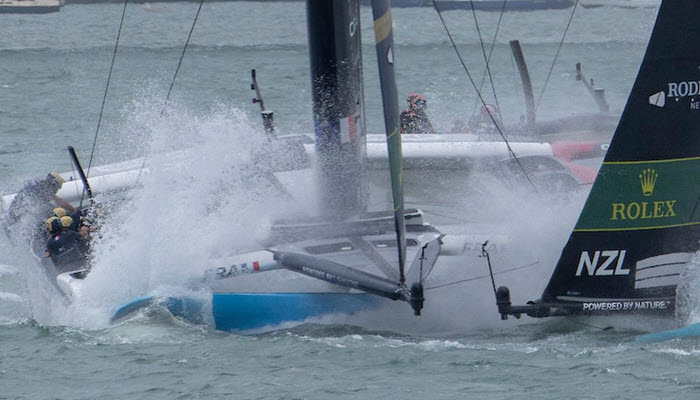
At the second event of the 2026 SailGP season, two of their F50s had a dramatic high-speed collision. Two sailors were taken to the hospital. One suffered compound fracture in both legs. That alone should give the sport pause.
Sailing has always involved risk. High-performance sailing even more so. But what we witnessed was not an unavoidable act of nature or a simple mistake. It was the foreseeable result of how racing rules are now being applied at the very top of the sport.
And that should concern anyone who cares about sailor safety.
The Rule That Quietly Keeps Sailors Safe
Across most of sailing, umpiring relies on a stabilizing principle known as the last point of certainty. World Sailing’s umpire guidance states it clearly:
“Unless the umpire is confident that a change has happened, the decision should be made on the basis that it has not happened. This is referred to as the last point of certainty.”
This principle is not limited to umpired formats. It is embedded directly in the Racing Rules of Sailing. Rule 18, which governs mark-room, says:
“If there is reasonable doubt that a boat obtained or broke an overlap in time, it shall be presumed that she did not.”
That sentence matters more than most sailors realize. It means that if an overlap previously existed, it continues to exist until it is absolutely certain that it no longer does. If a boat is entitled to room, that entitlement continues until it is certain the room has been used.
This is not a loophole. It is intentional. That small window of uncertainty creates space. Space in distance. Space in time. Space for human reaction. When boats are fast, heavily loaded, and close together, certainty comes late. Caution comes early.
What SailGP Changed
In SailGP, umpiring is conducted remotely from a digital booth using multiple camera angles, telemetry, and computer-verified positioning. The technology is remarkable. It is also extremely precise. But precision changes behavior.
Decisions are no longer based on what a human could be absolutely certain of in real time on the water. They are based on what data later confirms to be technically true.
Were you clear? Yes, by measurement. Were you clear in a way another sailor, traveling at extreme speed, could be certain in that instant? That is no longer the standard.
Sailors Sail to the Incentives
I regularly umpire grand-prix-level events where SailGP and America’s Cup sailors cross over into formats governed by World Sailing rules. The difference in behavior is unmistakable.
Overlaps are broken at the very last measurable moment at leeward marks, leaving no practical bailout for the boat that had been inside only seconds earlier. Windward boats press down onto leeward boats until bows are separated by centimeters, all at maximum speed and load.
Were these moves technically legal? Often, yes. Were they sailed with any meaningful margin for human error? No. When rules are enforced at the razor’s edge, sailors race to the razor’s edge.
Why This Leads to Crashes
Extreme precision does not automatically create safety. It removes the buffer that safety depends on. Uncertainty forces conservative decisions. Certainty invites optimization. When optimization happens at high speed, in tight spaces, with foiling boats that cannot slow or turn quickly, the margin for error disappears.
What we witnessed was not a failure of rules knowledge. It was the predictable outcome of a system that rewards being just clear enough, with no room left for anything to go wrong. Something always goes wrong.
The Question the Sport Must Answer
This is not an argument against SailGP. It is not an argument against technology. It is not an argument against elite performance. SailGP has done extraordinary things for the visibility of sailing.
But sailing is still sailed by humans, not data. Humans do not react in centimeters or milliseconds, especially at speed, under pressure, surrounded by noise, spray, and risk. The last point of certainty exists because the sport learned, over decades, that ambiguity is not a flaw. It is a safety feature.
High-precision, remote umpiring removes that feature. It changes incentives. It teaches sailors to sail closer, later, and harder, with less margin for error. That leaves the sport with a real question to answer. Technology and precision are a wonderful advancement. But are they what is best for the sport?
As someone who regularly umpires high-level racing and watches how elite sailors adapt their behavior to the rules we give them, I am certain I know my answer. Removing uncertainty from the rules does not make sailing safer. It makes the consequences of getting it wrong far more severe.
The sport can choose spectacle, or it can choose safety. Perfect precision does not give us both.
About the Author
Greg Kiely is a World Sailing International Umpire and a US Sailing Umpire Assessor. He is a former Head Coach at Annapolis Yacht Club and currently serves on the New York Yacht Club Judges and Umpires Committee. He regularly officiates high-level match racing, team racing, and grand-prix events.

Related Posts
Balancing offshore safety and complexity →

Spain win at SailGP Portsmouth →

New format for SailGP League →