

New format for SailGP League
Published on July 26th, 2026
The SailGP league confirmed that the remainder of Season Six will utilize a split fleet format for qualifiers, with the 13 teams to be divided in two separate fleets which then advance the top two in each group to a four boat final.
SailGP CEO Sir Russell Coutts said the move represents a natural evolution for the league as it enters its next phase of growth, with a focus on delivering a more consistent and engaging product for fans around the world.
“The first five years of SailGP were about proving the concept,” Coutts said. “Would this product work? Would it be commercially sustainable? The next phase is all about scaling the league, growing attendance at events, increasing broadcast audiences and delivering a more consistent product.
“That consistency applies across everything: the quality of racing, the format, the venues, the quality of the broadcast, the delivery of the hospitality experience, and the calendar.
“With fourteen teams due to compete next season, it’s a format that we have been planning to evolve to for sometime.”
One of the key benefits of group racing is the improvement in racing quality, particularly in lighter wind conditions where large fleets can quickly become spread out.
While seeing a full fleet of F50s line up together creates an impressive spectacle, Coutts explained that the reality of racing in close proximity can make it challenging for teams to maintain competitive battles throughout the fleet.
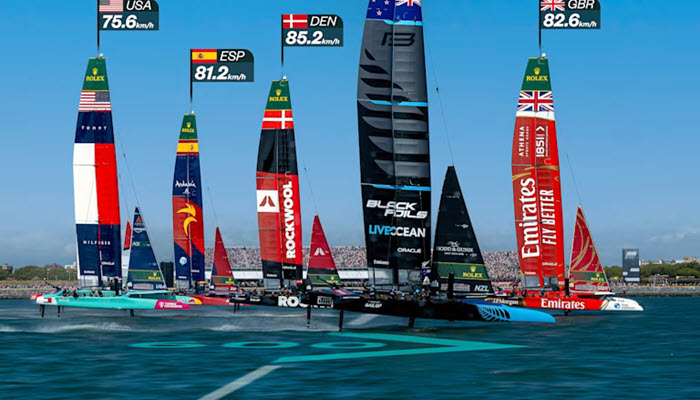
“Thirteen boats on the start line together looked impressive, but in lighter winds, with the amount of disturbed air coming off the wingsails, the fleet spread out very quickly.
“You’d often have the leading boat sailing away in undisturbed wind and sometimes even lapping the boats at the back sailing in more turbulent wind. We felt the quality of racing, particularly in lighter conditions, improved with smaller fleets.”
The change also provides a significant boost to team visibility, ensuring more teams are consistently involved in the on-screen action.
Coutts said analysis of broadcast coverage showed that group racing creates more opportunities for teams across the fleet to receive meaningful exposure, compared with larger fleet races where the focus naturally concentrates on the leaders.
“At first, some teams thought they’d get less coverage because they were only racing in half the races,” he said. “But when we analyzed the coverage, it became clear that in the old format the cameras naturally focused on the leading pack and the teams at the back received little airtime.
“Now, more teams spend more time racing in the mix, which means they receive more broadcast coverage. From a commercial perspective, that’s a real benefit for the teams.”
The format also enhances the viewing experience for a broader cross-section of fans, with clearer storylines and easier-to-follow racing.
“If you’re not that familiar with sailing, having less boats makes it easier to follow,” Coutts said. “With fewer boats, they’re generally on the same leg of the course for a greater percentage of the race. Our broadcast team has also found they can cover more aspects of the racing in more detail. There was almost too much going on in the thirteen boat format.
“We can also start races much sooner after the completion of the previous race which means less downtime in the 90 minute broadcast. If things are running well, we can limit the time between races to three minutes, which allows just enough time for the free-to-air broadcasters to schedule their advertising breaks.”
With SailGP continuing to grow towards its ambition of a 20-team league with 20 or more events, Coutts believes group racing will play an important role in building a more consistent and compelling global sports product.
“We believe we can grow to 10 boats in each fleet. Each time we add a new team, especially coupled with a home event, we gain a more engaged audience in that country.”
“We’re always going to continue to make decisions based on what’s best for the long-term growth and success of the teams and the league,” he said. “Innovation has always been at the heart of SailGP’s DNA, and this is a natural evolution of the championship.”
SailGP information – Portsmouth details – How to watch
Portmouth Results
1. Spain, Diego Botin (ESP), 2a-1a-6a-2a-3a-(1)
2. Sweden, Nathan Outteridge (AUS), 2b-1b-2b-3b-3b-(2)
3. Canada, Giles Scott (CAN/GBR), 1a-5a-2a-4a-2a-(3)
4. Switzerland, Sébastien Schneiter (SUI), 3b-2b-4b-4b-1b-(4)
5. New Zealand, Peter Burling (NZL), 4a-2a-1a-5a-4a
6. United States, Taylor Canfield (USA), 1b-3b-3b-6b-4b
7. Australia, Tom Slingsby (AUS), 5a-3a-3a-1a-6a
8. France, Quentin Delapierre (FRA), 5b-5b-5b-2b-2b
9. Denmark, Nicolai Sehested (DEN), 7a-6a-4a-3a-1a
10. Germany, Erik Heil (GER), 6b-4b-6b-1b-5b
11. Great Britain, Dylan Fletcher (GBR), 4b-6b-1b-5b-6b
12. Italy, Phil Robertson (NZL), 3a-4a-5a-7a-7a
13. Brazil, Martine Grael (GBR), 6a-7a-7a-6a-5a
Note: Three qualifying races on Saturday and two on Sunday, with fleet divided in Group A and Group B based on Season 6 standings. Top two from each group advanced to finals.
Season 6 Results (after 8 of 13 events)
1. Australia, Tom Slingsby (AUS), 2-1-5-1-1-1-4-7, 66 points
2. Spain, Diego Botin (ESP), 12-3-3-2-2-12-1-1, 54
3. Sweden, Nathan Outteridge (AUS), 4-5-9-3-11-5-2-2, 47
4. United States, Taylor Canfield (USA), 5-7-1-4-7-6-6-6, 46
5. Great Britain, Dylan Fletcher (GBR), 1-2-2-12-4-2-11-11, 44
6. France, Quentin Delapierre (FRA), 3-4*-13-8-9-4-10-8, 36
7. Canada, Giles Scott (CAN/GBR), 6-10-11-10-6-3-8-3, 31
8. Germany, Erik Heil (GER), 9-6-8-6-3-11-7-10, 28
9. Switzerland, Sébastien Schneiter (SUI), 11-12-10-11-5-8-3-4, 25
10. Denmark, Nicolai Sehested (DEN), 8-9-6-5-7-12-9, 24
11. Italy, Phil Robertson (NZL), 7-13-4-7-8-9-9-12, 22
12. New Zealand, Peter Burling (NZL), 13-8-12-13-13-13-5-5, 14
13. Brazil, Martine Grael/Paul Goodison (BRA/GBR), 10-11-7-9-12-10-13-13, 8
* Received compensation points for Sydney due to boat damage in Event 2.
Season 6 – 2026 Schedule:
• Jan 17-18 – Perth, Australia
• Feb 14-15 – Auckland, New Zealand
• Feb 28-March 1 – Sydney, Australia
• Apr 11-12 – Rio de Janeiro, Brazil
• May 9-10 – Hamilton, Bermuda
• May 30-31 – New York, USA
• June 20-21 – Halifax, Canada
• July 25-26- Portsmouth, GBR
• August 22-23 – Sassnitz, Germany
• Sept 5-6 – Valencia, Spain
• Sept 19-20 – Geneva, Switzerland
• Nov 21-22 – Dubai, UAE
• Nov 28-29 – Abu Dhabi, UAE
Note: The 11th event was moved to Geneva from Saint-Tropez, France.
Season 6 format:
• Thirteen teams compete in identical F50 catamarans.
• Each event is two days.
• All teams compete in up to seven qualifying fleet races of approximately 15 minutes.
• The top three teams from qualifying advance to a final race for the event title.
• The season ends with the Grand Final event which includes the Championship Final Race for the top three teams in the season standing.
• All league teams are privately owned, with New Zealand as the last to be acquired on June 19, 2026.
Note: The league confirmed on July 25 a shift to split fleet racing for the qualifiers which advances the top two from each fleet for a 4-boat final.
Season 6 prize money:
A total of USD $12.8 million is up for grabs in 2026. The winner of each of the 13 events takes home $400,000, with $260,000 for second and $140,000 for third. The team with the most points at the end of the season wins $400,000, while the team that wins the Championship Final Race wins USD $2 million.
F50 Configuration:
All teams use same configuration based on weather forecast. There are four wingsail sizes (18m, 24m, 27.5m, and 29m), six jib sizes, two T-foil daggerboards (high-speed and low-speed), and one set of rudders with high-speed and low-speed settings.
Established in 2018, SailGP seeks to be an annual, global sports league featuring fan-centric inshore racing among national teams in some of the iconic harbors around the globe.
Source: SailGP

Related Posts

SailGP Spain wins in Geneva →
SailGP: Five things to watch in Geneva →

Harry Melges IV out for SailGP Geneva →