

Closing gap between training and reality
Published on April 18th, 2026
As preparations build for the 2026 Newport Bermuda Race, organizers are placing renewed focus on one of offshore sailing’s most critical—and often under-practiced—skills: man overboard (MOB) recovery.
While safety regulations have long required crews to demonstrate MOB competency, real-world practice—particularly the full recovery of a person back onboard—has not always been consistently validated across the fleet. The result is a gap between theoretical knowledge and practical execution.
A new emphasis on the Practice On Your Own Boat (POYOB) program aims to close that gap.
The Newport Bermuda Race Safety Regulations (NBRSRs) outline clear expectations for MOB preparedness, including annual training, onboard drills, and the ability to demonstrate a successful recovery. However, translating those requirements into meaningful, repeatable onboard skills can be a challenge.
POYOB reframes those requirements into a structured, hands-on process—one that takes place not in a classroom, but aboard each crew’s own vessel.
Developed by the Cruising Club of America’s Safety and Seamanship Committee, the program is designed to build “muscle memory” through repetition and familiarity. Rather than relying solely on generalized instruction, crews practice using their own equipment, layouts, and communication styles.
The POYOB program combines preparation with practical application through two distinct phases:
• Dockside walkthroughs, where crews review procedures step-by-step before leaving the dock
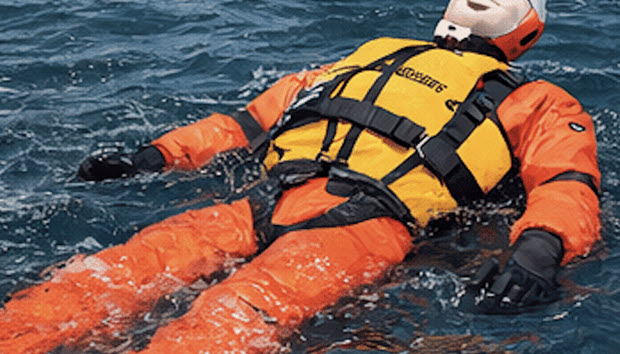
• On-the-water drills, where teams execute a full MOB recovery using a human-like object
This progression allows crews to move from discussion to action—testing boat handling, communication, and recovery techniques in realistic conditions. The exercises focus on the full sequence of an MOB event, including:
• Immediate response and crew coordination
• Maneuvering the vessel back to the victim
• Establishing contact using recovery equipment such as a LifeSling
• Safely hoisting a person back onboard
Importantly, the program emphasizes the final stage of recovery—often cited as the most difficult and least practiced element.
Beyond individual crew preparation, POYOB is also designed to generate insights across the broader sailing community.
Participants are encouraged to submit feedback after completing the exercises, documenting what worked, what didn’t, and how confidence levels changed through practice. Photos and video submissions further contribute to a growing library of real-world examples, showcasing how different boats and crews approach MOB recovery.
This collective feedback will help inform future Safety at Sea training while giving race organizers a clearer picture of fleet-wide preparedness. And as an added bonus, Landfall Navigation has agreed to throw in two $100 gift cards to those participants who share their experiences.
At its core, the POYOB initiative reflects a broader shift in offshore racing safety—moving from compliance-based requirements toward demonstrated, experience-based competency.
Every boat handles differently. Every crew communicates differently. Practicing aboard one’s own vessel allows teams to identify challenges, refine techniques, and build confidence in a way that standardized training alone cannot achieve.
As the 2026 race approaches, the program represents not just a requirement, but an opportunity: to strengthen safety culture, improve readiness, and ensure that when it matters most, crews are prepared to act.
Details: bermudarace.com/poyob
Source: Newport Bermuda Race

Related Posts
US Coast Guard is kicking butt →
Introduction to Keelboat Racing →
Paper vs eNav electronic charts →