


What no French team has done before
Published on July 7th, 2026
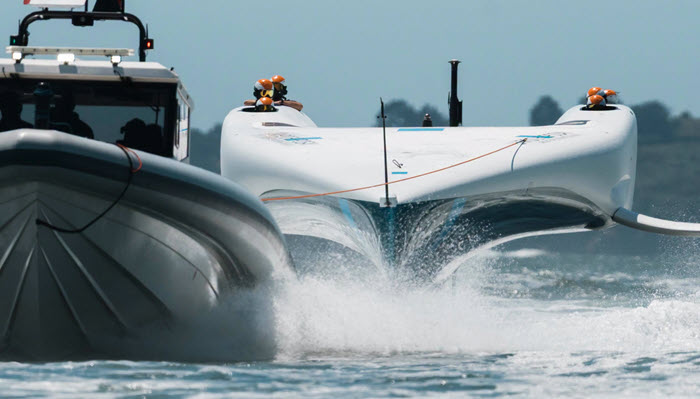
The first French challenge for the America’s Cup was in 1970, but despite this long history with the event, no single team has competed in two consecutive campaigns… until now. Known as Orient Express Racing Team in 2024, the rebranded La Roche-Posay Racing Team will be there in 2027.
However, the rules of the 38th America’s Cup require teams that competed in the previous edition to build on an existing hull. So, the challenge was not to build a new AC75, but to adapt the 2024 model within a radically revised technical framework.
The main hull remains, but much of what enables the foiler to sail, fly and be controlled has had to be redesigned. The deck plan, cockpits, weight distribution, control systems, electrical and hydraulic circuits, as well as crew ergonomics, have all been revised to comply with the new rules.
“Externally, the public will recognize the 2024 boat, but technically, this is not simply a refurbishment,” noted Antoine Carraz, Technical Director of the La Roche-Posay Racing Team. We’ve had to rethink its internal architecture and the way the crew interacts with the vessel. The challenge was to radically transform the boat whilst retaining its original platform.”

This philosophy changes the very nature of development. In the previous edition, a significant part of the performance hinged on the design of a new boat. For the 38th America’s Cup, the focus is more on systems integration, reliability, energy efficiency, flight control and, ultimately, the development of the appendages.
The most visible change is with the crew. In Barcelona, eight crew members were on board the AC75. In Naples, there will be just five, with a requirement to include at least one woman in the crew. The reduction is not simply a matter of cutting three posts. It requires a redistribution of roles, a rethink of the crew’s positioning, and making each function more accessible, quicker and more intuitive.
The bridge and cockpits have therefore been extensively redesigned. Each crew member must have instant access to the information needed for steering, sail trim, and flight control.
“Going from eight to five crew members changes everything: ergonomics, communications, the division of tasks and the control systems,” said Carraz. “With fewer people on board, every action must be simpler, more direct and perfectly coordinated. We have worked to ensure the boat remains extremely high-performance without becoming more complicated for the crew to operate.”
A sixth cockpit is also needed to accommodate a guest during training and races, although the guest will not be able to intervene in the boat’s handling. This innovation is unique in the sport, as a guest will be able to experience the thrills of the race, at the heart of the team, and in real time.
During the 37th America’s Cup, four sailors pedaled on board, these ‘cyclors’ generating the hydraulic power needed, in particular, to trim the sails. They will no longer be used in the next edition. Power will now be supplied mainly by batteries, requiring a complete overhaul of the electrical and hydraulic systems.
“The disappearance of the cyclors is a major development,” shared Carraz. “Previously, part of the performance depended directly on the sailors’ ability to generate power. Now, we have to manage a certain amount of on-board energy. We need to store it, distribute it and use it at the right moment, with the best possible efficiency.”
Just like in a racing electric vehicle, every expenditure of energy must be carefully managed. Engineers are therefore working on battery consumption, cooling, and the overall reliability of the system.
“We’re not just looking to have a lot of power available,” said Carraz. “Above all, we’re looking to avoid wasting it. A few seconds of operation, a maneuver or an adjustment repeated dozens of times can have a significant impact on a race’s energy balance.”
The AC75 receives thousands of data points in real time: speed, height above the water, forces on the appendages, sail positions, hydraulic pressure, and power consumption.
This data enables the sailors to understand what the boat is doing and to act with extreme precision. However, it cannot be used to create an autopilot. The rules say that decisions must remain in human hands. As a result, the technical team’s work focuses largely on the interfaces between the sailors and the boat: screens, buttons, steering wheels, controls, and maneuvering sequences.
‘The aim is not to replace the sailor with a computer,” Carraz explains. “It is to provide the sailor with the right information at the right time and to ensure that their command is carried out immediately. At these speeds, a control that is difficult to locate or information that is poorly presented can cost a great deal of ground.”
The boat must therefore manage a paradox: becoming technically more sophisticated whilst remaining simple to use at speeds of over 45 knots, all amidst noise, vibrations, and under intense sporting pressure.
As the hull is largely unchanged, the technical competition shifts to areas that are sometimes less visible to the public: the foils, the rudder, the sails, the control systems, and the aerodynamics of the deck and cockpits.
The foils, in particular, will play a central role. It is they that enable the AC75 to rise above the water. Their shape, rigidity, and ability to maintain the boat at a stable height directly influences its speed.
Designed in Vannes in 2023, and now prepared and operated from Lorient, the AC75 brings together expertise from the world of elite sailing, as well as from industry, digital technology, electronics, and research.
“The La Roche-Posay Racing Team’s AC75 is the result of a collective effort,” offered Carraz. “Behind the five sailors we’ll see on board, are engineers, technicians, builders, electronics specialists, hydraulics engineers and numerous partners.
La Roche-Posay Racing Team’s 2026 Program:
29 June to 17 July: Training in Lorient
1–14 August: Training in Lorient
Mid-August to end of September: Move to Naples
24–27 September: Naples Preliminary Regatta in the AC40 class
October: Start of sailing in Naples, host city of the 38th America’s Cup
Details: https://www.americascup.com/
Defender New Zealand and Challenger of Record from Great Britain confirmed the Protocol for the 38th America’s Cup on August 12, 2025. The close of the initial entry period was October 31, 2025, with late entries considered up to March 31, 2026.
Current entrants:
• Emirates Team New Zealand (NZL) – Defender
• Athena Racing (GBR) – Challenger of Record
• Luna Rossa (ITA) – Challenger
• Tudor Team Alinghi (SUI) – Challenger
• La Roche-Posay Racing Team (FRA) – Challenger
• American Racing Challenger Team USA (USA) – Challenger
• Team Australia (AUS) – Challenger
After the 2024 event, Barcelona, Spain declined hosting another edition, with the venue moved to Naples, Italy. Challenger racing begins in the spring before the 38th Match on July 10-18, 2027.
Preliminary Regattas:*
May 22-24, 2026 – Cagliari, Italy
September 24-27 – Naples, Italy
* The Protocol noted how there would be as many Preliminary Regattas as possible, with the intent to have three during 2026 and one possibly in early 2027, and a final event at the Match Venue immediately prior to the challenger series. Only two have been thus far revealed.
Source: La Roche-Posay Racing Team

Related Posts
America’s Cup: Bring on the lawyers →

Inside AC: How USA can catch up →
America’s Cup: What’s under the hood →