

Women moving in the right direction
Published on August 12th, 2026
As wings and foils creeped into sailing, there was a lot of learning to do, and men got most of that education. It didn’t have to be that way, as the Moth Class was ground zero for foiling, but women participants were rare, and that hasn’t changed much. As for other opportunities, men weren’t opening the door too far.
But mandates in SailGP and America’s Cup are now requiring women participants, but that doesn’t help much without overcoming a learning curve which has gotten pretty steep. There will be women on the boats, but what can they do when men have had such a head start?
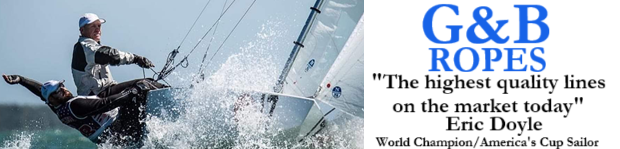
SailGP is trying to narrow the gap and hosted a Women’s Performance Session at the league’s English headquarters for 18 women that spent a day in the simulator sharpening skills and accelerating development.
Each SailGP team now has one woman racing, most in the strategist role introduced in the league’s second season. The 2025 season marked another significant step forward, with Martine Grael becoming the league’s first female driver for Brazil and Anna Weis joining the United States team as a full-time grinder.
But the female athletes have their sights set for higher still – training to become wing trimmers, flight controllers, and drivers, while reserve athletes build the skills required to step seamlessly into the strategist role.
The Canadian team coach Joe Glanfield and wing trimmer Paul Campbell-James were sharing how to trim the wingsail around the race track, while Kiwi strategist Liv Mackay worked closely with athletes in the strategist role, and New Zealand coaches Matt Stevens and Will McKenzie rounded out the coaching team.
The aim of simulator training is to build the playbook, muscle memory, and technical skill-set in a low-risk environment before stepping aboard an F50 worth millions of dollars, where a single mistake can end a race weekend.
Many of the men currently competing in SailGP benefited from weeks of structured, progressive training when the league first launched. In this era, as Grael experienced, opportunities often arrive in the form of being handed the wheel and thrown straight into racing… not ideal.
The session also gave athletes a window into just how powerful using data at SailGP has become. For those transitioning from Olympic or other small foiling classes, adapting to an environment where performance is measured through vast amounts of data is its own learning curve.
The group spent time with SailGP Data Analyst Jake Farren-Price, who introduced the software used to analyze live and post-race performance, daily reports, and the key metrics worth tracking and comparing across teams.
With performance data shared across the league, athletes have a unique opportunity to build a database of best practice by studying some of the world’s best sailors, whether analyzing different wing-trimming techniques or diving deeper into strategic decision-making.
Whilst there is still progress to be made before women are afforded the same opportunities as men with comparable experience, these women are moving in the right direction.
Participants:
• Julia Gross (Artemis)
• Felicia Fernstrom (Artemis)
• Liv Mackay (Black Foils)
• Kate Stewart (Black Foils)
• Tash Bryant (Bonds Flying Roos)
• Margaux Billy (DS Automobiles Team France)
• Anna Barth (Germany Deutsche Bank)
• Victoria Schultheis (Germany Deutsche Bank)
• Marina Arndt (Mubadala Brazil)
• Annie Haegar (Northstar)
• Ali Ten Hove (Northstar)
• Kahena Kunze (Rockwool Denmark)
• Pearl Lattanzi (Rockwool Denmark)
• Victoria Travascio (Los Gallos)
• Jana Germani (Red Bull Italy)
• Maelle Frascari (Red Bull Italy)
• Anna Weis (US SailGP Team)
• Louisa Nordstrom (US SailGP Team)
SailGP information – Sassnitz details – How to watch
Season 6 Results (after 8 of 13 events)
1. Australia, Tom Slingsby (AUS), 2-1-5-1-1-1-4-7, 66 points
2. Spain, Diego Botin (ESP), 12-3-3-2-2-12-1-1, 54
3. Sweden, Nathan Outteridge (AUS), 4-5-9-3-11-5-2-2, 47
4. United States, Taylor Canfield (USA), 5-7-1-4-7-6-6-6, 46
5. Great Britain, Dylan Fletcher (GBR), 1-2-2-12-4-2-11-11, 44
6. France, Quentin Delapierre (FRA), 3-4*-13-8-9-4-10-8, 36
7. Canada, Giles Scott (CAN/GBR), 6-10-11-10-6-3-8-3, 31
8. Germany, Erik Heil (GER), 9-6-8-6-3-11-7-10, 28
9. Switzerland, Sébastien Schneiter (SUI), 11-12-10-11-5-8-3-4, 25
10. Denmark, Nicolai Sehested (DEN), 8-9-6-5-7-12-9, 24
11. Italy, Phil Robertson (NZL), 7-13-4-7-8-9-9-12, 22
12. New Zealand, Peter Burling (NZL), 13-8-12-13-13-13-5-5, 14
13. Brazil, Martine Grael/Paul Goodison (BRA/GBR), 10-11-7-9-12-10-13-13, 8
* Received compensation points for Sydney due to boat damage in Event 2.
Season 6 – 2026 Schedule:
• Jan 17-18 – Perth, Australia
• Feb 14-15 – Auckland, New Zealand
• Feb 28-March 1 – Sydney, Australia
• Apr 11-12 – Rio de Janeiro, Brazil
• May 9-10 – Hamilton, Bermuda
• May 30-31 – New York, USA
• June 20-21 – Halifax, Canada
• July 25-26- Portsmouth, GBR
• August 22-23 – Sassnitz, Germany
• Sept 5-6 – Valencia, Spain
• Sept 19-20 – Geneva, Switzerland
• Nov 21-22 – Dubai, UAE
• Nov 28-29 – Abu Dhabi, UAE
Note: The 11th event was moved to Geneva from Saint-Tropez, France.
Season 6 format:
• Thirteen teams compete in identical F50 catamarans.
• Each event is two days.
• All teams compete in up to seven qualifying fleet races of approximately 15 minutes.
• The top three teams from qualifying advance to a final race for the event title.
• The season ends with the Grand Final event which includes the Championship Final Race for the top three teams in the season standing.
• All league teams are privately owned, with New Zealand as the last to be acquired on June 19, 2026.
Note: The league is experimenting with a split fleet format which advances the top two from each fleet for a 4-boat final.
Season 6 prize money:
A total of USD $12.8 million is up for grabs in 2026. The winner of each of the 13 events takes home $400,000, with $260,000 for second and $140,000 for third. The team with the most points at the end of the season wins $400,000, while the team that wins the Championship Final Race wins USD $2 million.
F50 Configuration:
All teams use same configuration based on weather forecast. There are four wingsail sizes (18m, 24m, 27.5m, and 29m), six jib sizes, two T-foil daggerboards (high-speed and low-speed), and one set of rudders with high-speed and low-speed settings.
Established in 2018, SailGP seeks to be an annual, global sports league featuring fan-centric inshore racing among national teams in some of the iconic harbors around the globe.
Source: SailGP

Related Posts
WATCH: AC Preliminary Regatta Naples →
The rule that disappears at the dock →
Has America’s Cup lost its way? →