

Autopilots, and who gets to decide
Published on September 14th, 2026
The 2025-2028 Racing Rules of Sailing state under RRS 52 that “A boat’s standing rigging, running rigging, spars and movable hull appendages shall be adjusted and operated only by the power provided by the crew.”
To date, it has been permissible for Organizing Authorities to modify this rule as it pleases, but that could be changing as World Sailing seeks to strengthen its control of the sport.
World Sailing’s Oceanic and Offshore Committee has approved a new Oceanic and Offshore Code that would bar Organizing Authorities from permitting autopilots for fully crewed boats — three or more crew — in any Category 4 through Category 0 race, and recommends separate scoring for boats sailing under different versions of Rule 52.
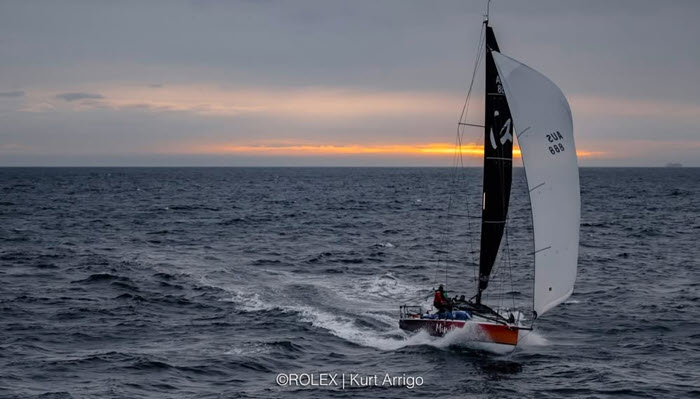
A tipping point may have been the 2025 Rolex Sydney Hobart Yacht Race when seven of the top ten in the overall standings were doublehanded teams using autopilots, racing boats from 32 to 35 feet.
Currently, the Fastnet, Transatlantic Race, Pacific Cup, both Mackinacs, Newport Bermuda, and Marion Bermuda all permit autopilots in some or all divisions. At least eleven organizations across four countries asked World Sailing to consult before the vote. It went ahead without them.
The proposals reach the 2026 World Sailing Annual Conference in November for review and decisions, with the papers to be published in October. Storm Trysail Club Commodore Andrew Weiss shares the position of his club:
I write as Commodore of the Storm Trysail Club (STC), a club founded on the proposition that offshore sailors are the best judges of what offshore sailing requires. On September 2, we asked World Sailing’s Oceanic and Offshore Committee to pause and consult before voting on a new offshore code. It did not.
Since then, we have been working with the New York Yacht Club (NYYC), the Royal Ocean Racing Club (RORC), and the Cruising Yacht Club of Australia (CYCA) on a joint response, though I am writing here only for STC. I believe most of the US sailors and organizers affected by this committee decision do not yet know it happened
Autopilots have been argued over in these pages for years, and reasonable sailors land in different places — which is what you would expect of a question whose answer depends on the boat, the fleet, the course, and who is aboard.
On September 4, the World Sailing committee voted to answer it once and for all — for every fully-crewed boat in every Category 0 through Category 4 race in the world or races run under the equivalent, such as the US Sailing Safety Equipment Requirements.
The vehicle is a new “Oceanic and Offshore Code,” approved as three linked proposals. The centerpiece, “Human Endeavor,” would prevent an Organizing Authority from modifying Rule 52 for boats with three or more crew, which in practice bars their use of autopilots. The only modification the Code would still allow is [one clause].
It also recommends that boats under the standard rule be scored separately from boats under any other version of it — dividing fleets that race together today.
A second proposal adds a propulsion restriction to Rule 42, [one clause]. The third has drawn the least attention and may matter most: it writes the Code into the committee’s terms of reference, giving it standing authority to amend rule-status material outside the process the Racing Rules Committee runs.
The ballot was electronic and the minutes are due September 18. By the Royal Ocean Racing Club’s account, which it asks be treated as provisional, nine of eighteen members took part: seven in favor, two abstaining.
Here is the difficulty with a one-size-fits-all answer. Organizing Authorities already answer the question, and they do not all answer it the same way.
• RORC permits automatic and wind-vane steering fleet-wide in the Rolex Fastnet Race.
• NYYC and RORC, with the Royal Yacht Squadron and the STC, permitted autopilots throughout the 2025 Transatlantic Race fleet, and said why: to let boats, particularly racer-cruisers, compete safely with fewer crew.
• The Pacific Cup permits self-steering for all entries.
• The Chicago and Bayview Mackinac races permit it in their Cruising divisions, each with a four-crew minimum.
• The Newport Bermuda Race permits autopilots in the Finisterre Division, minimum four, while applying Rule 52 in full to the St. David’s Lighthouse Division — one Organizing Authority, different answers for different fleets, arrived at deliberately.
• Marion Bermuda permits them in its Founders Division, minimum five.
• Trans Superior in its Cruising division, minimum three.
Not one of those is a doublehanded carve-out. They are considered decisions by experienced organizers, most made to keep crews on the water who would otherwise stay home. A single global standard would override all of it, and the case for doing so has not been made in public — no participation data, no safety analysis, and no consultation with the organizers who would have to implement it, let alone the sailors.
That is what turned a rules disagreement into something wider.
On August 27, the UK Doublehanded Offshore Series objected, with race-day data from the Fastnet and the Sydney Hobart. On August 28, RORC and CYCA jointly asked for “a formal and properly representative consultation,” on the plain reasoning that “Organizing Authorities are best placed to understand these local circumstances and the needs of their competitors.”
Over the following week, STC, NYYC, the Chicago Yacht Club, the Pacific Cup Yacht Club, the Noordzee Club, the Ocean Racing Club of Victoria, and others wrote asking the same. At least eleven organizations across four countries are on record. The vote proceeded without them.
The common position is narrow. Nobody argues autopilots must be permitted everywhere; nobody argues they should be banned. The ask is that Rule 52 remain a choice each Organizing Authority makes for its own races. Several of the same clubs accept the substance of the Rule 42 propulsion proposal and object only to its drafting and venue — which should dispose of any suggestion that this is reflexive opposition to regulation.
None of this had to happen this way.
World Sailing’s own 2025–2028 offshore strategy commits it to “empower organizing authorities” and to meet with major event organizers on “advances in technology.” The committee’s 2026 work plan lists as a task gathering “information from OA’s and Classes on the current approaches to regulating technology.”
That information was not gathered from the organizers now objecting. It exists, it is not in dispute, and, as the list above suggests, it would have been informative. And in July, World Sailing opened a two-way channel on the Offshore Special Regulations expressly to keep the offshore community “informed and involved.” That is the standard being asked for here.
The proposals now go to the 2026 World Sailing Annual Conference in Qingdao, November 16-21. A committee vote is a recommendation, not a decision: Council decides submissions, and Council members are elected by the member national authorities of each region.
The papers publish in October, and that is the real clock. Any Organizing Authority that shares the concern can say so to World Sailing and to its own national authority, and can ask what instruction that authority’s Council representatives will carry to Qingdao.
Whether autopilots belong in offshore racing is a reasonable question, and the fleets have been working through it for years — locally, pragmatically, race by race. The question now on the table is different: whether the people who run the races still get to answer it.
How you can help. If you lead a race committee or serve with an Organizing Authority — here or abroad — and agree that Rule 52 should remain the Organizing Authority’s call, write to [email protected] and we will be in touch about where your voice would do the most good.
Sources for the factual claims above:
• Race documents: Rolex Fastnet Race 2025 NOR 2.12; Transatlantic Race 2025 NOR [section]; Pacific Cup 2026 NOR Appendix II §9; Chicago Race to Mackinac 2026 NOR §5.5.1 (crew minimum at §4.2.3); Bayview Mackinac 2026 NOR §4.4.c.i; Newport Bermuda 2026 NOR 4.3 and 4.1; Marion Bermuda 2027 NOR 3.3.1; Trans Superior 2025 NOR [section].
• Navigating Offshore — World Sailing’s Plan to Support Offshore Sailing 2025–2028, announced November 28, 2025; Oceanic and Offshore Committee Work Plan 2026, both at sailing.org. The July 30, 2026 statement on the OSR consultation channel is reported in Sail-World, “New initiative supports OSR development.”
• The September 4 attendance and vote figures reflect RORC’s understanding, which it has asked be treated as unconfirmed: the meeting was difficult to follow, it was not always clear who was a voting member, and the electronic results were not visible to observers. Official minutes are due by September 18, 2026. If this runs after that date, please check the figures against the minutes; we will send corrected numbers the day they appear.
• The full text of every letter referenced, and the three proposals, are available as a background briefing on request.

Related Posts
When anchoring during a race →

How would you decide this? →
How would you decide this? →