


Questioning the redress remedy
Published on October 3rd, 2026
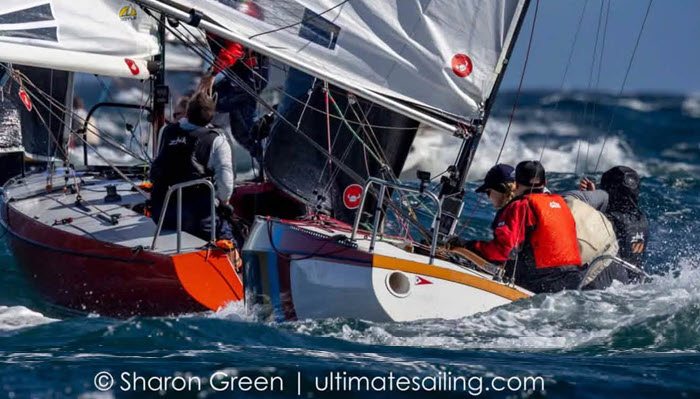
The 50th Anniversary Moore 24 National Championship was by all accounts a major victory for the one design class. Held in 2026 at its spiritual home of Santa Cruz Yacht Club, 74 of the roughly 150 boats were there, sporting the kind of colorful hulls and spinnakers that thrived in the 70s and 80s.
But for online fans, the 8-race series had a big “what the hell happened” question when the entire fleet received redress in a race. John Sweeney, who crewed for Will Benedict in the championship, shares what happened… and what should have happened:
How the Moore 24 Nationals Jury failed with the modern use of AI at its finger tips… the long-distance race 5 debacle explained.
This is how Claude could have helped. A race we finished in top 15 but got awarded a 34.6 on a bizarre redress instead. If we are going to use robot marks and Vakaros, the juries should fact-check findings in AI at minimum to make sure they are correct.

What happened
Race 5 was sailed on Course 5 (S–W–WO–CS–F), which the Sailing Instructions describe as finishing “inshore near harbor.” The race committee instead set the finish in the starting area, about 3 miles offshore, and told the fleet by VHF.
The SIs only allow changes posted before 0900 on the day they take effect (SI 2.1) and describe VHF course announcements as a non-binding courtesy (SI 9.6). No flag C was displayed. Mooregasm (USA 36) requested redress, arguing the RC had changed the SIs improperly and that many boats were seriously disadvantaged.
The Jury found that the RC committed an improper action by moving the finish more than 2 miles from the area described in the SIs, and that this made multiple boats’ scores significantly worse through no fault of their own. As redress, it replaced every boat’s Race 5 score with the average of its scores in Races 1–4 and 6.
Where the Jury was right
The finding of improper action is sound. The SIs gave a finish location, the RC set the line somewhere materially different, and nothing in the SIs allowed that change to be made on the water by radio. A Jury could reasonably conclude the RC got this wrong.
Where the decision falls short
Redress requires more than an RC error. The error must have made a boat’s score significantly worse, through no fault of its own. The facts found don’t establish that. They don’t say any boat sailed toward the harbor finish, missed the VHF hails, lost places, or was treated differently from the rest of the fleet.
On the recorded facts, every boat heard the same calls and crossed the same line. The conclusion that boats were harmed may be true, but the decision doesn’t show why, so the conclusion isn’t supported by the facts.
The remedy is also questionable. Redress should be as fair as possible to all boats affected. When an RC error affects the whole fleet equally, the usual fair outcome is to let the results stand, because the finishing order still reflects how boats sailed against each other.
Averaging every boat’s score removes the race in substance, while double-weighting the other races and wiping out genuine results, including boats that sailed their best race of the series. If the Jury believed the race was compromised for the fleet as a whole, abandoning it would have been the cleaner and more transparent option.
Finally, the decision cites “RRS 64.19(c),” which doesn’t match any rule I can identify. It’s probably a typo for the redress provision in rule 64, but it adds to the sense that the decision was written in a hurry late on a regatta night.
What should have happened
The Jury should have asked one key question: did the misplaced finish change the result between boats? If the evidence showed specific boats were misled, for example by sailing toward the harbor or missing the radio calls, redress should have been targeted at those boats, typically with average points or an adjusted finishing position.
If no boat was disadvantaged relative to the others, the request should have been denied and the results left to stand. Only if the race was unfair to the fleet as a whole should it have been abandoned. Fleet-wide averaging is the least supportable of these options.
Bottom line
The RC made a real error, and the Jury was right to say so. But the decision skips the step that connects the error to actual harm, and it chose a remedy that discarded a race the fleet completed fairly against each other. Letting the results stand, or limiting redress to boats shown to have been disadvantaged, would have been the more defensible outcome.

Related Posts
When anchoring during a race →

How would you decide this? →
How would you decide this? →