

Robot marks that set themselves
Published on October 6th, 2026
There are few examples where improvements to the sport have not also increased cost, and robotic marks has become the latest investment to consider. In this report by Carlos Insa, he looks at the growing use of autonomous GPS-guided marks in sailing:
For most of sailboat racing’s history, laying a course required sending a powerboat out with marks and anchors, a chart, a hand bearing compass, a GPS if available, and an educated guess about where the wind would settle. Increasingly, that work is being handed to the buoys themselves.
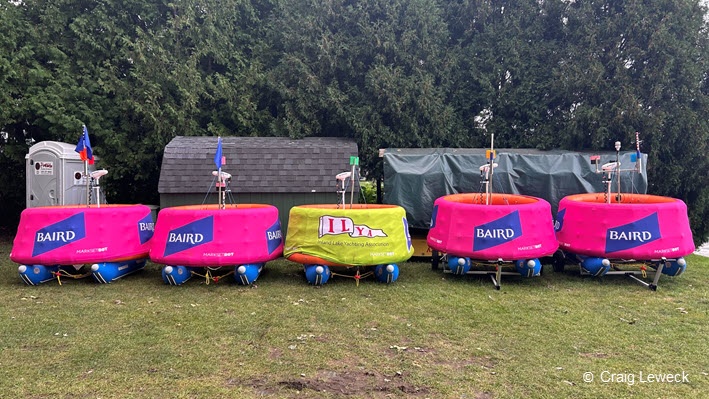
At a growing number of regattas, race committees are replacing anchored marks with autonomous, GPS-guided buoys that travel to their assigned positions and hold those positions without touching the seabed. SailGP has been among the most visible adopters. Developed by SailGP Technologies in partnership with ePropulsion and MarkSetBot, the circuit’s electric marks navigate and hold position using GPS, eliminating the need to anchor each buoy to the bottom.
The 52 SUPER SERIES followed a similar path in 2022, adopting marks from the German company Smartmark after testing them at the Rolex TP52 World Championship in Mallorca. The buoys can be positioned remotely within roughly 11 centimeters of a target GPS point. They use the same type of three-dimensional positioning technology found in drones, and the entire process is controlled from the race committee boat.

At the Paris 2024 Olympics, Switzerland-based Effetto Venturi supplied its compact Gipsy Buoy, which measures roughly 1.4 by 1.25 meters and can hold position in winds of up to 30 knots and currents of up to 3.5 knots. Race officials set the courses through a web application called RaceDesigner and adjusted the marks in real time as conditions on the Mediterranean changed throughout the competition.
The appeal to organizers is straightforward. Setting and resetting anchored marks consumes time and fuel along with human and support boat assets, while repeatedly dragging chain across the bottom can damage the seabed. A GPS-guided mark can be moved to a new position within minutes from the committee boat. Several suppliers now offer systems that can reposition an entire windward-leeward course without requiring a mark boat to leave the dock.
The technology still has skeptics, particularly among race officers who have used it at club and regional regattas rather than on well-funded professional circuits. In discussions among certified race officials, some report that autonomous marks perform well in deep water but struggle in shallow conditions.
Others note that committees often still need support boats on standby for rapid course changes because the marks can be slow to reposition. Battery life is another recurring concern. Marks that travel long distances under their own power can run low on charge and begin to drift, so many committees tow them to the course instead.
Those limitations have not slowed adoption, as beyond the highest levels of the sport, suppliers such as MarkSetBot, RoboMark, SMark, and Roboboj have found steady business at regional and national regattas. Even the radio-controlled sailing community has begun experimenting with smaller autonomous marks. The trend suggests that this technology is moving from novelty to standard equipment faster than some of the sport’s more cautious corners are ready to admit.

Related Posts
Perhaps future isn’t here quite yet →

My sport has been ruined →

Has technology reduced sailing’s spirit? →