

Planning for the adventure of a lifetime
Published on October 12th, 2026
The third edition of the Globe40 gets underway in just under two years, and among the doublehanded teams will be American skipper Brian McVickers and his co-skipper Graeme Esarey for the round-the-world race in Class40s. In this interview with McVickers, he explains his interest in this five-leg course.
Let’s begin with your sailing background.
I started sailing when I was 12-years old in Chicago, on Lake Michigan. I attended a summer program sailing on smaller boats such as Sunfish and Optimist dinghies. I quickly began racing, and learned that I like making sailboats go fast!
Everything focused on regattas and competitions across the country. I raced Lasers, 420s, FJs, J/22s, J/24s, and Thistles through grade school into high school where I founded the school’s racing team. Then I raced for Old Dominion University on the varsity sailing team in Virginia, dinghies and keel boats against other schools along the east coast of the United States.
In Chicago, I worked for three yacht clubs as a racing coach and sailing instructor managing some of the programs. My family had a Tartan 10 – a one-design 33-foot sloop with a fractional rig – that we raced very competitively. I started on the foredeck and moved back to skipper.
We raced all of the local regattas as well as Lake Michigan multi-day port-to-port races including eleven Chicago to Mackinac races. I would also sail on other larger boats, including Farr 40s and anywhere I could get a position racing.
In 2000, when my wife Amy and I married, we sold everything we had and moved onto a sailboat in Florida with the intent of traveling. We had an Allied Princess staysail ketch, which was more of a blue-water boat. We lived on our boat, Wildflower, for four years. Two years while we lived and worked in Florida, and then another two years sailing the Caribbean.
Eventually we went back to the mainland to be closer to family and begin raising our own in Arizona. We have two incredible kids, our daughter Charlie and our son Max who are now 21 and 19, eagerly accomplishing their own goals.
Since Arizona is landlocked, our sailing took a bit of a turn towards very intentional expedition sailing. I’ve been fortunate to carve out a month or two each year to go on big sailing trips. It became more about expedition and adventure sailing, exploring remote areas, and crossing oceans.
Highlights include an initial attempt at the Northwest Passage in 2021 which turned into a crossing the Pacific Ocean up into the Bering Sea and then all the way out to Attu Island, which is at the end of the Aleutian Island chain. Canada had closed access to its waters at the time, but we did get to ski the mountains on Attu!
In 2024, after the Canadian waters had opened, I was on a team of seven who successfully transited Northwest Passage, west to east, up over the top of Canada through the sea ice and down the coast of Baffin Island and iceberg alley. At one point we had over 75 large icebergs in view.
That was a unique trip because it was on an Open 60, Dog Bark, originally built for the BOC Challenge. My Globe40 co-skipper Graeme Esarey had refitted the boat for high-latitude sailing. It is unconfirmed but our team may hold the fastest sailboat transit of the Northwest Passage!
This past August, we took that same boat and sailed from Nova Scotia to Greenland and then over to Iceland, a route that I’ve also done the other direction from Iceland to Greenland on a Valiant 42 named Alchemy. If you’ve ever had the chance to sail southern Greenland, it’s quite spectacular because of the icebergs, sea ice, the fjords, wildlife, local culture, and the impressive remoteness. Navigating that area is quite exhilarating.
Do you think this experience will help you in the Globe40?
I certainly hope so. I would say yes. I think a lot of these experiences are what inspired me to do a Globe40 campaign.
There are quite a variety of adverse conditions throughout the areas I’ve sailed. From the Great Lakes, mini-oceans, to the higher latitudes of the Arctic with sea-ice and icebergs, and the mid latitudes of the Caribbean with its excitable weather. Each offer different conditions challenging for different reasons.
You have different weather patterns and different types of water behavior in all locations. The Bering Sea, for instance, is very tumultuous, with long opposing currents up to 17 knots, it’s like a sea of rivers. Over time this has all been good preparation.
Why did you decide to take part in the next Globe40?
You’re circumnavigating the globe, which in itself is an achievement. The way the Globe40 breaks it into different segments allows you to enjoy and experience the circumnavigation in a different way.
A circumnavigation without racing can be very slow. Circumnavigation with racing can be very competitive, challenging, and exciting. But at the same time, part of the idea of circumnavigating the globe is to experience more than just the water.
The beauty of the Globe40 using Class40 is the idea of point-to-point racing around the world without sacrificing the quality of competition or performance. You race, and then at each destination, you experience a different culture from that area of the world.
You were at finish for the previous race. What did you learn?
I wanted to see the boats in person, see the other racers and experience the culture. I wanted to meet the race organizers to get an idea of the event, the drive, and the inspiration that contributes to the race itself.
I wanted to speak with the skippers and learn about their experiences. I wanted to hear their stories firsthand and better understand what their challenges were during the race and get some advice from them. You learn so much more by going there, shaking someone’s hand and having a conversation. It was a very valuable experience.
Is there one leg you are especially looking forward to?
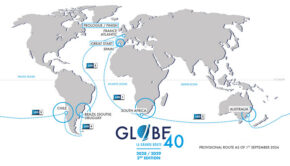
I’m really excited about the long legs down the Atlantic and across the Indian Ocean. I’m intrigued by these legs being nearly 6,000 nautical miles. It’s a very long distance to cover in comparison to the other stages of the race in which speed, durability, and endurance all come together.
It’s also very far from the United States. The opportunities to go and sail the eastern Atlantic Ocean or the Indian Ocean and other areas like that are not very easy to do just for a general race or recreational sail. You have to make a lot of effort to get there.
So, I think the long legs are going to be very interesting. The shorter legs, where you get a little bit more cultural interaction within a smaller period of time, will also be amazing and add a lot of appeal to the Globe40.
And, of course, we can not forget the rounding of the capes. The Globe40 includes many milestones for an ocean sailor. The opportunities to round the capes will be legendary!
What did you learn or take away from following the previous race?
In the last race you really started to see the differences between the scow boats and the sharps boats. You saw that difference within the Class40 fleet in general.
For the Globe40 specifically, I thought it was interesting from a race-management perspective to understand and try to figure out how to embrace both designs into a single event while keeping things competitive and enjoyable for the entire fleet.
I also thought it was great to see how all the skippers managed their boats very well throughout the event. There was one boat that lost a spreader and had to sit out an entire leg and then catch up with the fleet again. I really appreciated that some of the other boats’ lended their shore teams to help, and that the race management allowed them to continue participating in the Globe40 event overall.
Because of the amount of effort and work it takes for an individual boat to get to the starting line, the fact that all the boats are embraced as part of the fleet is a very special thing about the race organization.
How did you and Graeme decide to race together?
Initially it was a call or text. A couple of months later, we reinforced the idea somewhere in the Arctic on his boat, Dog Bark, standing watch together. I think I said, “Hey, seriously, how’d you like to go do this Globe40 race?” And he said, “Yeah, let’s go do it.” Then we pulled up the Starlink and started shopping for boats and studying the race course!
He’s a very skilled skipper. He’s also very adventurous and competitive, very good on the race course, and he has a lot of experience racing – offshore racing and really everything. He’s another person who grew up racing and grew up on the water, with lots of great experience, and he’s always up for a challenge.
You still need the boat. What’s your plan?
We’ve been looking at a few, and we definitely want to go with a scow. I’d like to get a boat that’s already qualified for the Globe40, with the extra bulkheads and things like that. I’d like it to be as turnkey as possible, within reason.
What I don’t want to do is get a boat where I have to do so much work to get it ready that every project becomes another challenge that could move us away from the goal. If you’ve got a boat that needs a lot of work, all those different things you’re working on can create problems. If something doesn’t go right, it could be over.
So we want a good boat that’s proven and well outfitted. Most of the skippers I spoke to completely refit their boats every two years. I think the reality is that, going into something like the Globe40, you want to have as new and proven equipment as possible. Not only is it a race, it is a test of durability and endurance for the boat and team.
Graeme and I are competitive by nature. When we look at racing, if we’re going to race, we’re going to get into it. So we immediately went to the idea of the scow bow because it seems to be the best way to do it based on the trajectory of the Class40 fleet.
We’re already shopping and trying to figure things out. Although each Class40 boat is part of the box class, each boat is surprisingly different from the next one, whether it’s the cockpit layout, the interior or the way the running rigging is put together. It’s a fun, and important challenge to find the right boat.
Do you intend to share your Globe40 experience during the race?
Both Graeme and I have extensive backgrounds in the outdoor, overland, adventure, travel, marine, and sailing markets. My background in media, journalism, video production, photography, and podcast will certainly contribute to sharing the Globe40 experience.
There is a unique story to tell in the modern sailing circumnavigation of the globe. We plan to document the entire experience running up to, and during the race. Today, and even more so in the years to come, connectivity from the middle of the world’s oceans will allow for a front row seat.
We also want to take this Globe40 opportunity to showcase opportunities within the sailing and marine industries. We want to interview the people we meet along the way and document their professions in an effort to help others find opportunities.
Race details – Notice of Race – Past news
Source: SIRIUS EVENTS

Related Posts
GLOBE40 to return for third edition →
What’s it like to race round the world? →
Tim Kent enters Global Solo Challenge →