

America’s Cup: What will fifth sailor do?
Published on October 13th, 2026
Despite the next America’s Cup being raced in “used” boats, how they will be used will be brand new. A reduced crew on the AC75 will have a helm and trimmer on each side of the boat, which is half the crew from the 2024 edition. The duel roles are necessary with the massive sail plan, but there will also be a fifth crew position and at least one woman on the sailing team. This report takes a close look at these two variables:
Over the coming weeks, a number of AC75 yachts will be fully operational in the new deck configuration that features six pods in total for five sailors (and one guest passenger). Several of the teams will be sailing and training out of Naples from their new Italian bases in Bagnoli and with so many vantage points, these incredible yachts will provide the ultimate storyline on the Road to Naples 2027.
Having five sailors in race mode onboard the AC75s at the Louis Vuitton 38th America’s Cup is precisely one more active sailor than was required to sail the boats in the last Cup in Barcelona in 2024. But what exactly does that fifth sailor do? And where will they sit? The answer could reveal one of the most intriguing development battles of the 2027 America’s Cup.
For Naples 2027 everything changes. The cyclors are gone. Stored and managed electrical energy now powers the hydraulic systems, and a Programmable Logic Controller (PLC) manages sail, mast, and board controls. But instead of reducing the sailing team simply to the four obvious positions of two helms and two trimmers, the new AC75 Class Rule specifies five crew members, at least one of whom must be female.
So, what does sailor number five, or ‘P5’ as they are calling the position, actually do? That is where things become fascinating because there is no requirement for every team to reach the same answer.
The fact that nearly all the teams call the fifth person role ‘P5’ is already telling us quite a lot because if the role were simply another trimmer or navigator, it could have been defined accordingly. Instead, teams are effectively being given another highly skilled sailor and asked to determine how best to use that person’s processing capacity and sailing talent.
Tudor Team Alinghi’s David Endean openly admitted that the Swiss have yet to finalize precisely how the role will work. “With all the automation happening now, it allows that workload to be divided up in different ways,” he said at the team announcement in Barcelona, adding that the Swiss see plenty of opportunity in how the P5 position develops. That is perhaps the key as the fifth sailor potentially changes the architecture of how the entire AC75 is sailed.
THE STRATEGIST
The most obvious answer is strategy. An AC75 is an extraordinarily difficult boat from which to see a yacht race as the deck-sweeping mainsail is enormous. The crew are buried inside aerodynamic cockpits. Sailors on opposite sides of the yacht are physically separated, and their fields of vision are restricted to 180 degrees. In ,it is more like 90 degrees as arcing your head all the way around to the full 180 degrees is not a practical option.
The official America’s Cup description of the new crew structure specifically raises the possibility of a strategist working with the two helms and taking the broader view of the racecourse and that could be hugely valuable. The helms are trying to sail an AC75 at upwards of 50 knots while simultaneously managing pitch, cant, roll, and other control functions, judging the boundary, executing starts and racing the other boat.
Meanwhile, somebody still needs to answer the oldest questions in yacht racing like: Where is the pressure? What is happening on the other side of the course? What is the current doing? Which gate is favored? What is the opponent setting up for? Where is the next shift?
A dedicated strategist could remove a significant amount of that processing load from the helms and with fleet racing now included on the opening weekend of the Louis Vuitton Cup, situational awareness becomes even more important. Six AC75s approaching a boundary or gate simultaneously is an entirely different tactical problem from conventional two-boat match racing. For the first time in the AC75 era, having somebody whose primary responsibility is simply to look outside the boat could become an enormous asset.
BUT WHY WASTE A PAIR OF HANDS?
There is another school of thought. Why use one of only five sailors purely as a tactician when that sailor can also operate the boat? This is where the fifth position becomes much more interesting.
The strategist could simultaneously own a package of control functions and modern AC75 sailors already operate multiple controls. The steering wheels contain arrays of buttons and switches, while trimmers and flight controllers manage far more than conventional sheets. With battery power replacing the cyclors, the physical generation of hydraulic pressure is no longer occupying four human beings.
That doesn’t mean the yacht has become simpler. Quite the opposite. It means the human resource previously consumed generating power can now be redirected towards controlling performance. P5 could therefore be strategist and systems operator simultaneously.
DATA AT 50 KNOTS
There is another intriguing clue from Switzerland. Tudor Team Alinghi sailor Nathalie Brugger has said that discussion amongst the teams suggests the fifth-sailor role may require significant data-processing skill and that makes considerable sense, especially as an AC75 produces a torrent of information from its battery of sensors around the yacht.
The problem is not obtaining information. The problem is deciding which information matters right now, so a fifth sailor capable of interpreting that data and turning it into a useful call could become extremely powerful. The skill lies in converting data into a decision quickly enough that it still matters. At 50 knots, information has a very short shelf life.
THE HUMAN PROCESSOR
This is perhaps the best way to think about P5. The fifth sailor could become a human processor sitting between the yacht’s data systems and the sailors actually driving it.
The AC75’s electronics know an extraordinary amount about what the boat is doing. The sailors know what they are trying to achieve. Somebody needs to connect those two things. If the boat is half a knot below target, why? And, most importantly, should anything be changed? The fastest teams may be those that can answer those questions without distracting the helmsman or trimmer from their primary tasks.
AN EXTRA FLIGHT CONTROLLER?
There is another possibility. P5 could assume part of the flight-control workload. The official description of AC75 crew roles already combines Flight Controller / Trimmer, reflecting how closely the aerodynamic and hydrodynamic sides of the yacht interact.
But there is no reason every team has to divide those responsibilities identically. One team might give its trimmers extensive foil-control functions. Another could move some of those functions to P5 and that could free the trimmer to concentrate more intensely on the double-skinned mainsail. Or P5 could manage particular control functions during manoeuvres when workload peaks.
MANEUVERS MAY DECIDE THE ROLE
The biggest clue to the optimum configuration may come during tacks and gybes. Straight-line sailing is comparatively easy to divide between sailors. Maneuvers are different. In a matter of seconds, the yacht has to change foil, alter aerodynamic loading, turn through the wind, transfer steering responsibility from one side of the boat to the other and maintain flight so several things happen almost simultaneously and that produces enormous workload.
P5 could therefore have a relatively quiet job for much of a leg before becoming crucial during maneuvers. Certain control functions could effectively be handed to the fifth sailor through the tack or gybe, allowing the helms and trimmers to concentrate on their most important inputs and outputs. The optimum answer will almost certainly emerge through thousands of hours in simulators before being refined on the water.
AN “EXTRA PAIR OF EYES”
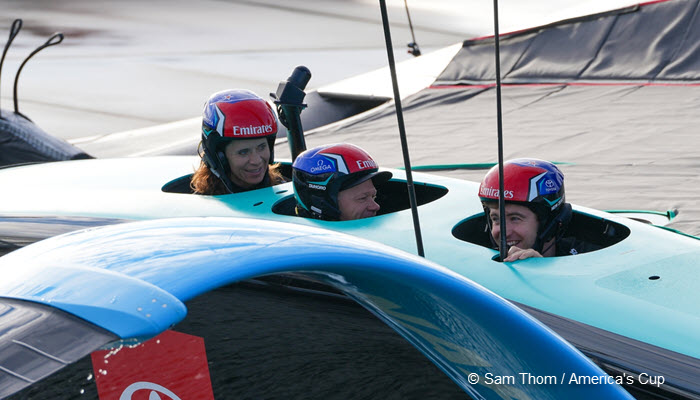
Emirates Team New Zealand’s Jo Aleh has offered perhaps the simplest description of the opportunity when she casually described her role as an “extra set of hands and eyes.” That may ultimately prove more important than creating a rigid fifth job title.
Aleh says the Defender is still working through exactly how responsibilities should be divided and that flexibility could be deliberate and could mean that P5 has many roles to perform at key moments on the AC75.
LUNA ROSSA – AN EARLY CLUE?
Naples may already have given us a clue about one possible solution. Maria Giubilei’s performance aboard Luna Rossa during the Preliminary Regatta inevitably attracted attention, and America’s Cup analysis following the event suggested she could be a natural candidate for the Italian AC75 fifth-sailor position – potentially combining trim, data analysis, and systems controls. That combination is revealing. Not tactician. Not trimmer. Not flight controller. But elements of all three.
If that proves to be the direction teams take, P5 may demand a rather unusual sailor. Someone with elite racing instincts, an understanding of high-speed foiling, strong technical knowledge, exceptional communication skills and the ability to absorb data without becoming buried in it. That is quite a job description!
AND AT LEAST ONE WILL BE A WOMAN
There is another important element. For the first time in America’s Cup history, each AC75 will race with at least one female sailor among its five-person crew. It should not automatically be assumed that the female sailor will occupy P5, and the Class Rule doesn’t say that.
Women could helm, trim, control flight or occupy whatever position their team determines produces the fastest combination. Indeed, as the teams develop their crews, the really interesting question will be whether the concept of a designated P5 survives at all. One team might put its female sailor on the wheel. Another might use her as a trimmer. Another could develop a dedicated strategy/data role. Crew architecture itself is now part of the new development race.
Already we are seeing differences in set-up with Jo Aleh operating the P5 position from the starboard side, whilst Maria Giubilei for Luna Rossa and Maëlenn Lemaitre for La Roche-Posay Racing Team control from the port side.
The coveted P5 position is certain to be one of the stories of the Louis Vuitton 38th America’s Cup, and once we have onboard audio coming back from the boats as they race, we will know a whole lot more. Stay tuned.
Defender New Zealand and Challenger of Record from Great Britain confirmed the Protocol for the 38th America’s Cup on August 12, 2025. The close of the initial entry period was October 31, 2025, with late entries considered up to March 31, 2026.
The AC75 has a helm and trimmer on each side of the boat along with a fifth crew position and a sixth passenger position.
38th America’s Cup: https://www.americascup.com/
38th America’s Cup entrants:
• Emirates Team New Zealand (NZL) – Defender
• Athena Racing (GBR) – Challenger of Record
• Luna Rossa (ITA) – Challenger
• Tudor Team Alinghi (SUI) – Challenger
• La Roche-Posay Racing Team (FRA) – Challenger
• American Racing Challenger Team USA (USA) – Challenger
• Team Australia (AUS) – Challenger
After the 2024 event, Barcelona, Spain declined hosting another edition, with the venue moved to Naples, Italy. Challenger racing is May 22 to July 4 before the 38th Match on July 10-19. Full details.
Preliminary Regattas:*
May 22-24, 2026 – Cagliari, Italy
September 24-27 – Naples, Italy
* The Protocol noted how there would be as many Preliminary Regattas as possible, with the intent to have three during 2026 and one possibly in early 2027, and a final event at the Match Venue immediately prior to the challenger series. Only two have been thus far revealed.
Source: AC media

Related Posts
America’s Cup: Bring on the lawyers →
Inside AC: How USA can catch up →
America’s Cup: What’s under the hood →