Supreme maritime rescue recognized
Published on November 8th, 2026
The International Ocean Safety Award is annually presented for a supreme maritime rescue, a significant advancement in rescue technology, or an individual/organization’s dedication to promoting safety at sea.
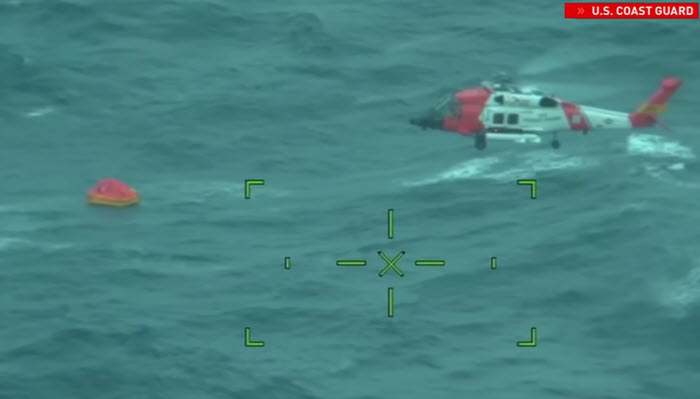
The 2026 recipient was the U.S. Coast Guard East District, which oversees the mid-Atlantic region, for the successful rescue of five crew members from the 54-foot catamaran Magic Bus, 260 nautical miles off Cape Hatteras, N.C., in a force 8-9 gale on November 6, 2025.
The rescue occurred during an 1,100-mile migration voyage from Long Island Sound, Connecticut, to sunnier climes in the Bahamas which many yachts undertake at the start of the winter.
Magic Bus had an experienced delivery crew on board, and the forecast predicted 20-knot fair winds for much of the voyage. It should have been a fast, stable passage for this 20-year-old South African-built multihull.
But one day out, the crew discovered the port engine compartment had flooded, and used buckets, hand pumps, and electric pumps to stem the flow. They even utilized the starboard engine intake, running a temporary hose between the two compartments to increase the combined pumping capacity to 5,000 gallons per hour. It was all to no avail.
Then, in the middle of the night, all hell broke loose. The working jib sheet parted with a bang. Moments later, the lazy sheet, whipping around uncontrollably, caught the corner of the saloon hatch and ripped it clean off the deck. Water was now pouring in from above and below the waterline.
Sitting at home, Magic Bus owner Brandon Flack had already been alerted to the hull leak via a sat phone link with the boat and was busy trying to troubleshoot the problem. At 03:30, skipper Buster Pike called again to say that they were abandoning ship.
Disturbingly, the crew had been unable to raise the US Coast Guard. The catamaran did not have an SSB radio, so they tried to initiate a PAN-PAN call via VHF radio an hour before abandoning the boat. It didn’t have the range to reach other vessels in the region, let alone the shore.
They then tried calling the Coast Guard using their mobile phones through the boat’s Starlink router. They searched the Coast Guard website for a number, only to find themselves on an automated voice response system with endless prompts for different departments. The one they chose led to an ‘Out of Office message. Ironically, they couldn’t even send an email because the website was unmanned – the result of a government close-down!
Pike had to ask his owner to alert the Coast Guard moments before they abandoned ship – which Flack did by dialing the US general emergency 911 phone number.
The crew jumped into their 12-man liferaft, assuming the EPIRB they carried with them from Magic Bus, along with the personal location beacons (PLBs) attached to each man’s lifejacket, would lead rescuers directly to their position. They didn’t.
Their 8-year-old floating EPIRB had never had its lithium-ion battery serviced, and the PLBs on the lifejackets only operate when the jacket is inflated. The crew chose not to because they thought inflation would impede their movement in the life raft. No one knew that inflation was the only way to turn them on.
Mercifully, Flack gave the Coast Guard the last known position of Magic Bus. Three hours after abandoning ship, a Coast Guard HC-130 Hercules aircraft circled above and dropped a survival kit to the crew, including a handheld VHF. The crew now had direct communication for the first time.
As their distance was beyond helicopter range, the US aircraft carrier George H. W. Bush was diverted to serve as a refueling point for the outward and return flights of an MH-60 air/sea rescue helicopter. All told, the successful rescue took 9 hours, from abandoning ship to touchdown at the Coast Guard Air Station in Elizabeth City, North Carolina.
A week later, another delivery crew heading south came across Magic Bus upturned. Photos showed that the port rudder skeg had broken away from the hull. Whatever the cause, this successful rescue shows that catastrophes often start small before developing into an emergency. Survival was down to experience, good seamanship… and a great rescue service!
The Award was presented to Lt Commander Andrea Rice, the U.S. Coast Guard UK Detachment Supervisor who underlined some of the lessons learned from this emergency rescue:
• Share your intended voyage and timings with contacts ashore – including the Coast Guard, and keep shore contacts alerted to progress and problems.
• Ensure all safety equipment is in service and crew know how to operate it – including life jackets and personal location beacons. Ensuring all the crew have an understanding of how equipment works and what the implications are of using it, both for the crew and the SAR assets, is vital to a safe rescue.
• Have an emergency call action plan posted in the nav station with direct contact details for the Coast Guard and shore contacts.
• When voyaging further than VHF range (20-30 miles) offshore, carry a working Single Side Band (SSB) radio and/or sat phone telecommunications onboard.
• Have a contingency plan with ports of refuge listed in the event of an adverse change in weather conditions or an emergency.
• If an emergency arises, issue a PAN-PAN call to alert the Coast Guard as soon as possible so they can monitor the situation and plan for a possible rescue.
For a first-person account of Magic Bus rescue by crewman Dylan Flack, click here.
Source: Barry Pickthall

Related Posts
Maybe this voyage was a bad idea →
Being a Coastie just got cooler →
US Coast Guard is kicking butt →