

Ted Turner: From famous to superstar
Published on May 6th, 2026
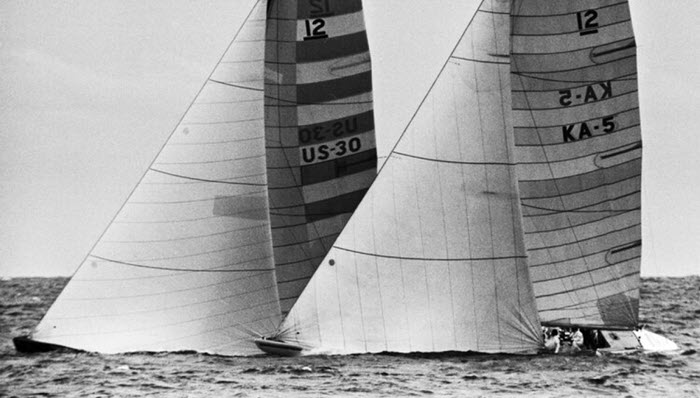
With the passing of Ted Turner, his dominant 4-0 victory over Australia in the 1977 America’s Cup is brought back to life with extracts taken from the event archives:
The Defense trials were somewhat closer. However, the lingering doubts about Ted Turner within the hierarchy of the New York Yacht Club persisted. Many years later, Gary Jobson opined that:
“I think the New York Yacht Club realized that Turner had the talent and the crew was good, and Courageous might be the right boat, but what about this mercurial southerner? Should he really be representing the New York Yacht Club in the America’s Cup? I think those of us in the boat bet they were looking for any excuse to get us eliminated and the only way to keep going was to keep winning.”
And win they did, starting the defense trials with five straight wins before finally losing a race to Ted Hood’s Independence. For Lowell North’s Enterprise, it was a difficult start, losing two straight races to Courageous and then sharing a two-race day with Independence.
North was tinkering still with Enterprise, and after another shared day with Independence before fog ruled out sailing for two days, he was fired, with Halsey Herreshoff coming onboard to boost the afterguard and Malin Burnham instated as skipper.
It had little effect initially, and Turner was quick to capitalize on the disarray in the Enterprise camp, thumping in two victories as racing resumed and a further victory against Independence the following day.
Hood’s hopes were fading fast too, even after replacing tactician Scott Perry with Steve Van Dyck and two further defeats by Enterprise and a 1 minute 23 second victory by Courageous saw the straw boater wearing Committee of the NYYC thanking Hood for his participation and excusing Independence from further trials.
Turner sealed the Defense nomination for Courageous the following day on Tuesday 30th August 1977 with a resounding, tactically brilliant race against Enterprise that saw Courageous on the right side of two shifts on the first leg and, never headed, sailed off to a 1 minute 26 second victory.
There was no other choice, Courageous with Turner, the ‘Mouth from the South’ was the nominated Defender for the America’s Cup, having lost just one race from 11 in the trials. Devastating performance and right when it mattered.
After being informed of his nomination to defend the America’s Cup by the NYYC Committee, Turner had commented: “There will never be a time in my life as good as this time. I can’t believe all this is really happening to me.”
So, with confidence high, the crew of Courageous, led by a skipper very much at his prime – Turner was 38 years old – the Americans faced a familiar foe, one they had encountered many times on the global grand prix yachting circuit, in Alan Bond.
Bond’s campaign had been one of steady improvement, something that had been monitored from afar by the Courageous syndicate who knew they were facing a much faster threat than Southern Cross posed in 1974.
The Australians also had controversially brought in match-racing ace and American national Andy Rose to the afterguard as tactician just before the semi-finals of the Challenger Series, and the move seemed to work with Rose gelling with skipper Noel Robins well. All was set for the 1977 Match.
It was September 13th, 1977, and Newport, Rhode Island was cold with a 12-knot breeze blowing from the south by the time the boats arrived at the racecourse after the customary long tow out from their Newport bases.
The pre-start circling was naturally aggressive as had become the norm in modern match-racing and with just 30 seconds left on the clock, both boats hardened up on timed-runs to the line on starboard tack. Gary Jobson, tactician on Courageous, called for Turner to hold the right and in the dying seconds, Turner tacked off on to port leaving Australia to head for the pin end of the line.
Both boats were late for the start line but with an expected veer out on the starboard layline, Australia came back on to port to follow Courageous after five minutes of windward work. With Courageous able to point consistently higher, the gauge visually decreased over a port tack leg that lasted for some 17 minutes.
When Courageous tacked, she was easily crossing Australia so Rose called for a tack beneath in what should have been a relatively clear leeward position, but the call was too late and Turner just eased Courageous over the top, blanketing the Australian’s sails.
Robins tacked immediately, a move that Turner ignored, electing to sail out of phase to the windward mark. It was brilliant tactical sailing in the conditions and Courageous rounded mark one with a lead of 1 minute and 8 seconds and headed off on a reach to the wing mark, setting her spinnaker with perfect crew co-ordination.
The expected offwind performance of Australia failed to materialize on the two reaching legs and Courageous was ahead by 1 minute 23 seconds at the first leeward mark, but closed up on the next beat courtesy of a favorable 20-degree windshift.
Encouragingly though for Courageous, whose tactician Gary Jobson had casually recorded the speed of Australia whilst training some weeks earlier and had chosen to keep the data to himself, the final run saw Courageous extend marginally before turning for home and stretching away. The final delta was 1 minute 48 seconds with the Australians ruing their choice of headsail and a lay day was called to re-group.
When the boats came back out for race two on the 15th September 1977, a rather familiar pattern began to emerge – that of Courageous being able to pinch higher to the wind than the Australians – and despite the race being abandoned as the 4:40pm time limit was breached, the Australians knew they had a problem with the American’s speed and point.
When race two was re-run in just 11 knots of southerly unstable air, it was the sort of conditions that Ben Lexcen and Johan Valentijn had in mind when they designed Australia. However, Turner made the best of the pre-start, trailing Australia down to the committee boat before gybing first and setting up in the leeward position, confident of his boat’s ability to hold and gain in a lane.
However, Australia held solid to windward for the opening minutes, and when Courageous tacked to come back on port, Turner, unable to cross opted for an aggressive lee bow tack setting right up underneath the Australians and it was effectively the move that won the race. Australia was forced to tack off and in doing so, opted to change headsails that cost them time that they could simply never make up. Courageous led by two minutes at the top mark.
Australia, though, were in this race to fight and despite rounding the leeward mark after the first two reaches, some 2 minutes 48 seconds adrift, managed to take 30 seconds out of Courageous on the second beat. With the wind building up to 15 knots for the run, Australia closed by another minute, setting the two up for a final beat where Courageous tenaciously covered to win by a delta of 1 minute and 3 seconds.
It was 2-0 to Turner and the defense of the America’s Cup was on.
Race three dawned as a typical Newport late summer day with fog reluctant to lift and a persistent drizzle blowing around on an 8-knot unstable south westerly. The pre-start was an anodyne affair with the two boats shadow-boxing in the circling and never really engaging. In the final moments, Courageous had set-up to leeward and ahead on starboard tack for the lead into the line.
With no other option, Robins wheeled away onto port, crossing some six seconds down and heading right. Turner and Jobson realized that they had to keep close in the veering wind so tacked over to cover after 45 seconds and a long drag race ensued out to the west.
Spectators observed that at various times, both boats locked into favorable shifts that put either one ahead, and arguably if Australia had tacked on one noticeable header she would have at the very least engaged with Courageous. Robins and Rose didn’t take the opportunity, claiming afterwards that they would not have been able to cross (but they didn’t have to?) and when the wind came back in favor of Courageous, the race was as good as lost.
Turner and Jobson were in marvelous sync, rounding the top mark 1 minute and 50 seconds ahead, and despite the breeze veering on the first reach causing both boats to gybe, by the first leeward mark they had extended to just over three minutes ahead.
That lead was extended further on the second beat to some 3 minutes 27 seconds before the Australians clawed their way back into the race on the final run as they brought down extra pressure and rounded 1 minutes 57 seconds astern at the final leeward mark.
Courageous kept a close cover on the final beat to cross the finish line and record a 2 minute 32 second victory as the “Rocky’ theme tune blared from a Coast Guard cutter. The writing was on the wall for Bond’s Australia campaign but, ever the optimist, in the press conference afterwards declared that more breeze would favor the Australians and that a better performance was on the cards. It was false hope.
The final race begun in some 14 knots – the wind Gods had answered Bond’s prayers – but the differences between the two boats were perhaps amplified by the conditions. Both boats started on port tack with Courageous to leeward and pointing so well that Australia just couldn’t roll over the top and was forced to eventually tack away.
Turner followed in quick pursuit and, now on starboard, held the advantage. Robins tacked and ducked the stern of Courageous and the call onboard the American boat was to stand on with the afterguard believing they were in a lift, and it was a full two minutes before they tacked to cover. When they did, the cross was easy, and the lift thus confirmed.
At the top mark Courageous was 44 seconds ahead and headed off on the two reaches with confidence in their downwind speed to stay ahead. By the leeward mark the Americans had stretched the lead to 56 seconds and as the wind began to drop, the second windward leg saw a tactical masterclass of Newport sailing as Courageous streaked into a 2 minute and 11 second lead that they further extended on the run.
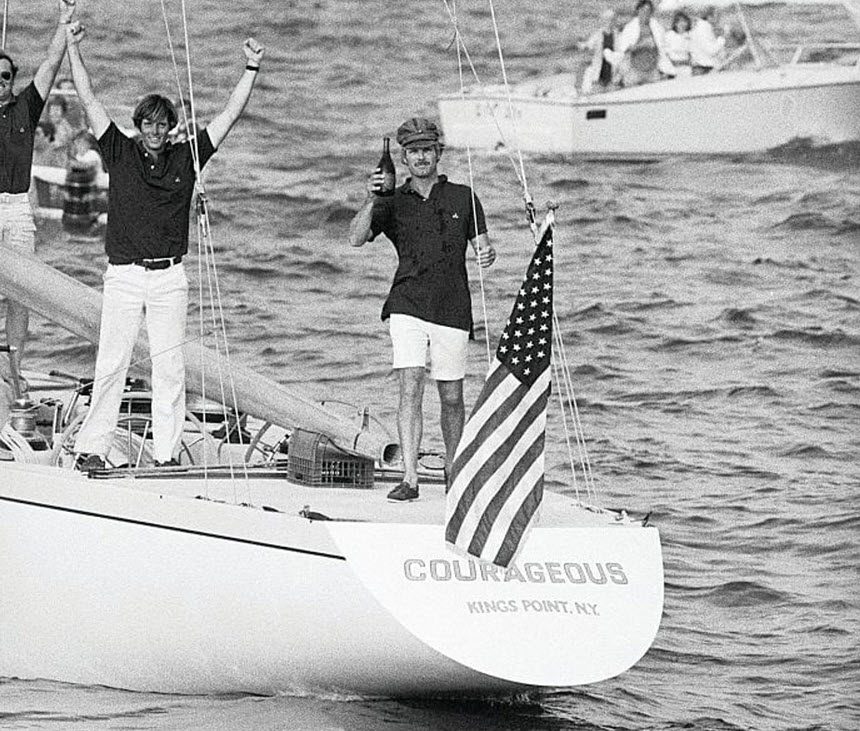
By the finish line, it was a slam-dunk and the winning margin was 2 minutes 25 seconds as Newport went wild for their new hero in Ted Turner.
Much has been written about the immediate aftermath of the 1977 contest, and in particular an unfortunate, rather intoxicated, press conference that occurred immediately after the racing. However, some 32 years later, Jobson offered a snapshot that summed up that summer beautifully: “I think the ’77 Cup race was a high point of our lives. We were the underdogs going into that summer. We were going to have to perform at an absolutely superlative level. It was a crew of 100-percent winners.”
The America’s Cup had been defended in style by one of the true mavericks and characters of the event’s long history and the Auld Mug was safe once again in West 44th Street, home of the New York Yacht Club. Ted Turner meanwhile had: “rocketed from famous to superstar,” according to the New York Times.
The rest as they say, is history.
Details: https://www.americascup.com/
Defender New Zealand and Challenger of Record from Great Britain confirmed the Protocol for the 38th America’s Cup on August 12, 2025. The close of the initial entry period was October 31, 2025, with late entries considered up to March 31, 2026.
Current entrants:
• Emirates Team New Zealand (NZL) – Defender
• Athena Racing (GBR) – Challenger of Record
• Luna Rossa (ITA) – Challenger
• Tudor Team Alinghi (SUI) – Challenger
• La Roche-Posay Racing Team (FRA) – Challenger
• American Racing Challenger Team USA (USA) – Challenger
After the 2024 event, Barcelona, Spain declined hosting another edition, with the venue moved to Naples, Italy. Challenger racing begins in the spring before the 38th Match on July 10-18, 2027.
Preliminary Regattas:*
May 21-24, 2026 – Cagliari, Sardinia
* More are to be announced.
Source: AC38 Event Limited

Related Posts
What is it like to sail with Ted Turner? →
Eight Bells: Ted Turner →

How to not be labeled as a foreigner →