

All in the family for 2026 edition
Published on April 25th, 2026
by Jan Pehrson
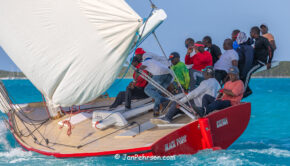
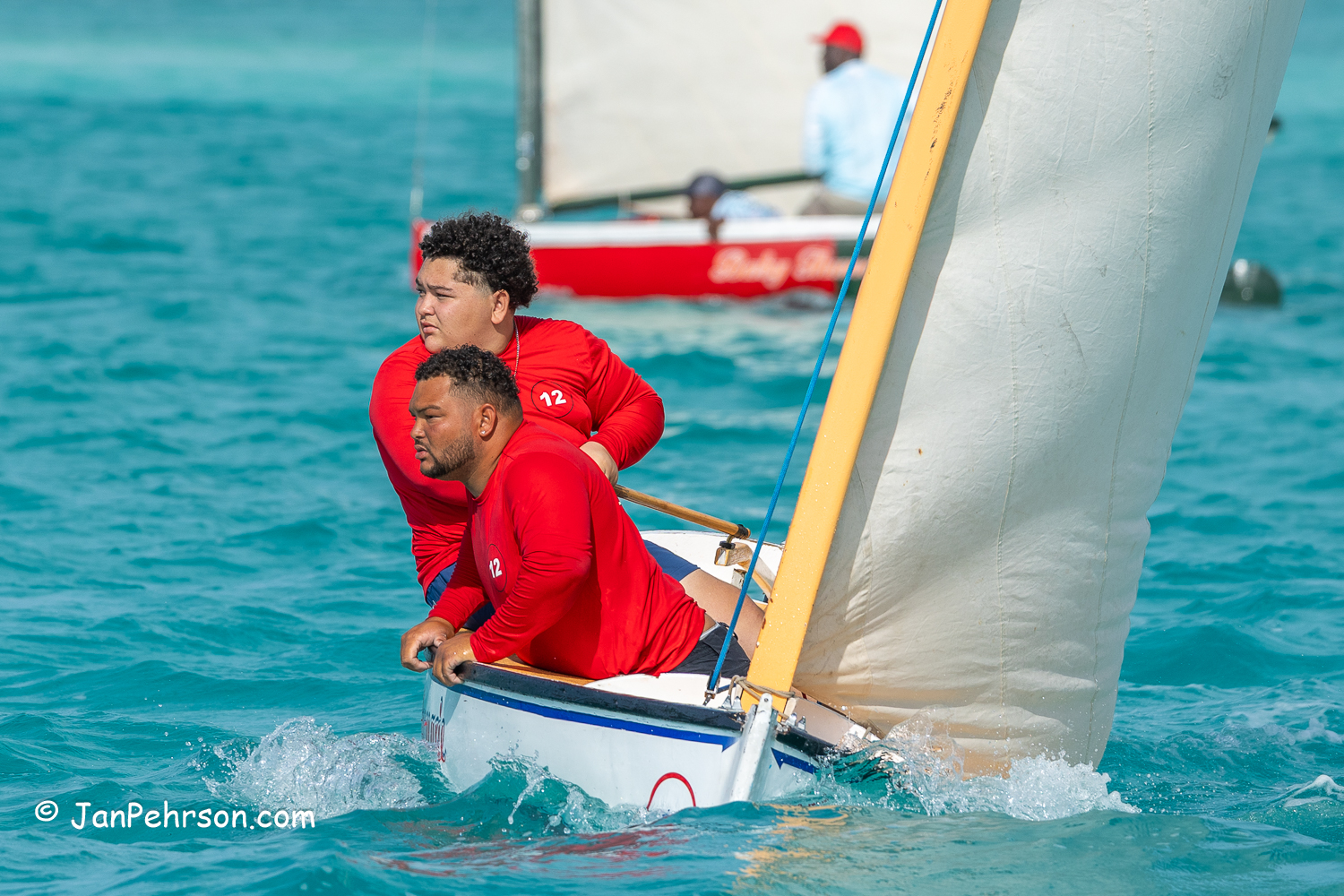
The 70th anniversary of the National Family Island Regatta was held April 22-25 in Elizabeth Harbor alongside George Town, Bahamas, Exuma. Four classes of Bahamian Wooden Racing Sloops completed for prize money and bragging rights – A-Class (28 feet long), B-Class (21 feet long), C-Class (17 feet long), and E-Class (12 feet long).
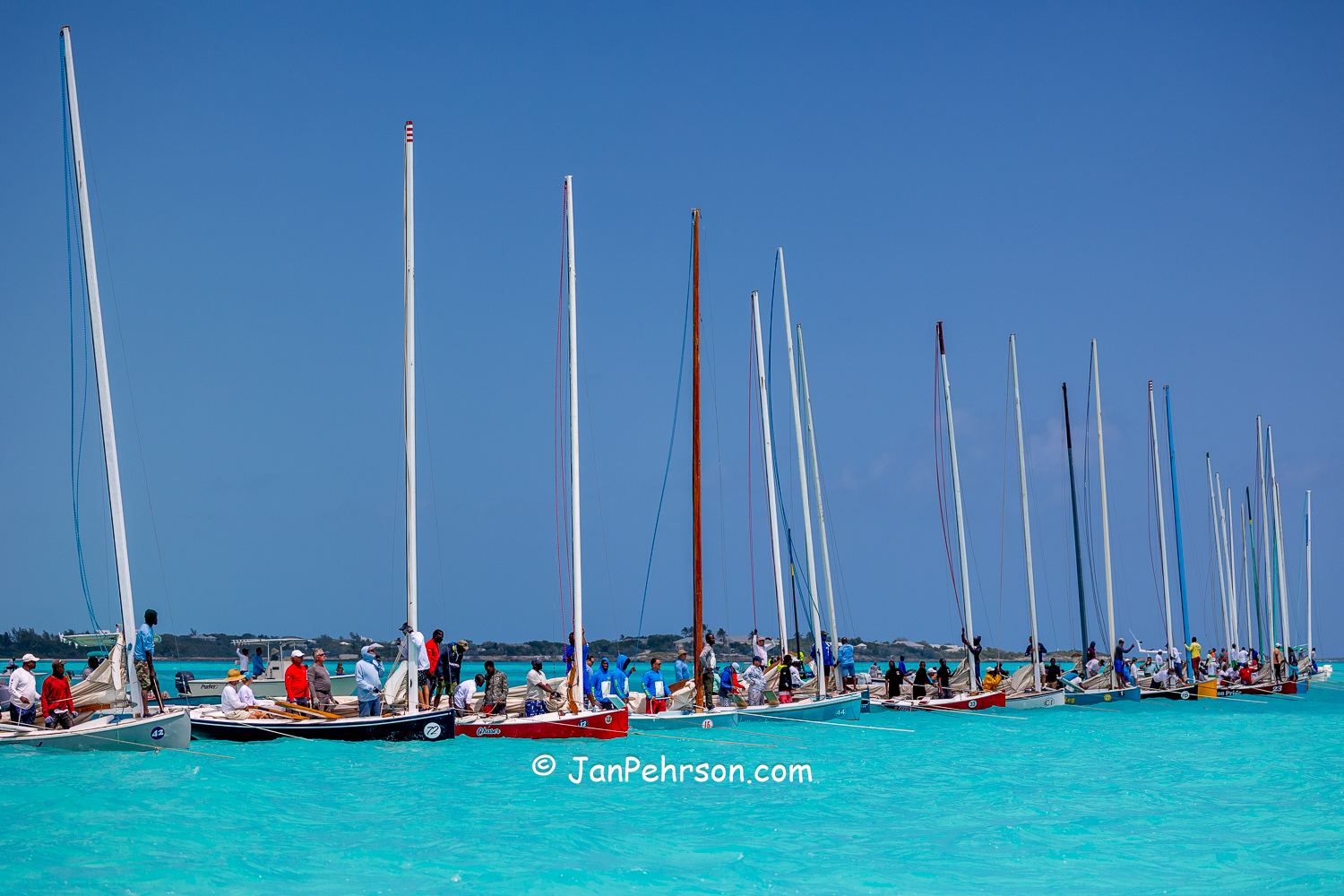
What has changed since the early regattas? Races start on time! Sometimes crew wear matching tee shirts! Boats line up at the start in (almost) even lines! Races can be followed at home on TV, radio, phone apps, and social media! GPS and drones are used to track finishes and penalties! There is more prize money than there used to be! Boats are faster than they used to be!
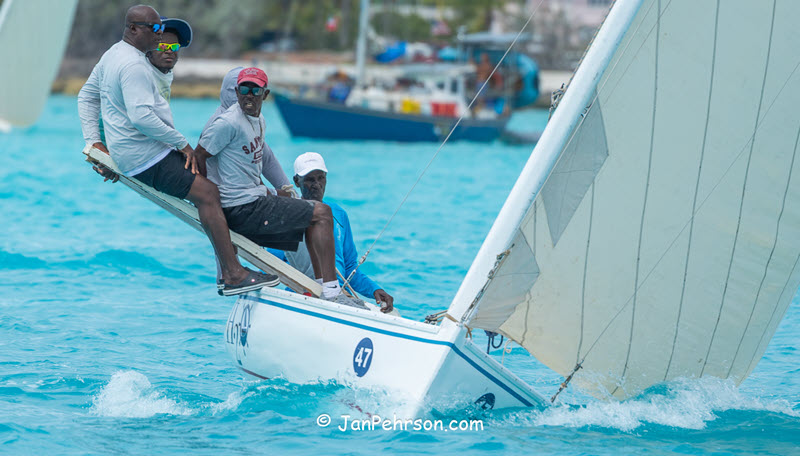
In the 1950s, fourth-generation Exumian and legendary photographer Basil Minns was a young man working for the newspapers in Nassau. He documented the early regattas in beautiful black and white photos. Since that time, masts have grown taller and booms have grown longer. The boats are a lot crankier now — they have more people on them because they are harder to handle.
Today, Bahamian racing sloops typically carry large crews, with A-Class boats using 15 to over 18 people to act as human ballast on long “pry” boards. This is spectacular — crews called “pry riders” sit on the pry boards, perched one behind the other, high over the water, feet dangling in the air, with nothing — and I mean absolutely nothing — to hold onto but the plank they sit on.
But the basic rules are the same. Boats must be made of wood and use no fancy electronics or modern winches. Just skill matters. They must be built in the Bahamas, designed along traditional lines – that means “no ugly boats” — and skippered and crewed by Bahamians.
It’s all about fun! There are nearly 700 islands in the Bahamas with about 30 inhabited. Rivalries are inter-island, with families and neighbors from one island competing against families and neighbors from other islands.
In March 1954, the inaugural National Family Island Regatta assembled nearly 70 native sloops, schooners, and dinghies in Elizabeth Harbor. This year, there were about 100 sloops registered. Bahamian wooden boat regattas, unlike most other wooden boat regattas around the globe, continue to grow due to youth participation in both boatbuilding and racing, government sponsorship, and onshore activities that draw the partying public to have fun, fun, and more fun.
Bahamian Wooden Boat Racing skippers range in age from pre-teens to 80s. At its core, Bahamian sloop sailing is about mentoring youth. At the kickoff meeting, the two oldest active skippers, 83-year-old Effort Kemp and 82-year-old Lee Armbrister, were honored with lifetime achievement awards before a standing ovation from their peers. They consistently win regattas and are recognized for their sportsmanship and leadership.
“When we first started, we had to sew up the sails,” said Kemp. “You know, ain’t no money been around to buy no sail. And we had to use sand for ballast. Now everybody’s going to lead. In the early days, if you got too much weight, too much crew, you couldn’t dump them in the sea. You couldn’t dump them in the water, but you could get rid of them on the land or into a small boat and keep sailing. You didn’t have to finish with the same people.”
Armbrister added, “Sailing was always my passion. We start from a tender age while still in school. We’d just go and get one of the small boats and a couple of us would go and play around, having fun. After school, we took to sailing as a means of support. The Cuba trade and the Haiti trade was open at that time. We trade on sailing schooners between Ragged Island, Cuba, and Haiti.
“We brought salt from Ragged Island, dry conch, dry fish. We traded with the other islands for peas, corn and stuff. And we went to Cuba before Castro took over and bought potatoes, plantains, bananas, peanuts. Haiti, we used to load those boats down with mangoes, come back, stop at Ragged Island for a day or two and come to Nassau. Sell the cargo and did that year after year.
“I started sailing in regattas when I was like 25 years old, about 60 years ago. If you won, you got a little bit of chicken change, so you could buy a little drink or something. It was mostly for bragging rights. After working for a year fishing, it was good to get together for fellowship with one another and have fun.”
Race Results:
Class-A: (1) New Legend, David Knowles, Long Island, (2) Tida Wave, Brooks Miller, Exuma, (3) Running Tide, Stefan Knowles, Long Island
Class-B: (1) Lonesome Dove, Jeff Gale, Abaco, (2) Susan Chase V, Stefan Knowles, Long Island, (3) Queen Drucilla, Stephano Kemp, Acklins
Class-C: (1) Sassie Sue, Stefan Knowles, Long Island, (2) Xena, David Knowles, Long Island, 3) Shroud, Fernando Dercardenas, New Providence
Class-E: (1) Miss Agnes, Alvin McKenzie, Exuma, (2) Lady Kayla, Joss Knowles, Exuma, (3) One Bahamas, Wyllan Braynen, Exuma
Jan Pehrson is a sailing photojournalist who spends summers in San Francisco, California and winters in St. Pete Beach, Florida. As a racing and cruising sailor and Coast Guard licensed skipper, Jan’s familiarity with sailing and the sailing community lends an in-depth element to her prolific array of photographs and articles. Contact her at www.janpehrson.com

Related Posts
Helping the sport thrive in the Bahamas →
Bahamian sloop racing on the rise →
National Committee praises supporter →