

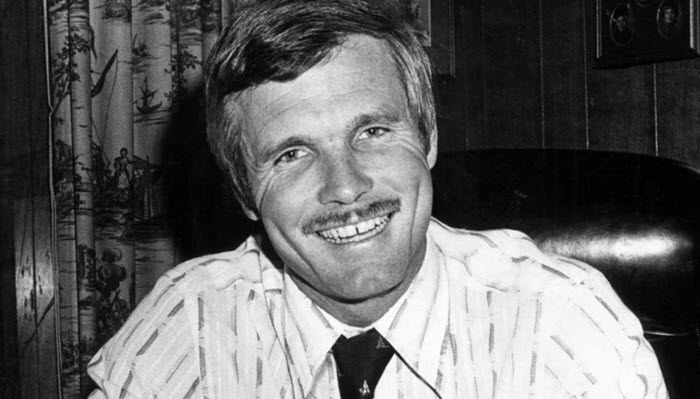
What mattered to him was winning
Published on May 20th, 2026
G. Bruce Knecht, a former Wall Street Journal reporter, is also the author of The Proving Ground: The Inside Story of the 1998 Sydney to Hobart Race and The Comeback: How Larry Ellison’s Team Won the America’s Cup. In this report, he highlights how Ted Turner was not just any rich sailing guy.
Ted Turner was losing.
The 1977 America’s Cup had scarcely begun. Three years earlier, Turner had been beaten decisively in sailing’s most prestigious competition, and now, only minutes into the opening race of his second campaign, the yacht he helmed, Courageous, trailed by half a boat length.
From the spectator boats off Newport, the gap was invisible. To Courageous’ s crew, it was glaringly apparent. These were the moments when the crews discovered the ultimate truth about their boats—which one was faster—and Turner’s face was already streaked with sweat. No one onboard said a word.
Unlike most of the wealthy men had competed in the America’s Cup, Turner hadn’t purchased his way onboard. At 37, he was still years from becoming the billionaire media baron the world would come to know. The New York Yacht Club had chosen him to lead its syndicate because he was one of the finest helmsmen in the world, fiercely competitive, and a skipper with an uncommon ability to inspire the people around him to perform beyond themselves.
There had been reservations. Turner drank too much, chased women too openly, and spoke too loudly. He was already known as “The Mouth of the South,” a nickname that would soon give way to the more enduring “Captain Outrageous.” None of that sat well with the yacht club’s patrician leadership. But winning carried its own authority. Turner had accumulated trophies at a remarkable rate and twice been named Yachtsman of the Year by the U.S. Sailing Association.
Now, though, none of that seemed to matter. Turner believed the sails were optimally trimmed and that he was sailing the perfect course, but Courageous continued to lag behind the Australian challenger.
It was Gary Jobson, Courageous’ 26-year-old tactician, who finally broke the silence. “Well,” he said, “they’re not slow.”
Turner allowed himself the hint of a grin before he said, “Yeah, but they’re not fast either.”
But something had to change. Turning to Robbie Doyle, the young sailmaker who was trimming the mainsail, Turner asked, “What can we do to go faster?”
Doyle had already been asking himself the same question. He hesitated but eventually said, “We might be able to go with a lighter jib.”
“Can we?” Turner asked.
Doyle hesitated again. He knew Turner’s instinct—in business as well as racing—was to push responsibility downward, to force operators into becoming decision-makers. But this operator was uncertain.
He knew the wind was weaker than forecast and that the lighter jib was slightly larger and fuller in shape, which meant it might generate more power in the softer breeze. But changing sails mid-race was risky.
The replacement had to be hoisted before the current one could come down; the dropping had to happen as the boat changed directions and it had to be done quickly. All of that would cost precious seconds. If anything tangled, the consequences could be catastrophic.
Doyle spoke to John (LJ) Edgcomb, the crewman who would be responsible for making the changes. LJ didn’t hesitate. “Sure,” he said. “Done.”
His confidence settled Doyle’s nerves. They committed to the maneuver and LJ executed flawlessly. Then, almost imperceptibly at first, Australia began to fall behind. By the time the yachts rounded the first mark, Courageous had opened a commanding lead. Turner and his crew never gave it up and they went on to sweep the series.
The moment the final race ended, restraint vanished. The crew—all amateurs, the last America’s Cup crew for which that would be true—began drinking beer before Courageous even reached the dock. When they got there, someone gave Turner a bottle of Aquavit, and he took several long pulls from it on his way to the press conference. When he sat down to face journalists, he was incapable of speech.
“It wasn’t good,” Jobson recalled.
Turner, who grew up in Savannah, Georgia, began sailing when he was eight. “I didn’t have much choice,” he later said. “I tried everything else and I wasn’t quite big enough or fast enough to play in the major sports.” While a student at Brown University, where he was a member of the sailing team, Turner watched his first America’s Cup off Newport in 1958.
“Someday,” he told friends, “I’m going to be out there.”
Yet Turner later believed his greatest victory came not in the America’s Cup but two years later in the Fastnet Race, the notoriously punishing 695-mile offshore race from the English Channel to Fastnet Rock near the southwest corner of Ireland and back to England. During the second night of the 1979 race, hurricane-force winds hammered the fleet. Waves rose to 50 feet.
“Twenty people are going to die out here tonight,” Turner told Jobson, the only member of the America’s Cup crew who was onboard.
That turned out to be only a slight exaggeration. Fifteen sailors died and 130 were rescued from their yachts or directly from the sea. During the worst of the storm, from midnight until four in the morning, Turner was at the wheel. He and his crew didn’t just survive. They were first to cross the finish line. Afterward, Turner said, “Sailing in rough weather is what the sport is all about.”
Turner also won the Sydney to Hobart Race, another storied ocean race, in 1972 and again in 1983, but by then his focus had shifted to his fast-growing media empire. Jobson, who remained close to Turner and spoke to him a few days before he died, regularly tried to lure him back to yacht racing, but he never did. “He always said, ‘I can’t do it unless I’m all in, and I just don’t have time,’” said Jobson.
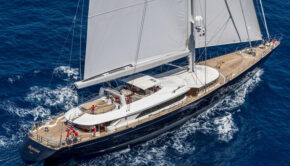
And he had no interest in uncompetitive boating. Unlike so many other billionaires, he never acquired a megayacht. Leisurely sailing was also of no interest. “Going out for an afternoon sail was never Ted’s thing,” Jobson said. “What mattered to him was winning.”
Editor’s note: Ted Turner died peacefully May 6, 2026 at his home near Tallahassee, Florida. He was 87.

Related Posts
Ted Turner: From famous to superstar →
What is it like to sail with Ted Turner? →
Eight Bells: Ted Turner →