

Are we reaching a tipping point?
Published on July 7th, 2026
If yacht designers hope to stay in business, seeking jobs beyond competitive sailing improves the odds. While VPLP Design has a strong presence in the sport, they have been exploring how wingsails can support other maritime practices, present and future.
After the firm’s involvement with BMW Oracle’s trimaran USA 17 which used a massive wingsail to win the 2010 America’s Cup, the experience encouraged VPLP’s architects and engineers to reflect on how to extend the concept to other uses, especially to the shipping sector which consumes vast amounts of fossil fuels.
This led to the creation in 2015 of Ocean Wings, a company tasked with developing an automated and reefable propulsion system that could be operated by a non-specialist crew.
Installing the first demonstrator on a small production trimaran established the basic concept of OceanWings, VPLP Design’s very own wingsail.
“Our guiding principle was to retain a rigid structure of composite ribs to manage profile and distortions,” said partner architect Quentin Lucet. “The camber of the two sail flaps is achieved through the use of two independent masts. This offers an infinite number of trimming possibilities so you can play with its profile and aerodynamic lift, and thus the ship’s propulsion.”
In 2020, VPLP Design was commissioned to design Canopée, a 121-metre RoRo (Roll-on/Roll-off) vessel destined to transport parts of the Ariane 6 rocket from Europe to French Guiana. The project turned out to be a veritable proof of concept for the system.
Launched in 2023 with four wingsails of 363 m² area, the ship amply demonstrated the effectiveness of the concept because it enabled fuel savings of 25–50% compared to a ship powered solely by conventional engines.
With the same goal of proving that wind-assisted propulsion is a real solution to the problems involved in de-carbonizing maritime transport, two OceanWings were installed on Energy Observer 1, a catamaran which sailed round the world without the aid of fossil fuels.
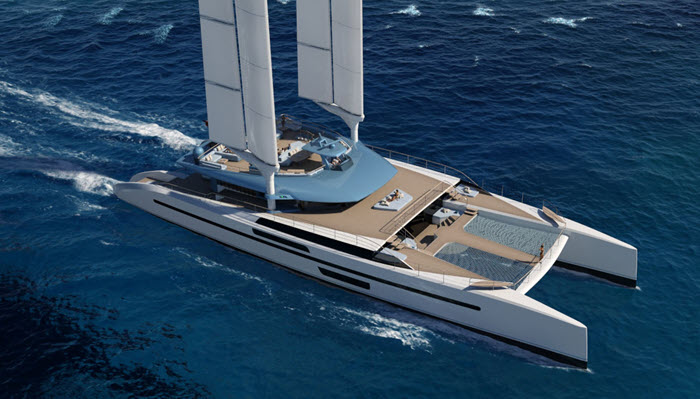
“Another example is the MODX 70 catamaran, launched in 2025, the first cruising yacht to feature a wingsail on each hull,” adds Lucet. “And last but not least, in addition to all these projects, over the last ten years we have produced numerous wing-yacht concepts, such as the Komorebi 138, the Studio Boat, Evidence, EMC, and Aperio.”
VPLP Design hopes to continue with more responsible maritime practices, with Lucet believing they’ve reached “a tipping point” which should lead to a general uptake of these wing yachts which combine performance, ease of use, and energy sobriety.

Related Posts
Ocean health for the future →
Antifouling with the power of sound →
These sailors will really be sailing →