

Designing fastest boat in the world
Published on May 13th, 2026
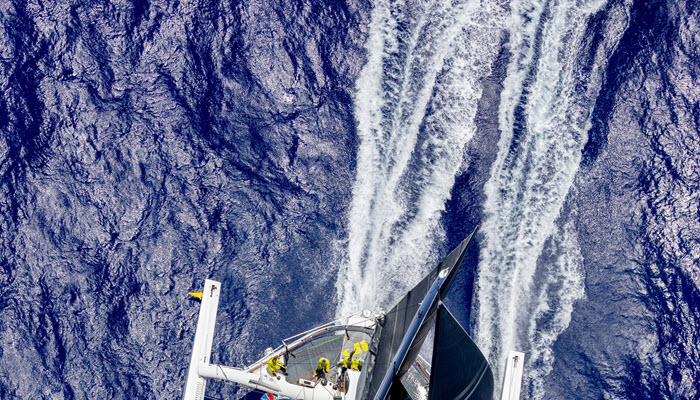
In mid-April, American Jason Carroll and his Argo Racing team committed to a 2029 launch for a trimaran the size of an Ultim (32 metres long, 23 metres beam), entrusting her design to VPLP Design. Partner architect Quentin Lucet tells us more about this ambitious project:
How did this project with team Argo come about?
We’ve had a working relationship with Argo for several years. We helped them develop the MOD70, specifically updating the foils and rudder blades. This gave us the chance to get to know each other, and allowed them to discover our tools.
I understand they had been thinking about moving up a gear for some time, going for a bigger boat. This project developed gradually, over a period of about eighteen months. We started developing preliminary concepts, discussing their requirements, and when they decided it was the right time to move forward, we had already completed several cycles of the design spiral.
This meant we were able to show owner Jason Carroll and his team a serious initial draft, and once they had given their green light, we were ready to get down to the nitty-gritty. It’s obviously immensely satisfying for us because this type of project, by virtue of its scale, doesn’t happen often in an architect’s career.

How are you organizing the work?
At VPLP, six or seven of us are working full-time on the project. We expect the design phase to take a year and once the plans have been delivered to the Multiplast yard, we can expect a two-year construction phase.
We’re also working with Chad [Corning, team manager at Argo] to build the best team possible so we can design the fastest boat in the world. The goal is to surround ourselves with specialists who, in their respective fields, are at the pinnacle of the sport. People who have worked on the America’s Cup, for example.
This will allow us to move it up a notch compared to what we could have done if we had limited ourselves to a uniquely French approach. This cultural mix is, in fact, one of the project’s strong points, fostering a collegial atmosphere, an esprit d’équipe, a trust in each other which will – I am certain – allow us to build the best boat possible.
From an architectural point of view, what direction are you taking?
What’s particularly interesting about this project is we don’t have to adhere to the rules of the Ultim class [because the goal is to break records]. We have greater scope for trying something a little different, in particular in terms of aerodynamics and the layout of the platform. It’s exciting to be able to consider such broad concepts, and to have this extra degree of freedom compared to the rules of the Ultim class.
What does that change specifically?
All the Ultims that we have designed so far were mainly for single or double-handed sailing. In this case, we know that there will always be a crew of six or seven aboard. So the self-regulating aspects that we aim for in short-handed boats, we’re not going to do quite as much for a fully crewed boat. This allows us to be a bit more extreme in our choices or, at the very least, to explore avenues that we might not have taken for a “pure” Ultim.
This boat belongs to a second era in flying Ultims. Where can progress be made compared to the first generation?
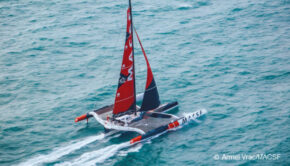
On a boat like Macif, when she was launched in August 2015, foils were able to carry about 30% of the displacement, so we were really in skimming mode. In the following generation (2017–2021) we achieved the major goal of making the trimarans fly continuously, but in certain sea conditions, they still had to return to the surface or use their buoyancy to relaunch. For this new generation, the approach differs in the sense that the objective is to fly all the time. This really is the attitude we’re adopting for the design phase.

Related Posts
Take drudgery out of the delivery →
Are we reaching a tipping point? →
Rare sailing record obliterated →