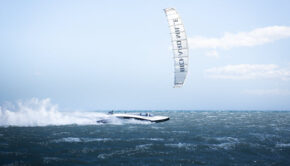



When you have a need for speed
Published on July 21st, 2026
The World Sailing Speed Record Council is the only trusted authority for the sport, and their list of speed records include both routes and measured distances. The most famous is the 500-meter course, and as it is the shortest distance, the speed is the fastest.
In November 2012, the Sailrocket speed sailing program delivered on 11 years of dedicated work, setting the outright record at 65.45 knots, averaged across the span. No one has since gotten close, with expert marine consultant Jean Sans explaining the battle for speed:
Once the speed required to generate lift is reached, the Foiler lifts out of the water. Its speed then increases very rapidly, reaching a speed limit of around 40 knots, which appears insurmountable.
This phenomenon of speed limitation is also observed in subsonic[1] aircraft (fitted with jet engines), at around Mach 0.84 when at cruising altitude (10,000 m). At this altitude, the speed of sound is around 1,070 km/h (300 m/s). Mach 0.84 corresponds to 900 km/h.

These two vehicles, which generate lift over water or air, use identical types of airfoil profiles for their foils or wings. These are asymmetrical, cambered airfoils with a relative thickness of approximately 12 per cent (such as the NACA 64-12 or 2412, for example[2]), mounted on rectangular, trapezoidal or elliptical wing or foil shapes.
In fact, this ‘wall’ does indeed exist on both vehicles, but for very different physical reasons.
On an airplane, the limit arises from the transition from subsonic (Mach <1) to supersonic (Mach >1) flight. At this point, the compressibility of the air, shock waves and drag generate vibrations that affect the wing’s structure and/or cause flow separation phenomena around the upper and lower surfaces. These phenomena lead to flight failure.
On a foiler, the foil moves through water, where the speed of sound is around 1,500 m/s. Travelling at 40 knots (20 m/s) through water – which is a completely incompressible fluid – corresponds to Mach 0.013. There is therefore no risk of a shock wave.
However, at around 18 m/s (35 knots), cavitation phenomena appear on the upper surface and then on the lower surface.
Among other things, these cause the foil to lose lift.
Stall first affects the upper surface (the area of low pressure) and then the lower surface.
This phenomenon does not depend solely on speed, but on the moment when the local pressure on the upper surface reaches the level of the saturated vapor pressure PV.
The phenomenon of cavitation is similar to boiling in a saucepan, but at a lower temperature, with the gaseous phase consisting of water vapor. The only difference between boiling and cavitation lies in the ‘driving force’ that triggers the phenomenon.
In boiling, the temperature varies at constant pressure, whereas in cavitation, the pressure (on the upper surface) changes at a constant temperature of the water flowing around the foil.
At this moment, the water flowing around a foil undergoes a sudden phase change, transitioning from a liquid to a vapor state.
As vapor has a density 55 times lower than that of the liquid, a bubble forms locally on the upper surface; the water flow then separates from the upper surface, simultaneously causing a loss of lift from the foil and erosion of its surface (an increase in roughness and therefore in drag). Cavitation depends primarily on the absolute pressure at the foil’s surfaces and the water temperature.
Added to this phenomenon is the risk of ventilation. Ventilation is the suction of air from the air/water interface at the arm supporting the foil (connection to the Foiler’s hull). The air then propagates along the arm towards the foil. This amplifies the hydrodynamic drag forces as well as the structural stresses. All these disruptive phenomena render the system unstable.
In conclusion, for a foiler, the ‘wall’ is not a physical barrier like Mach 1 for airplanes, but a hydrodynamic and technological one.
We often hear of foilers reaching speeds of 45 and even 50 knots. This is possible, but the performance is very short-lived because the deterioration of the surface condition of the upper and lower surfaces escalates very rapidly (the surface very quickly resembles ‘coarse-grained’ sandpaper), regardless of the material (titanium, high-modulus steel, carbon fiber, etc.), leading to an inevitable drop in lift and, consequently, in the foil’s performance.
——————-
[1] This applies to jet-powered aircraft; internal combustion engines cannot reach speeds in excess of 600 km/h or altitudes of 6,000 m.
[2] Various types of aerodynamic profiles are catalogued worldwide. These include the Joukowshi, Eppler, NACA and Göttingen profiles, amongst others, with the NACA types being the best known.

Related Posts
Kitesurfing speed record in France →
Hitting pause button to break record →

Fastest kitesurfer in the world →