


Storms are getting stranger
Published on September 23rd, 2026
Robert Hoffer is a technologist, doing stuff above our paygrade, but he’s also a lifelong sailor and shares how his two worlds are merging:
It was 1979 when the sea killed fifteen sailors because the forecast failed. More recently, it nearly happened again.
I was fifteen at the time, racing on Long Island Sound when the word came over the radio about the Fastnet Race in August 1979. There were 303 yachts out of Cowes on a 605-mile run to the Fastnet Rock and back, a forecast that said rough, and a storm that said otherwise.
Fifteen sailors died. Five yachts were lost. Twenty-four crews abandoned ship – and several of those abandoned boats were later found still afloat. The boats survived. The men who left them didn’t.
John Rousmaniere sailed that race and wrote the book every offshore sailor owns: Fastnet, Force 10. Read it and you learn the real lesson of 1979. The inquiry that followed rewrote offshore safety – storm sails, harnesses and tethers, qualifying miles, liferaft, and radio standards. Survival at sea turned out to be engineered, not braved.
What the Fastnet crews never got was time. The storm outran the forecast, and no one on those boats had hours to spare.
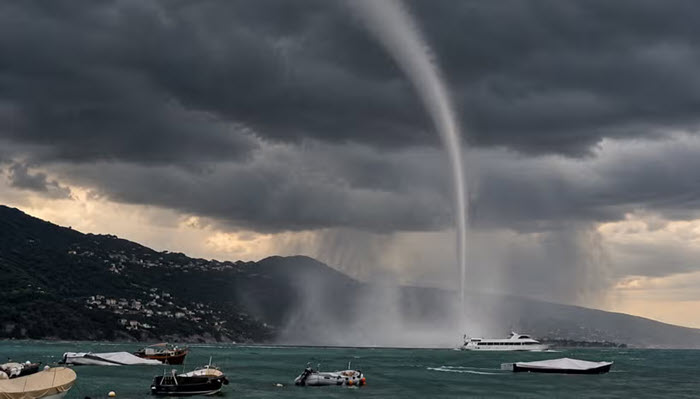
It nearly happened again on September 10, meters from boats, on the Ligurian coast when violent storms tore across northern Italy. Two women died in the floods, and a giant waterspout swept straight through the Bay of Rapallo – past Zoagli, past Santa Margherita, a tourist boat near-missed in waters I know.
Two summers ago, in the same Mediterranean, the 56-meter superyacht Bayesian went down off Sicily in about sixteen minutes – seven dead, including Mike Lynch – hit by what investigators called a downburst. Meteorologists called it “the extreme of the extreme,” turbocharged by record-warm sea water.
And here is the part that should stop every sailor cold: it was visible in the data hours ahead. Nobody was looking.
“Random” is the word sailors have always used for weather like this. Random is becoming the forecast. Mediterranean cyclones – medicanes – are projected to strengthen as the sea warms. The North Atlantic now spins up storms with a rapid intensification trend that would have been science fiction in 1979.
Even the German yachting press runs features on the changing storm climate, and The Ocean Race fleet crosses the Atlantic trailing instruments, collecting Gulf Stream data – sailors turned climate sensors whether they like it or not. The sea my generation learned is not the sea my son will sail.
Now the turn, because this is not a eulogy. The same artificial intelligence my tech industry argues about over drinks has quietly become the best storm-seeing tool ever built – and this part is not marketing; it is operational fact.
In February 2025, ECMWF – the European weather center, the grown-ups’ table of forecasting – made AIFS, its first AI forecast model, operational. By July it was running an AI ensemble. Google DeepMind’s GraphCast beat the best physics-based model on ninety percent of measured variables.
NOAA and the National Hurricane Center now formally score AI hurricane track forecasts alongside the traditional ones. On the water, Sofar Ocean’s buoy network feeds an AI routing system that documents a 6.9 percent average fuel saving per voyage – meaning it reads the sea better than habit does.
PredictWind will build AI polars for a cruising boat anyone can buy. A racing crew crossed the winter Atlantic this year on AI routing and shaved two and a half days.
For fifteen dollars a month and a satellite connection, a family on a forty-footer now has more weather intelligence than the entire Fastnet fleet had in 1979. Let that sink in.
But here is the honest edge, and I will not trade it for a cleaner pitch: the AI global models are brilliant at track and pattern – the synoptic picture, days out. The Med killers are convective. Downbursts and waterspouts spin up in minutes, over a few hundred meters of sea, and no global model on Earth resolves that scale yet. The Bayesian was almost certainly lost to exactly that gap.
So the honest promise is this: AI buys hours, not certainty. Better warnings, routing that never sleeps, a lookout that reads every buoy and satellite pass while you do. Hours. And hours are precisely what the crews of 1979 didn’t have. The sailor’s eye and the VHF in the cockpit still close the last mile. They always will.
The Fastnet inquiry taught us that survival is engineered. The generation before mine engineered the boat – the sails, the harness, the liferaft. Ours gets to engineer the warning. The storms are getting stranger, the sea is getting warmer, and random is the new normal. For the first time in the history of going to sea, we have a lookout that doesn’t blink.
Use it. Fifteen families from one August night in 1979 would tell you what that’s worth.

Related Posts

Historically quiet hurricane season →
Significant storm suspends offshore race →
Why sailors look to the red sky? →