

America’s Cup: What’s under the hood
Published on October 10th, 2026
For the America’s Cup, mechatronics – electronics and software engineers – have become every bit as embedded in America’s Cup design teams as naval architects, aerodynamicists and structural engineers. The modern AC75 is still a sailing yacht, but there is an extraordinarily sophisticated layer of electronics to control it.
The Programmable Logic Controller (PLC) sits at the heart of that world. Small, largely unseen and operating continuously beneath the deck, it helps turn human intention into precise mechanical movement. At more than 50 knots, that movement needs to be virtually perfect because in the modern America’s Cup, speed is not simply about creating power. Increasingly, it is about controlling it.
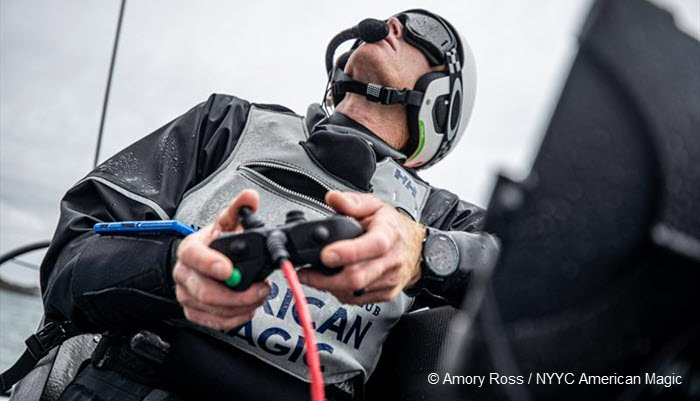
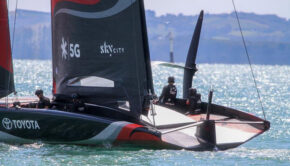
At more than 50 knots, there is very little room for hesitation. An AC75 is balancing on a foil wing beneath the water while enormous aerodynamic loads are being generated by the double-skinned mainsail above it. Sailors are continually asking for changes to sail shape, foil settings, mast controls and other systems, often by tiny amounts and sometimes several times within a matter of seconds.
Thousands of lines of code can sit between a sailor pressing a button and the correct actuator moving at the correct speed and by the required amount. During the previous Cup cycle, the British team described the process as ‘a web of wiring, processors and electronics translating crew inputs into precise hydraulic movement.’
Precision is everything as a large unintended movement at 45 or 50 knots could be disastrous. Equally, a control system that is too slow, inaccurate, or inconsistent will simply make the yacht slower. The PLC has to execute commands repeatedly, rapidly, and reliably in an extraordinarily hostile environment.
The electronics on an AC75 are operating in an environment involving salt water, vibration, enormous structural loads, heat, and constant shock, all onboard a platform traveling at motorway speeds while repeatedly accelerating and decelerating. The AC75 adds another layer of complexity because its electronics must interact with exceptionally powerful hydraulic systems.
Luna Rossa has previously described the AC75 as a mechatronic system where industrial computers sit between the sailors and hydraulic actuators operating at pressures that can reach around 600 bar. That combination of mechanical engineering, electronics, hydraulics, and software is one of the defining technologies of the modern America’s Cup and the ultimate battleground for the teams.
There are several major electronic and control architectures aboard the yacht. Historically these have included the Foil Cant System, instrumentation and logging systems, crew information systems, and electronic control circuits governing hydraulic functions. Luna Rossa described these four areas during the first generation of AC75 development.
The Foil Cant System provides a particularly good illustration of what a PLC can do with the AC75’s enormous foil arms having to move between their lowered foiling position and raised position during maneuvers.
In development of the original one-design Foil Cant System, Emirates Team New Zealand used a Beckhoff PLC alongside the motor controller, hydraulic pump, accumulator and cylinders. The system had to control an enormous moving mass smoothly while managing the oscillations generated by the foil arm and wing.
The PLC could therefore be tuned to help make that movement smooth and controlled rather than simply commanding an actuator to move from one position to another. This is control engineering rather than conventional yacht mechanics, and it happens repeatedly around the boat.
This is also why software engineers have become such important members of modern America’s Cup design teams. The hardware may provide the capability, but software determines how effectively that capability can be exploited.
The system needs to recognize an input, determine what action is permitted, translate that request into an appropriate command, communicate with the relevant hardware and make the adjustment accurately. Small improvements in latency, accuracy, repeatability, or control quality can translate into better sailing performance.
For the Louis Vuitton 38th America’s Cup, the importance of electronic management has increased still further. One of the major changes for the 2027 AC75 is the removal of the cyclors used during the 37th America’s Cup. Instead, the AC75 will use stored (and limited) electrical energy.
A specified one-design battery arrangement forms the primary battery bank supplying energy for the yacht’s moveable systems, while the rules allow teams considerable freedom in the development of their control systems, hydraulics, and electronics within the existing hull architecture.
The official AC75 specification describes the lithium battery system as driving the hydraulics and powering the PLC, with the PLC managing sail, mast, and board controls and that represents a profound change inside the boat.
The physical hulls themselves are being reused albeit adapted from previous America’s Cup campaigns, but much of the development battle has moved beneath the surface into foils, systems, and electronic management.
As Emirates Team New Zealand Chief Designer Dan Bernasconi noted when the AC38 rules were published, analysis of the AC37 yachts suggested that differences between the hull shapes were relatively small, while the major gains were being found in foils and systems. For 2027, that places even greater emphasis on the engineers working on the invisible parts of the yacht.
Much of America’s Cup development can be seen. New foil shapes attract recon photographers immediately as they come out of the team bases. Sail configurations can be analysed from chase boats. Rudders, aero treatments and modifications are scrutinized almost immediately after a yacht leaves the shed.
However, the PLC and the software surrounding it are different and most of their performance is invisible. You cannot stand on the dock and photograph an algorithm, and you cannot easily determine how efficiently another team’s control architecture processes an input or how accurately its hydraulic system reproduces a sailor’s command and yet these areas may contain some of the most valuable performance gains of the entire campaign.
Defender New Zealand and Challenger of Record from Great Britain confirmed the Protocol for the 38th America’s Cup on August 12, 2025. The close of the initial entry period was October 31, 2025, with late entries considered up to March 31, 2026.
The AC75 has a helm and trimmer on each side of the boat along with a fifth crew position and a sixth passenger position.
38th America’s Cup: https://www.americascup.com/
38th America’s Cup entrants:
• Emirates Team New Zealand (NZL) – Defender
• Athena Racing (GBR) – Challenger of Record
• Luna Rossa (ITA) – Challenger
• Tudor Team Alinghi (SUI) – Challenger
• La Roche-Posay Racing Team (FRA) – Challenger
• American Racing Challenger Team USA (USA) – Challenger
• Team Australia (AUS) – Challenger
After the 2024 event, Barcelona, Spain declined hosting another edition, with the venue moved to Naples, Italy. Challenger racing is May 22 to July 4 before the 38th Match on July 10-19. Full details.
Preliminary Regattas:*
May 22-24, 2026 – Cagliari, Italy
September 24-27 – Naples, Italy
* The Protocol noted how there would be as many Preliminary Regattas as possible, with the intent to have three during 2026 and one possibly in early 2027, and a final event at the Match Venue immediately prior to the challenger series. Only two have been thus far revealed.
Source: AC media

Related Posts
America’s Cup: Bring on the lawyers →
Returning to birthplace, ten years later →
Is sport relevant without an audience? →