

Gitana 18: A 10-15% speed gain expected
Published on December 3rd, 2025
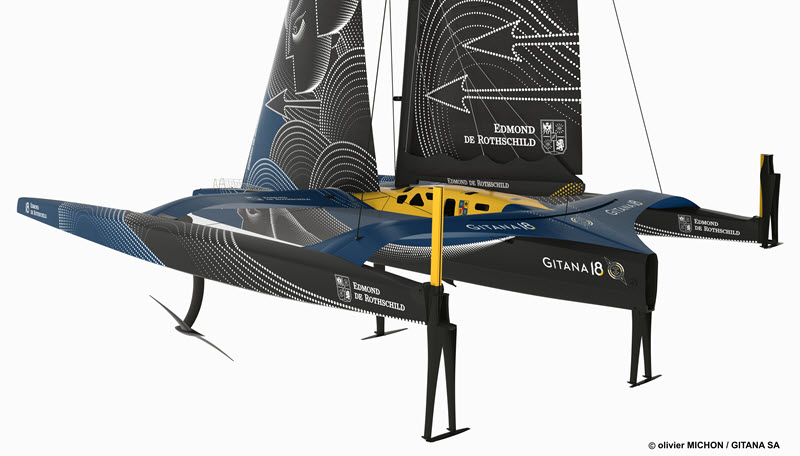
The new Gitana/Verdier designed Maxi Edmond de Rothschild has been unveiled, revealing the 32-metre giant, adorned with revolutionary appendages, which seeks to pave a new way forward for a whole new generation of flying offshore multihulls.
Back in 2017, Ariane de Rothschild and Gitana Team were the first to believe that offshore flight was the future of offshore racing. Driven by this conviction, they created and designed the first large oceanic multihull capable of flying in the open ocean.
Eight years later, armed with the experience of covering over 200,000 nautical miles on all the oceans of the globe aboard Gitana 17, the new Maxi Edmond de Rothschild has focused on significantly raising the bar in offshore racing.
On paper, based on thousands of tests carried out in a simulator, the new Maxi Edmond de Rothschild ticks all the boxes with a 10 to 15% gain in speed expected. Now, all that remains is to get to grips with and tame this otherworldly creature in real-world conditions.

The culture of innovation and boldness is intrinsically linked to the history of the Gitanas, and to the philosophy of its owners, embodied today by Ariane de Rothschild and her daughters. It involves planning projects over time and accepting a degree of risk.
“Within my family, we’ve always enjoyed a passion for competition, performance and also one of technological disruption. It’s about being disruptive, knowing how to take risks, gauging them and managing them. This is fully in line with our philosophy,” admits Ariane de Rothschild.
Like her predecessor, the Maxi Edmond de Rothschild aims to break new ground, this time by switching from hybrid mode to 100% flight, as well as be at the forefront of a new generation of large ever more high-performance oceanic trimarans. To do this, it was vital to brave the still uncharted territory, create new concepts and test innovative solutions.
“She’s an extraordinary trimaran, a blend of art and technology,” reports Cyril Dardashti, Gitana Team general manager. “We’ve challenged ourselves right across the board. The result is bold.”
The appendages of the new Maxi Edmond de Rothschild mark a spectacular departure in a whole host of domains. They are the fruit of many months of brainstorming, creation and testing to come up with a range of totally unique geometries, systems and trimming possibilities.
Inspired by the appendages on the flying monohulls of the America’s Cup, these Y-foils equipped with a wing spanning over 5 metres have been designed to generate considerable lift, boost power and permit a number of different trimming options in order to optimize flight on every point of sail, in all manner of conditions.
The revolutionary rudders with a U-shaped geometry are geared to withstand cavitation. Additionally, the centerboard on the central hull, together with its large-scale lifting surface, are a departure from everything that has previously been designed on this type of boat.
The rig on the new Maxi Edmond de Rothschild also stands out through the presence of spreaders whose dynamic forces can be adjusted, enabling the mast to bend to modify the power of the mainsail whilst sailing: a world first on this scale.
The cockpit and the coachroof are structurally integral to the central hull to give it the maximum stiffness: a Gitana concept and implementation. Elements of Gitana 18’s design are the subject of a patent application.
“With this new boat, we hope to achieve as close to perfect flight as possible,” declares skipper Charles Caudrelier. “Ideally, we’ll be able to fly very high without ever touching the waves. We hope to be able to fly in 3-metre waves and reach an average sailing speed bordering on 40 knots.”
Gitana 18 constitutes dozens of moving parts, parts with unexpected geometries, novel attachment systems, forty-four rams, kilometers of electric cables and an abundance of electronics.
“These systems are reminiscent of the ones you find in F1 or aerospace,” admits Pierre Tissier, with acknowledges Sébastien Sainson, director of Gitana’s design office adding, “Mechatronics – a combination of mechanical/hydraulic/electronic systems -, is witnessing a sea change in terms of what we know today.”
• 200,000 hours of construction
• 50,000 hours of study
• 80% of the platform manufactured in an autoclave
• 36-month gestation
• +200 people involved in the Gitana 18 project
Source: SeaClear Communications

Related Posts

Groundbreaking boat to get first test →
32-metre trimaran in full flight →
Designing fastest boat in the world →