


Speed is rooted in SailGP’s DNA
Published on September 6th, 2025
The phrase ‘Speed Kills’ has been a slogan in various road safety campaigns worldwide, and was the name of a horrible John Travolta movie about a speedboat racing champion. Those two words are easily understood, and as SailGP driver Phil Robertson explains, are integral to the success of the burgeoning sports league:
Before I joined SailGP I’d maybe only gone 37 knots on a boat, and that was on a GC32 in the Extreme Sailing Series. Joining SailGP, that changed of course, and I can remember going 40 knots for the first time – it was actually quite scary, because it was so new.
You’re going into the unknown: you don’t know what’s going to happen, how the boat’s going to react. If it goes wrong how wrong is it going to go at that speed? I really vividly remember my first crash, a high-speed nose dive where we got a little bit high. It was in the first season of SailGP, and not knowing how it was going to go or what was going to happen next was pretty scary.
It’s amazing how fast you adapt though. Now 40 knots feels slow! And the F50s are actually pretty safe. I’m really comfortable on the boats – I know what’s going to happen if I get it a bit wrong at really high speeds. It’s actually way worse crashing a smaller boat at high speed.
In an F50 everything happens a lot slower, and you’re protected because you’re in a cockpit rather than sitting exposed on the side of a boat. As humans we adapt really fast and now I would say in SailGP it’s actually quite normal to be doing 90 to 100 km/h. It feels comfortable.
There aren’t a lot of venues that allow for those kinds of speeds though, so there are only a handful of times a year where you have those top-end high speed conditions. Flat water is key to unlocking those top speeds because it allows teams to push their F50s to the limit without worrying too much about losing control. Wavy conditions are the opposite: then you’re just trying to slow the boat down to keep it under control. Wind and waves are a recipe for a horrible day!
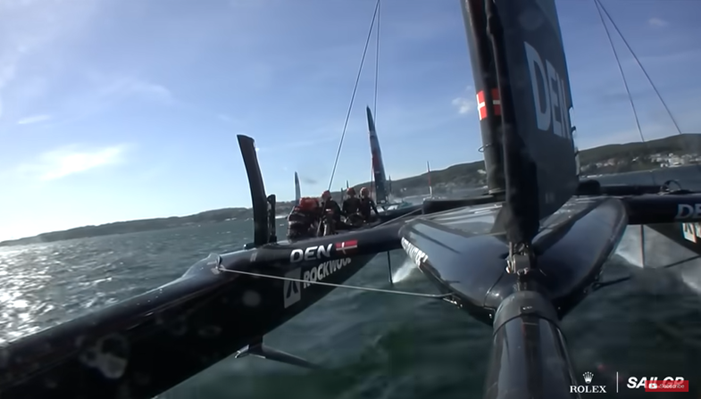
A good example of how flat water can unlock top speeds was in Sassnitz with ROCKWOOL Racing breaking the all-time SailGP speed record. It was windy, the sea was flat and you could just tell something big was about to happen.
As they approached the first mark there was a big dark patch on the course, and the wing trimmer was telling the driver there was a big puff coming. As they went round the mark they just took off. Their speed of 103.93km/h was a couple of km/h more than we hit during T-foil testing in San Francisco ahead of the 2025 Season, and four more than the previous record set during racing.
It was huge! I knew it was going to be fast, but I didn’t expect it to be that fast! It wasn’t just the Danes either: several other teams punched through the 100km/h mark. It was incredible to see. I was impressed by their composure, that was quite cool to see and that’s just professionalism you know, it’s another day in the office.
To give you a sense of what it feels like on board, I think there was a comment from Nikolai Sehested (ROCKWOOL Racing driver) saying everything was shaking – and it does. It’s a little bit like getting the speed wobbles on a skateboard. Everything starts to shake, the wheel vibrates, and it feels a little out of control.
For a fan to experience that speed, the easiest way to do it is to drive down the highway at 100 km an hour and stick your head out the window. That is the sort of air flow that’s coming over your whole body and face on an F50. You’re outside in the elements, you’re trying to control the boat, and it’s quite distracting having that wind blowing over your face the whole time. It’s something which is quite surreal and unique to our sport I think.
The worst thing that can happen at that speed is the windward hull or the windward foil touching down. That just blasts jets of water into the back cockpit at the wing trimmer and driver, and these are the two guys that need to be concentrating the most. In those moments you want – and need – to be 100 percent focused and with no distractions.
The crew knows the bear-away from a reach to a run is going to be where you hit those peak speeds, so they will be switched on to that. There’s not much time to be stoked at how fast you’re going – you might notice the speedo out of the corner of your eye but then you’re on to your next job. Boundaries appear fast at those speeds and you can’t change direction while going that quickly, so you are concentrating on slowing the boat down and staying out of trouble.
Some people will question whether SailGP should be going faster, but for me speed is rooted in SailGP’s DNA. My take on it is that sport’s got to be pushing the boundaries of what’s possible. SailGP could back off and say “right, we’ll design a package with a top speed of 90km/h”, but I think that would become boring to watch because everyone would be well in control, and really comfortable with that speed.
With the introduction of the T-foils, the speed has gone up a notch. It’s made everyone uncomfortable again, and that’s good. It’s added a new challenge, a new element of difficulty to the boat and something new to learn which I think has made the racing exciting again.
As an athlete you want to be challenged. We are very competitive people – we like challenges, so throw a new foil in the mix and we want to beat everyone else on that new foil. We want to be the first to get the maximum speed out of it. It’s good for the athletes, the fans and the sport.
SailGP needs boats that are relevant, that are pushing the boundaries, and it’s what they’ve got. There are a handful of boats that have ever gone above 100km/h, and often they were built purely for speed. The F50s are doing these speeds racing round a course, and that’s unique. It would be like racing a drag car in F1, but a drag car can’t turn corners. An F50 can.
I think the new speed record is going to stand for some time. Sure you could go out to a particular venue and wait for perfect conditions, but to do it in racing? I think it could be two or three years before we see it broken – but you never know in SailGP, the record could fall in Saint-Tropez this week!
SailGP information – Saint-Tropez event – YouTube
Season 5 Leaderboard (after 8 events)
1. Australia – Tom Slingsby, 61 points
2. New Zealand – Peter Burling, 61 points
3. Great Britain – Dylan Fletcher, 58 points
4. Spain – Diego Botin, 56 points
5. France – Quintin Delapierre, 47 points*
6. Canada – Giles Scott, 44 points
7. Switzerland – Sebastien Schneiter, 30 points
8. Denmark – Nicolai Sehested, 22 points**
9. Italy – Ruggero Tita, 20 points
10. Brazil – Martine Grael, 11 points**
11. Germany – Erik Heil, 6 points**
12. United States – Taylor Canfield, -8 points**
* France was awarded points for the first two events as their F50 was not available
**Teams receive season penalty points for incidents during practice or racing
Season 5 Schedule – 14 events *
2024
November 23-24 – Dubai, UAE
2025
January 18-19 – Auckland, New Zealand
February 8-9 – Sydney, Australia
March 15-16 – Los Angeles, USA
March 22-23 – San Francisco, USA
May 3-4 – Rio de Janeiro, Brazil
June 7-8 – New York City, USA
July 19-20 – Portsmouth, Great Britain
August 16-17 – Sassnitz, Germany
September 6-7 – Taranto, Italy
September 12-13 – Saint-Tropez, France
September 20-21 – Geneva, Switzerland
October 4-5 – Andalucía – Cádiz, Spain
November 7-8 – Middle East
November 29-30 – Grand Final – Abu Dhabi, UAE
* The season began with 14 events but Tranto was replaced with Saint-Tropez, while Rio and Middle East were cancelled.
Format for Season 5:
• Teams compete in identical F50 catamarans.
• Each event runs across two days.
• Five qualifying fleet races of approximately 15 minutes may be scheduled for each regatta.
• The top three teams from qualifying advance to a final race to be crowned event champion and earn the largest share of the prize purse (amount not confirmed; Season 4 had $400,000.00 USD prize purse with winning team earning $200k at each event).
• The season ends with the Grand Final, which includes the Championship Final Race for the top three teams in the season standing with the winner claiming a monetary award (amount not confirmed; Season 4 had $2 million USD prize).
• The top team on points ahead of the three-boat Championship Final will get a monetary award (amount not confirmed; Season 4 had a $350,000.00 prize).
• The league still owns the New Zealand and Spain teams and are looking at how they can bring new investment into them.
For competition documents, click here.
Established in 2018, SailGP seeks to be an annual, global sports league featuring fan-centric inshore racing among national teams in some of the iconic harbors around the globe.
Source: SailGP

Related Posts
When the obstacles keep winning →

SailGP Spain wins in Geneva →
SailGP: Five things to watch in Geneva →