


Necessary conversation for women
Published on May 6th, 2026
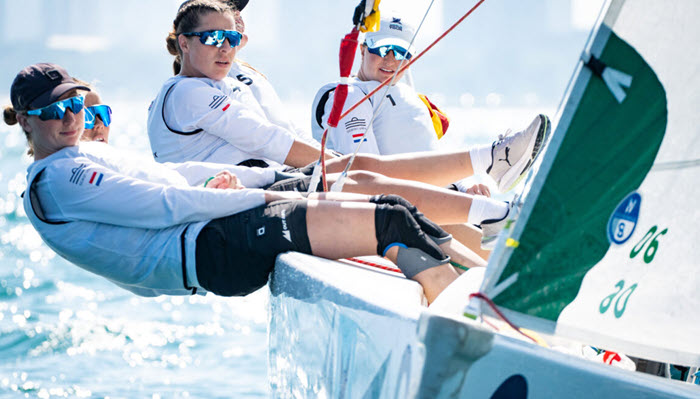
Josefine Boel Rasmussen is a Danish match racing sailor who finds that current regulations are impacting the growth of women in the sport. Here’s her op-ed:
The weight limit for women in match racing no longer reflects the women who sail it.
With an upcoming event, I have been restricting food and water to make weight. This happens before every event. Last year I weighed in somewhere between 72 and 73 kg at events. My natural weight is closer to 75 or 76 kg.
I have been doing this for years. I am not writing to complain about it. I am writing this because it is unnecessary, and because the rule that makes it necessary is overdue for a change.

I started match racing at 18. I am now 36, have two children, and have spent most of my adult life competing at the top of the sport.
A gap that is hard to ignore
The average weight limit for women in match racing is set at 68 kg (150 lb). For open events, it is 87.5 kg (193 lb). That is a difference of 19.5 kg between women and men competing in the same boats, on the same courses, under the same conditions.
Women are permitted an additional crew member to compensate for physical strength, and that works well. The men’s weight limit broadly reflects reality. The women’s does not.
The limit has not been updated for decades. In that time, women have become both taller and heavier. Across global datasets, there is no doubt about this trend — and in the countries where match racing is most active, the average weight of younger women now sits between 70 and 74 kg (154-163 lb).
The first question should be about sailing
Every female match racing skipper knows the situation: you want to bring back a former crew member, or you have found a talented new sailor you want on your team. The first question you have to ask is not “can you sail?” or “when are you available?” It is “what do you weigh?”
Now imagine you are 17 years old, making the transition from dinghy sailing to keelboats. You are keen, you are learning, and you are not yet sure whether this is your world. The first formal requirement is a weigh-in. That is not a good introduction to the sport, and it is one we can simply choose to stop.
The symmetry of the argument
Some will argue that raising the limit makes it harder for lighter women to find a place on a crew. That is a fair point. But the exact same argument applies to the current limit: it makes it harder for heavier women to participate. Any fixed average excludes someone. The question is whether the limit is set in the right place for the women actually sailing in 2026.
Why this debate stays stuck
When this question comes up among sailors, it tends to generate an emotional debate. That is understandable. Everyone argues from the crew they have today, and from that vantage point any change can look like a threat. But that is precisely why the conversation needs to move beyond individual situations and look at the structural picture.
The sailors who are not yet in the sport, the 17-year-old moving from dinghies to keelboats, the former crew member you would love to bring back — they are not in the room when that debate happens. The data is the closest thing they have to a voice.
Two proposals
Raise the average weight limit for women from 68 kg to 70 kg (154 lb). This is a modest adjustment that will not meaningfully change existing crew compositions, but will create genuine flexibility in recruitment. A 2 kg (4.4 lb) increase will not change who is on the water today.
What it will do is stop the quiet practice of dehydrating before an event and putting it all back on afterwards — and remove the constraint that leads some crews to limit strength training in order to stay within the limit.
Match racing is one of the few sports where sailors can compete at a high level across many years and stages of life. A weight limit should reflect that reality — setting a fair framework, not keeping sailors artificially small.
The figure 70 kg is not arbitrary. When five women compete as a crew in Open events, the applicable total weight limit is 350 kg — exactly 70 kg per person. World Sailing has already established 70 kg as a reasonable average in one context. Applying the same figure consistently across women’s events is not a radical step.
Remove weight limits entirely from all under-23 events. Young sailors should be developing their skills and finding their place in the sport. A weigh-in should not be part of that experience.
The process has stalled
This is not a new conversation. World Sailing’s Match Racing Committee has formally considered the question and voted in favor of raising the limit to 73 kg (161 lb) — a higher figure than what I am proposing here. That proposal was subsequently withdrawn and does not appear in the committee’s current work plan for 2025 to 2028.
Meanwhile, “Steering the Course: Women in Sailing” remains a stated strategic priority for World Sailing, and the committee’s own objectives include creating a pathway from dinghy racing into keelboat racing. A weight limit that has not kept pace with the women it applies to works against both of those goals.
The committee found 73 kg reasonable. The proposal stalled because the conversation had not been had first. I hope this is a start.

Related Posts

Bringing the sport to the people →

Legacy lives on at Youth Champs 2026 →

Why nobody hangs out anymore →