


It’s not Sailing, It’s Olympic Sailing
Published on September 27th, 2025
At some point, if there is an insufficient audience for Olympic Sailing, the International Olympic Committee will remove the sport from the Games. Keeping the Olympics relevant and profitable are the priorities, and well, Sailing is on the outside looking in.
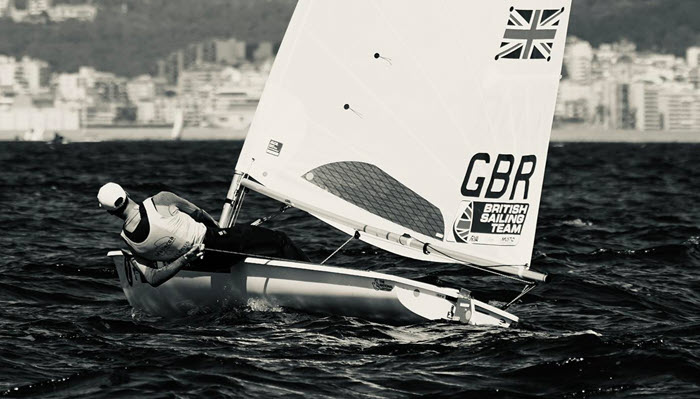
These, apparently, are desperate times, with World Sailing and each Olympic Class proposing formats they hope will attract attention. The Men’s and Women’s One Person Dinghy events are testing a new approach in Portugal, which prompted this observation from Paris 2024 Olympian Micky Beckett (GBR):
Olympic sailing is getting reformed and recycled. What an international regatta looks like is about to undergo the biggest change in decades. As someone who has lived and breathed this sport and doesn’t want to see it become a game, the coming changes leave me feeling uneasy.
Apparently Olympic sailing isn’t interesting enough and fails to captivate a global audience in the way that the mainstream sports can. If the sport is to remain in the Olympics, and if people like me don’t want to be out of a job, then seemingly it needs fixing.

My concern lies with the total lack of consideration for what it is to be a competitor in this sport or someone that aspires to be just that. The wider sport is being overlooked, where the existing link between Olympic sailing and its grassroots is already far too thin.
The current proposals, the type which we just raced with at the Sailing Grand Slam Final, will make Olympic sailing wholly unrecognizable to any grassroots participant; a dislocation which I don’t think the sport will recover from.
Realistically, a large part of the rationale for this change is due to the underwhelming spectacle of sailing at the Paris 2024 Olympics. This wasn’t due to a lack of effort on the part of the athletes, organizers, or production team; it’s because there was usually no wind. No matter how well intentioned, change for the wrong reasons won’t fix a problem we don’t have.
For some time to win in Olympic sailing, you have to showcase the values that the sport is so well known for.
You want to be the best, you want to win? You need to be tough. Not Tour de France tough, but tougher than you look. You need to be patient, accurate, and ruthless to a point that few could understand. You need to be able to win a race without any idea when it will start or what conditions it will take place in. You need to endure whilst your legs scream for air so you can play the chess game against the rest. You need to be consistent. These are Olympic sailing’s values.
Contrary to what the IOC might think, plenty of people follow the sport because they know sailing provides a unique showcase for people who excel in the aforementioned values. And with a small amount of patience to understand the game, it’s entertaining too. Sailing regattas are long because the weather is variable, preparation for an event is to learn how to sail in all conditions, not gamble on one race in one condition.
Regardless of the method by which it is decided, there will always be medalists and a winner. The question that is being asked, is how do we choose our winners? Who is the champion of the values that sailing requires?
If the winner becomes so because they qualified to a winner take-all-race and luck shines upon them that day, as will happen if insufficient time is given to scrutinize their ability, then the competitors will be the first to know the raw injustice of it.
Spectators will know because simply put, they aren’t stupid. They want to see a competition, not a lottery. And most importantly, the people who really matter in all of this, those we inspire to go out, go on the water, leave their phone behind and take on an adventure, they won’t buy what we’re selling.
In the pursuit for drama to cater for an audience with such supposedly short attention spans, there is a guarantee of creating random outcomes with the mistaken notion of selling jeopardy.
The Olympics itself is the pinnacle of raw human endeavor where the very finest athletes in the world excel at something surprisingly relatable. Within that, sailing is unique, it must embrace that and not apologize for it, we should focus on telling the story, not changing it.
SailGP is a monumental spectacle taking place in some of the best venues in the world. Where that comes at the cost of racing quality, the ebbs and flows of fortune of different conditions are negated by the year that it takes to qualify for the Grand Final.
If the Olympic race course is a much hyped and poorly conceived ‘stadium venue’ with just one broadcast window to differentiate between 10th and 1st in each class, something has gone seriously wrong. Olympic sailing must do its utmost to remain something which the grassroots of the sport will recognize, appreciate and aspire to take part in.
Sailing is the freedom to explore and drive your boat years before you could a car, it’s unique in its ability to provide purpose and skills to anyone at any age, who may find themselves without the direction they need in their life. There are no genetic prerequisites that the elite end of all other sports will require of you, there is a place for everyone.
The sport will only ask you one question… do you care?
Los Angeles 2028 Olympic Sailing Program:
First Week – July 16-20
Men’s Kiteboard – Formula Kite Class – Long Beach, CA
Women’s Kiteboard – Formula Kite Class – Long Beach, CA
Men’s Windsurfing – iQFOiL – Long Beach, CA
Women’s Windsurfing – iQFOiL – Long Beach, CA
Second Week – July 23-28
Men’s One Person Dinghy – ILCA 7 – Los Angeles, CA
Women’s One Person Dinghy – ILCA 6 – Los Angeles, CA
Mixed Two Person Dinghy – 470 – Los Angeles, CA
Men’s Skiff – 49er – Los Angeles, CA
Women’s Skiff – 49erFX – Los Angeles, CA
Mixed Multihull – Nacra 17 – Los Angeles, CA
Dates: July 16-28

Related Posts

Is this how to run a reelection campaign? →
Bring back real regattas →

Designed to maximize modern kinetics →