

Preparing for the mental challenge
Published on October 15th, 2024
The Vendée Globe solo round-the-world race, which sets sail from Les Sables D’Olonne on November 10, is a test of sailing skill, of sporting competitiveness, and endurance for both boat and sailor.
But perhaps its most difficult and least well understood challenge is the psychological one – how do you sail alone around the world for 80 days or more, through some of the most dangerous seas on the planet, and keep your strength of mind?
The record entry of 40 IMOCA sailors in the 2024-25 edition of this classic race, will all experience moments of sheer joy, but also deep disillusionment and negativity. They will be frightened at times, lonely or even bored, and they will have to contend with lack of sleep, lack of fresh food and the company of others.
They will race alone against the elements and, to some extent, against their own inner demons as they take on the global course in the toughest race in sailing.
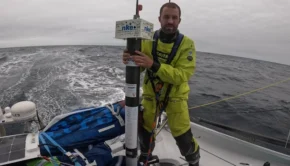
Sébastien Marsset, the 39-year-old skipper of Foussier, has been doing a lot of preparation work in this area during the build-up to what will be his first Vendée Globe on board his 2006-generation Farr-designed IMOCA. When asked about the hardest part of the psychological challenge of this race, he says it is facing himself.
“It’s facing your own weakness. Maneuvering the boat is one thing and you can break stuff, but I know how to maneuver the boat. But in this race, things will happen that I cannot predict – they are going to come as a surprise – and I really don’t know how I am going to react to them because I have never spent that much time alone offshore and I’ve never spent that much time on my own.”
Marsset has sailed the global course before as part of a Jules Verne Trophy crew on the maxi-trimaran Spindrift, so he has some idea of what he will be facing. But that does not mean he is under-estimating the challenge that lies ahead and he has been working with sports psychologist Anne-Sophie Douguet as part of his preparation.
“We have been working on all the challenges I am facing on shore and at sea and on my personal side and my professional side,” he explained. “We are trying to get me into the best position for the start of the race and we have been working on the tools I am going to be using while sailing, because I need to be 100% effective.”
Marsset has been breaking the Vendée Globe down into manageable-sized chunks to help him cope with the overall scale of the challenge. He imagines an opening phase, for example, of three-to-five days after the start which could feature rough weather, then a slightly easier section going past Madeira and the Canaries, then the period in the Trade Winds and then the Doldrums. In his mind he can identify each one and tick them off as he goes.
“I’m working on cutting down the racetrack into different pieces and appreciating the journey that I will have already done. I don’t know what the Vendée Globe is going to bring me – it’s going to be around 90 days and I want to sail one day after the other, in a way that is short in terms of thinking.”
Marsset is disarmingly honest about the scale of the psychological challenge he will face and one particularly interesting aspect of it, for him, is that by far the most stressful element of his Vendée Globe so far has been the challenge on shore during the build-up.
His campaign has been constantly short of funds and in danger of collapse and it has taken all his mental strength to keep his focus on getting to the start. “I have had to deal with a lot on shore,” he says, “and for now, it has been a lot more challenging onshore than offshore.”
So how can Vendée Globe sailors deal with the stress of racing alone? Dutch organizational psychologist Anje-Marijcke Van Boxtel, who worked with the victorious 11th Hour Racing Team during The Ocean Race 2023-24, finds that preparation in this area is absolutely essential and can make all the difference.
She says sailors can benefit by creating what she calls their own “personal compass of effective and ineffective behavior” and self-knowledge in this area is hugely powerful. For example, a sailor needs to understand how his or her mind might react when under extreme pressure alone.
“You have to know what you will do in dangerous triggering situations which elicit a lot of adrenaline and cortisol and a lot of emotions,” she said. “So when you know what are triggering situations for you, and when you recognize your own emotions and thought patterns and behavior, you are able to regulate them better.”
Van Boxtel says dealing with emotions is a key skill and trying to suppress an extreme reaction to a crisis or to a sudden problem will only make it worse.
“What you should do is develop the ability to experience emotions with a ‘witnessing mind,’” she said. “So accept them, be able to sit with them, don’t try to put them in your big toe and forget them because they will rule your life. That is the first thing – being able to accept those emotions when they come from challenging circumstances in the outside world.”
She says a similar technique applies to fear which, she says, is a totally natural response to what can be very dangerous predicaments for sailors in the Vendée Globe.
“Acknowledge that fear is a healthy emotion that helps you survive,” she said. “So be scared, allow yourself to be scared, reassure yourself that that is a very apt reaction to a very dangerous environment but then – and you have to prepare this too – then realize how am I going to behave in a very good way, sailing-wise, even when I’m scared? What am I going to say to myself when I’m scared? – because our thoughts can regulate our emotions and our behavior.”
Sleep deprivation is a particular danger in the Vendée Globe. Van Boxtel says the key to coping with it is identifying it early and then knowing how to deal with it.
“You have to know what it does to your brain and to your behavior – like you are likely to stop eating properly – because you can lose control of it if you miss the first signs and the situation can deteriorate very quickly, leading to losing your perseverance and your cognitive structure.”
While Van Boxtel presents tools to deal with all aspects of the psychological challenge of the Vendée Globe, it will be during extremely difficult moments when preparation helps give a sailor techniques to rely on when the going gets really tough.
Marsset knows enough about life offshore alone to know how difficult it can be.
“It’s like when you are lacking sleep, it does affect how you are feeling a lot,” he said. “You can feel really high after a good moment of navigation, or a good ranking, and then you can get really low, sometimes for no reason, or for a reason that you think is important, but often that is not really the case. On the boat it’s really hard to moderate your feelings, to get the right feelings and to know that the way you are seeing the situation is not accurate. That’s quite difficult.”
Event information – Entry list – Facebook
The Vendée Globe, raced in the 60-foot IMOCA, is the elite solo, non-stop round the world race. On November 10, 40 skippers will start the 2024-25 edition which begins and ends in Les Sables d’Olonne, France. Armel Le Cléac’h, winning in 2017, holds the record for the 24300 nm course of 74 days 03 hours 35 minutes 46 seconds. Only one sailor has won it twice: Michel Desjoyeaux in 2001 and 2009. This is tenth running of the race.
Source: Ed Gorman, IMOCA

Related Posts
In case you were wondering… →
Vendée Globe returns in 2028 →
Fighting cancer, Winning Vendée Globe →