

Form ecosystem to keep sailors engaged
Published on June 1st, 2026
The story “Growing Season in Chicago” by Doug Fritz caught the attention of Dr. Ignacio Gallardo who shares this review of sailing in the region:
Doug Fritz captures something many of us on South Lake Michigan have known for decades: Chicago sailing has remained resilient because it was built on a deep, highly interconnected foundation.
The market’s strength did not happen by accident, nor was it sustained by a single yacht club, regatta, or class. It was cultivated over generations through fleets, mentorship, dealers, boatyards, and a culture that understood that sailing is ultimately a community sport.
What makes the South Lake Michigan market unique is that the seeds for today’s participation were sown in the 1980s, 1990s, and early 2000s through strong, highly active one-design fleets that fostered continuity within the sport.
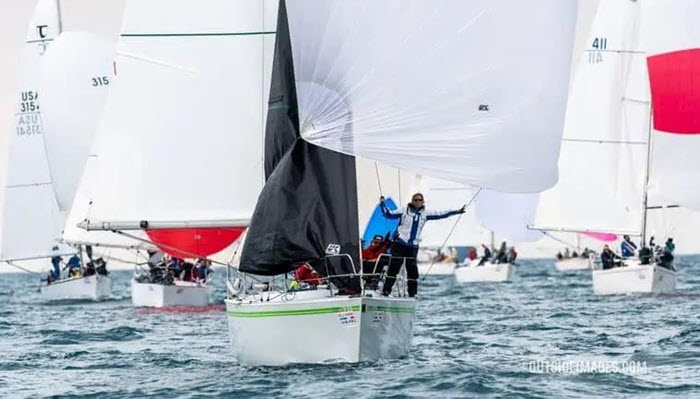
The Tartan 10 fleet was an early cornerstone. It was accessible and competitive, drawing a broad range of sailors. Around it grew a community that valued participation, skill development, and camaraderie. Then came the J/105s, Beneteau First 36.7s and 40.7s, and Farr 40s.
Each platform developed its own ecosystem of owners, crew, rivalries, and friendships. More importantly, these fleets created pathways. A young sailor might begin as rail meat on a Tartan 10 or a 36.7, move into a tactician role on a J/105, and eventually become an owner in a J/109, J/111, or later the J/70 fleet.
Healthy sailing communities are built when sailors can grow within the ecosystem rather than constantly starting over. South Lake Michigan benefited from exactly that continuity. These fleets exposed hundreds of sailors to racing culture, offshore sailing, boat handling, and teamwork. Crew became owners. Owners became mentors. Programs became institutions.
Behind many of these successful fleets stood a handful of dealers and industry leaders who understood they were not merely selling boats. They were building culture.
Richie Stearns was instrumental in that evolution. Through his years at Larsen Marine and later at his own dealership, he championed platforms such as the Tartan 10, the J/105, the J/109, and the J/111. More importantly, he supported the sailors behind them.
He knew how to build enthusiasm for the LS10s, the 105 fleet, and, later, the sprit boat evolution that modernized racing participation on the lake. His credibility as a competitor mattered. Sailors trusted him because he raced, won, and lived the sport authentically.
The same could be said of Carroll Marine and its role in establishing the Farr 40 fleet on Lake Michigan. The Farr 40 marked a leap in professionalism and competitiveness, elevating the local racing scene. It exposed local sailors to grand prix-level competition and brought national attention to Chicago racing.
Then came Karma Yacht Sales, led by Lou Sandoval and Jack Buoscio, which played perhaps one of the most transformative roles in expanding participation in the late 1990s and early 2000s. They did not simply introduce the Beneteau First 36.7 and 40.7 platforms to the region. They built fleets around them.
Karma sold more Beneteau 36.7s than any dealer in North America, and remarkably, those fleets remain active and competitive today. The 40.7 fleet similarly created a strong pipeline of offshore and distance-racing talent.
There was even an ambitious attempt to establish a Sydney 38 fleet around 2000. Although the class never fully materialized locally, the effort itself reflected something important about that era: people were willing to invest in building communities around boats, not merely to transact inventory.
What distinguished these dealers from traditional sales organizations was ambassadorship.
Stearns was winning major races and Mac races aboard the boats he represented. Sandoval and Buoscio built the Karma program into one of the most successful offshore racing programs in Lake Michigan history, capturing an unprecedented two consecutive three-peats and a total of eight Chicago Yacht Club Race to Mackinac section wins.
Those victories mattered not only for trophies but also for inspiring participation. Sailors wanted to be part of programs that were active, visible, competitive, and welcoming. Both still race in the fleet to this day.
Sandoval’s contributions extended well beyond racing success. As a Lake Michigan Hall of Fame sailor, he later helped shape the next generation by leading the sailing program at Saint Ignatius College Prep, sailing out of Chicago Yacht Club’s Belmont Harbor. That kind of long-term investment in youth development is precisely what sustains sailing communities across generations.
This is the part of the story that many outside the industry miss.
Strong sailing markets do not emerge solely from wealth or geography. They emerge from what might best be described as “fertilized soil.” Fleets create opportunity. Dealers create enthusiasm. Boatyards and tradespeople provide support infrastructure. Yacht clubs provide venues and traditions. Mentors create continuity. Together, they form an ecosystem that keeps sailors engaged over decades.
That is what brought my wife and me to purchase our boat from Karma Yacht Sales in 2016. We didn’t buy a racer; we bought a cruiser to make passage in, but the ambassadorship of the brand is what brought us in.
Unfortunately, much of that ecosystem has diminished.
The community of sailboat dealers, yards, riggers, sailmakers, and marine tradespeople that once animated South Lake Michigan is smaller today. Many of the individuals who once served as connectors and ambassadors have retired or moved on.
At the same time, the cost of entry into competitive sailing has escalated dramatically. Modern racing programs can now begin at $300,000, before even fully accounting for sails, electronics, transportation, and campaign costs.
That reality reveals a dangerous blind spot within parts of the industry.
When the pathway to ownership becomes too narrow, the pipeline weakens. Sailing cannot sustain itself solely through high-cost grand prix programs. The historical strength of South Lake Michigan came from robust middle-market fleets, which allowed ambitious sailors to participate without seven-figure budgets.
The good news is that the solution already exists because Chicago has experienced it before.
The future growth of sailing on South Lake Michigan will likely come from rebuilding strong owner-driver fleets, supporting affordable one-design classes, investing in youth and collegiate sailing, and reestablishing the local dealer and service network as active community builders rather than as transactional businesses.
The next great fleet may not be the fastest or most expensive boat on the water. It may simply be the platform that consistently gets 25 boats on a starting line, introduces new sailors to the sport, and creates an environment where people feel welcome in the community.
That is how Chicago became strong in the first place.
The true legacy of the Tartan 10s, J/105s, 36.7s, 40.7s, Farr 40s, J/109s, J/111s, and J/70s is not measured by trophies alone. It is measured by the generations of sailors they produced and the community they helped build.
If the sailing industry wants to grow again, the lesson from South Lake Michigan is clear: stop focusing solely on selling boats and start building ecosystems. That is the soil in which sailing thrives.

Related Posts

Breaking down barriers to a sport →
Make participation easy and worthwhile →
Praising the diversity within sailing →