

Homecoming at 172nd Annual Regatta
Published on June 15th, 2026
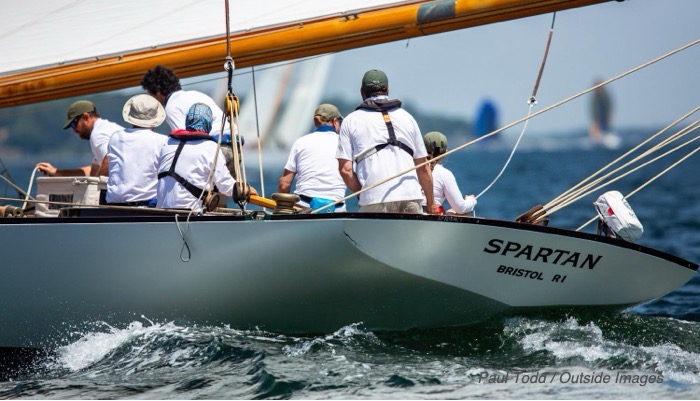
The 172nd edition of North America’s oldest recurring sailing competition, the New York Yacht Club’s Annual Regatta, held June 12-14, 2026, served as a homecoming for one of the grand dames of classic yachting, the NY50 SPARTAN. Birthed at the legendary Herreshoff Manufacturing Company in Bristol, R.I., in 1913, the 70-foot SPARTAN is the sole survivor of nine sisterships built by Captain Nathanael Herreshoff for New York Yacht Club members. She’s spent most of the last decade battling on the Mediterranean classics circuit, but owner Charlie Ryan brought her back to the United States for this celebratory summer. This past weekend, she looked as if she’d been sailing here all her life.
“Because of the America 250th celebration, a couple of the European boats wanted to come over here,” said Ryan. “So, we’ve got a Fife called VIOLA, and TUIGA, which is a 15-Metre. I thought, ‘Well, they’re going to come, I should come home too.’ I joined the Club. So that was kind of like a thought of, ‘Well, we should get the boat sailing in some of the Club’s regattas.’ And then on the personal front, I moved from London back to Philadelphia.”
With neither VIOLA nor TUIGA entered in the Annual Regatta, Ryan and the SPARTAN crew battled a couple of Annual Regatta stalwarts for the top prize in the Classics B division: the Sparkman & Stephens 52-footer DORADE, built in 1930, and the 12-Metre ONAWA, built in 1928.
Success in the regatta, with three firsts in four races, was the product of some favorable conditions and a lot of hard work over the past 15 years both restoring the yacht and learning how to make her sing.
“Captain Nat designed her for Long Island Sound, so she’s a weapon on flat water,” said Ryan, noting how the conditions in Narragansett Bay this weekend couldn’t have been more perfect. “The first regatta we sailed in, we could not get the boat to point. We were tacking through like 120 degrees. That was in 2010. SPARTAN had a Marconi rig in the late ’70s. So, no one had seen a 50 with the original gaff rig.
“We went and looked at the photographs, tried to discern what they were doing. We also worked hard on the sails. We worked with the guys at North to come up with a little bit more belly in the sail to give it a bit more power. It was probably about three or four years ago that we really figured it out. And then we started winning a bunch of regattas in the Med. And that was basically the culmination of all that effort.”
New York Yacht Club’s Annual Regatta was first sailed on the Hudson River on July 16 and 18, 1846. A similar competition the previous year was called a Trial of Speed. With a few exceptions for world wars and other global crises, the event has been held every year since. For the majority of its existence, the Annual Regatta was raced on waters close to New York City.
Since 1988, however, the event has been sailed out of the Harbour Court clubhouse in Newport, R.I., and, in 2004, it settled into the current three-day format, which includes a race around Conanicut Island on Friday, two days of buoy or navigator-course racing on Saturday and Sunday and nightly social activities on the grounds of the historic Harbour Court mansion. The 172nd Annual Regatta featured a fleet 150 boats.
Bill and Jackie Baxter’s J/111 FIREBALL is no stranger to the East Coast Regatta circuit. The boat pops up in regattas everywhere from Key West to Long Island Sound, often finding its way to the sharp end of the results table. But until this weekend, the Stamford, Conn., based team had never competed in North America’s oldest sailing event, the New York Yacht Club’s Annual Regatta in Newport, R.I.
The FIREBALL team was rewarded with a spectacular weekend of sunshine and moderate breeze, and a first-place trophy, courtesy of a dominating performance in the 16-boat PHRF C Class, the second largest at the 135-boat regatta. “We loved it,” said Bill Baxter. “This is the first time we’ve done the New York Yacht Club Annual Regatta. I love sailing up in Narragansett Bay. I really enjoyed the event.”
With 53 boats, spread across four classes, the PHRF racing at the Annual Regatta was more competitive than ever. While the ORC classes focused on windward-leeward buoy racing, competitors in the PHRF classes sailed navigator-style courses around government marks. While the inherent differences in the PHRF division spread things out relative to the one-design fleets, success must still be earned.
“I think that’s the best part of PHRF,” said Baxter. “We had racing boats, cruising boats and racer-cruisers, and we all had tight racing. The Navy 44 won one of the races today, which was just awesome.”
Also experiencing something new this weekend was Mitchell Callahan, freshly graduated from Harvard University where he earned multiple All-American honors. Callahan served as a fill-in helmsman on Ryan McKillen’s M32 catamaran SURGE. With the support of the reigning world champion crew, he came away victorious in the 9-boat class.
“It was my first time really touching the boat or seeing it up close,” said Callahan. “I feel lucky to have had the opportunity to sail with Taylor [Canfield] and these guys, and to be entrusted with Ryan’s boat. I just followed instructions out there.
“It’s really intense. It’s like nothing I’ve ever experienced before. Being on a boat that fast is incredible. You have to be really precise and accurate, and keep both ears open for communication. That was my goal.”
The Annual Regatta represented the Northeast debut of the ClubSwan 28 one-design, with seven boats competing. Veteran one-design skipper George Gamble came from behind, a pair of seconds today lifting him to the overall win. To learn a new boat, Gamble and his crew went back to basics.
“I bought the very first one [in the United States],” he said. “I’ve had it since January, and got a lot of time on the boat, which definitely helps. We sail every chance we get. We’ll be back here for Race Week and then also for the Safe Harbor Race Weekend. We’re doing every event.
“The boat has a very fine groove. And the setup is very important. We have had enough time to experiment with our setup and how we adjust the rig for each condition, that gives us a little bit of an advantage. But [boatspeed] wasn’t everything. We barely pulled out first today. We had three different people win races. It’s not easy.”
With a 15th in the first race, Steve Liebel and his crew on the IC37 NEW WAVE saw their margin for error disappear for the remainder of the regatta. Fortunately for them, and unfortunately for the rest of the 22-boat fleet, they were up to the challenge. Two firsts, two seconds and a fourth in the remaining races were just enough to claim the win by 1-point over Megan Grapengeter-Rudnick and John Hele’s VIGILANT team, which claimed second and proved their preparation for the Women’s International Championship in September is on point.
“It’s a very competitive fleet, we had 22 boats out there, great crews. We had a tough first race and we had to claw back,” said Liebel. “You’ve got to have good boat speed, but if you’re not in a good lane, it’s going to hurt you. Some good starts, some managing the fleet. It was a fun time.”
SPARTAN and many other classics will return for the Tiedemann Classics Regatta, June 27 and 28. The IC37, PHRF and ORC fleets will be back on the water July 16 to 19 for Race Week at Newport.
Event Website – Two-Day Series Final Scores – Around the Island Results
Source: NYYC

Related Posts
Making it safe to come and play again →
North America’s oldest regatta →
Not every regatta is a world championship →