

Yachts that broke the rules
Published on June 3rd, 2026
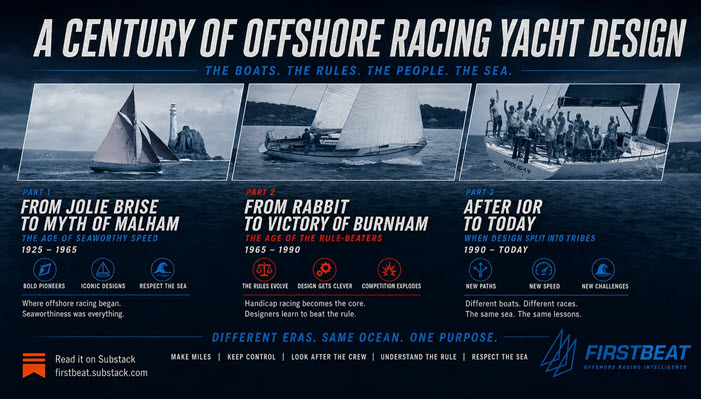
Yacht Racing Performance Coach Stuart Greenfield provides the second part of a three part series about what’s happening to offshore racing:
At the end of Part 1, offshore yacht design was still balanced between two old masters: the sea and the designer’s conscience. The boats were becoming faster, lighter, and more purposeful, but most of them still carried the memory of working craft, cruising yachts, and the older idea that seaworthiness was not an optional extra.
That would change.
From the mid-1960s onwards, the designer no longer had to answer only to the owner, the crew, and the sea. He had to answer to the measurer — more accurately, he had to outwit the measurer without appearing to have done so. The rating rule moved from the background into the middle of the design office, and the shape of offshore racing yachts began to reveal not just what made a boat fast, but what made a boat measure so it appeared to be slower than it actually was. In some ways, Olin Stephens had achieved this years earlier by designing a hull that extended its water line length when heeled, thereby increasing its theoretical displacement boat speed. Things were going to get much more interesting, however.
This was the age of the rule-beaters. – Full report

Related Posts
What is your system for sailing offshore? →
Autopilots, and who gets to decide →
Wild encounters around the course →